

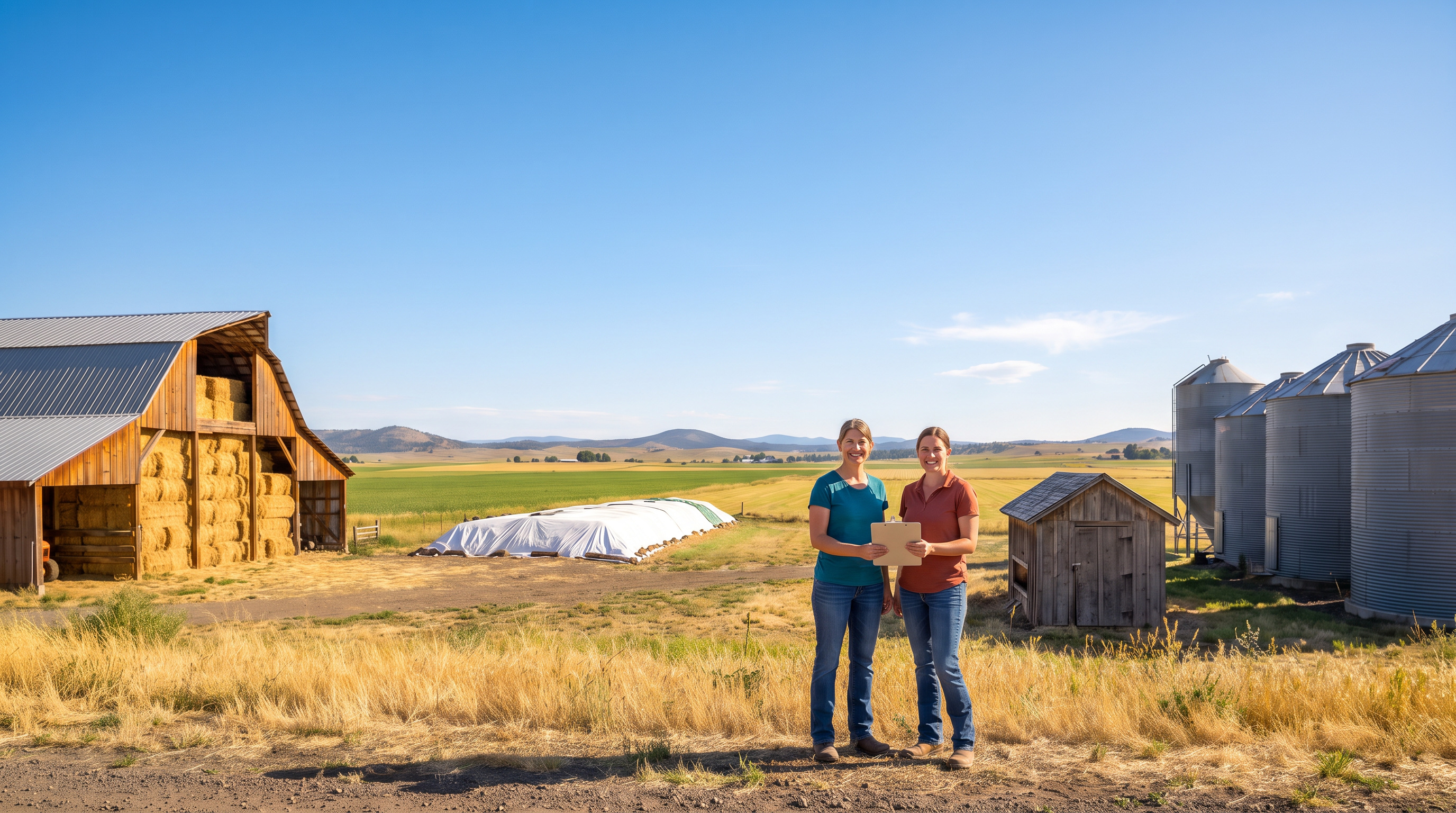

A full hay barn, grain bin, or silage bunker can represent months of work and the feed your livestock will need through winter. Yet an insurance review may focus on tractors, buildings, and cattle while overlooking the products inside those buildings—or stacked outside them. Start your farm and ranch insurance review with the feed inventory, not just the structures.
The short answer: do not assume hay, grain, silage, and purchased feed are insured because the barn is insured or because you carry crop insurance. Confirm the covered property category, ownership, storage locations, peak values, valuation, causes of loss, deductibles, and exclusions. Then ask separately about equipment, lost income, emergency feed purchases, and any storage agreements.
For a cattle ranch near Prineville or Powell Butte, an irrigated hay operation around Madras, a horse property outside Redmond, or a mixed farm in Northeast Oregon, stored feed is both an asset and an operating necessity. Losing it can affect more than the balance sheet: replacement feed must be suitable, available, transported, and safely stored.
This article is educational, not a coverage determination, safety certification, crop-policy interpretation, or legal advice. Actual policies, endorsements, insurer acceptance, ownership, and loss facts control. Availability and eligibility vary. Loss-prevention practices do not guarantee insurance payment.
1. Separate the Building, Equipment, and Stored Products
A hay barn’s roof and walls, a grain bin’s installed equipment, and the grain inside it are not interchangeable insurance categories. Carrier descriptions distinguish farm buildings from farm personal property, including grain, silage, hay, and feed.[1] [2] Your declarations may use scheduled items, blanket categories, or a combination; read the definitions as well as the limit.
Ask your agent to identify where each asset belongs: baled hay, bulk grain, silage, feed ingredients, bagged livestock feed, supplements, bedding, empty storage structures, augers, and portable equipment. Do not use “farm contents” as shorthand for everything. Purchased feed, products grown on the farm, products for resale, and products owned by another person may be treated differently.
A replacement-cost provision for the barn does not automatically make the hay replacement-cost property. Review your Oregon farm insurance options against the operation you actually run, including any feed sales, custom storage, processing, or changes in ownership.
2. Harvested Inventory Is a Different Question From Crop Insurance
Crop insurance addresses defined crops, coverage periods, and loss triggers. It should not be treated as a general policy for stored products. USDA’s published Common Crop Insurance Policy Basic Provisions include harvest among the events that can end coverage, subject to the applicable crop provisions and endorsements.[3] The cited 2024 document is background—not a determination of your current crop contract.
Ask the crop-insurance specialist when protection ends for the actual crop and product. Ask the farm-property insurer what applies afterward: hay baled and stacked in a field, grain delivered to a bin, silage placed in a bag or bunker, and products transported to a buyer or warehouse. Do not assume that a crop-policy quality adjustment covers later storage deterioration.
Our Oregon farm and crop insurance guide provides related questions. The practical task is to identify any change in responsibility between growing, harvest, transit, storage, and sale—not to assume one policy covers the entire chain.
3. Insure the Seasonal Peak, Not Just the Annual Average
Your feed inventory may be lowest just before harvest and highest after baling, combining, or a large purchased-feed delivery. A limit based on an average month can miss the concentration of value in autumn. Identify the maximum quantity likely to be held at each address, in each structure, and outdoors at the same time.
Carrier materials describe optional peak-season arrangements for specified inventory and time periods.[1] Such an arrangement is not automatically included and does not establish a particular settlement method. Ask whether your policy needs an updated schedule, seasonal increase, reporting arrangement, or another insurer-approved approach, including its effective dates and conditions.
Keep quantities and values distinct. Record bale counts and weights, grain quantities, silage estimates, feed receipts, and the method used to estimate value. Then confirm whether the policy uses market value, actual cash value, replacement cost, or another commodity-specific method. Emergency freight, feed testing, price increases, and storage expenses should not simply be added to a presumed claim payment.
For cattle operations, explain the consequences of losing a winter feed reserve alongside animal-care responsibilities. Our feedlot and backgrounding insurance article connects feed inventory with the wider livestock business without assuming the same coverage applies to every asset.
4. Hay Fire, Moisture, and Spoilage Are Not the Same Loss
Hay can heat internally when moisture supports microbial activity. Travelers highlights the weeks after baling as an important monitoring period and recommends moisture control and appropriate storage practices.[4] Rain exposure, ground moisture, damaged roofs, and poor storage conditions also deserve attention. A dry-looking outside surface does not settle what is happening within a stack.
Ask how the actual policy treats fire, lightning, wind damage, water intrusion, theft, and other events. Then ask separately about mold, ordinary deterioration, pests, contamination, fermentation problems, and reduced feed quality. The fact that feed is unusable does not establish a covered cause of loss. A refrigerated-products endorsement should not be assumed to cover every kind of stored forage.[1] [2]
Use bale-specific extension and qualified fire-safety guidance rather than a universal moisture threshold from an insurance article. If you suspect a heating or burning stack, keep people clear and contact the fire service; do not climb onto it, pull it apart, or attempt an improvised investigation. Separately control ignition sources near storage. Our farm-shop and welding insurance guide offers related questions about repair work, fire, and surrounding property.
Bring Your Highest Feed Values—not Just the Barn Values.
Prineville Insurance can help organize the insurance questions for your hay, grain, silage, purchased feed, storage buildings, and equipment. Bring declarations, location details, inventory records, and any storage or purchase agreements.
5. Grain, Silage, and Purchased Feed Need Their Own Questions
Bulk grain brings different storage conditions from baled hay. Document the bin, commodity, quantity, quality records, drying and aeration arrangements, and whether the grain belongs to you or a customer. Grain dust, moving equipment, engulfment, and hazardous atmospheres create serious safety risks.[6] Do not enter a bin or attempt a rescue based on an online checklist; use qualified safety support and emergency responders.
Silage may be stored in tower silos, bunkers, bags, or piles. Oregon State describes important differences among these arrangements, including the role of intact coverings and exposed surfaces in storage losses.[5] Explain the actual system, storage value, covering condition, drainage, and handling equipment to the insurer. A damaged bag and a covered fire are not automatically the same insurance question.
Fermenting silage can produce dangerous gases, including gases that displace oxygen; ordinary dust masks do not establish protection.[7] Keep children, visitors, and untrained people away from hazardous areas. Discuss a site-specific safety plan with qualified professionals. Insurance is not a substitute for safe grain and silage handling.
For purchased feed, retain receipts and supplier details, record when ownership transfers, and distinguish ordinary supplies from goods for resale or products stored for someone else. If your operation also conditions or stores seed, see our seed production, cleaning, and farm storage article. Processing and commercial storage can change the business description your insurer needs.
6. Map Offsite Storage, Delivery, and Other People’s Products
Hay in a neighbor’s barn, rented farm storage, a public warehouse, and a commercial elevator should not all be treated as “offsite.” Give the insurer the exact address, facility type, owner, storage duration, security, and peak value. Off-premises coverage can contain conditions, time limits, sublimits, and facility-specific exceptions; confirm the wording before products leave the listed premises.
Review your feed in someone else’s building and someone else’s feed in yours as two separate exposures. The landlord’s building insurance does not automatically cover your products. Your insurance for property you own does not automatically cover a neighbor’s inventory or your contractual responsibility for it.
Discuss loading, unloading, transit, storage charges, transfer of title, and written responsibility for loss. If you bale or harvest for another producer, our custom farming and custom haying guide explains why the work agreement and insured operation deserve review together. A certificate or another party’s statement that it is insured does not settle ownership or coverage.
7. Equipment Failure and Feed-Replacement Costs Are Separate Issues
A failed auger, dryer, fan, motor, conveyor, or power supply can interrupt storage management or feeding. Physical damage insurance for a building or machine does not automatically establish mechanical-breakdown protection, coverage for damaged feed, or payment for resulting downtime. Ask how each part of the loss would be evaluated, including maintenance requirements and exclusions.
If equipment is borrowed, rented, or leased, identify who owns it and who is responsible under the agreement. Our farm equipment rental and leasing guide offers related contract questions. Tell the insurer about permanent installations as well as portable handling equipment.
After a feed loss, you may need emergency purchases, freight, temporary storage, altered rations, and additional labor. A payment for destroyed inventory does not establish separate coverage for all those costs. Carrier descriptions treat farm income and other extensions as separately conditioned arrangements.[1] Ask about the triggering event, limits, valuation, time provisions, continuing expenses, and any extra-expense coverage.
Ordinary price increases, reduced feed quality, a supply shortage, or a planned equipment shutdown are not automatically covered interruptions. Our business income insurance guide develops this distinction. Maintain a realistic alternative-feed plan without assuming insurance will reimburse every part of it.
A Stored-Feed Insurance Checklist Before Winter
Bring an inventory by product and location; peak quantities and values; ownership and purchase records; storage addresses and agreements; photographs taken from safe accessible positions; bale or delivery dates; relevant moisture or quality records; equipment lists; and current policy declarations and endorsements. Identify feed reserved for your animals separately from feed awaiting sale or belonging to a customer.
Ask the agent to confirm the covered categories, named insured, locations, limits, deductibles, valuation, covered causes of loss, important exclusions, reporting duties, and any accepted changes. Revisit the review after a major feed purchase, a new storage site, a new silo or dryer, or a change in commercial activities—not only at renewal.
The goal is not to promise one policy that covers every storage problem. It is to make your feed supply visible in the insurance conversation, while you still have time to address unanswered questions.
Frequently Asked Questions
Does insuring my hay barn also insure the hay inside it?
Not automatically. Buildings, permanently installed equipment, and stored farm personal property can be separate insured categories. Check the declarations, covered-property definitions, limits, locations, valuation, deductibles, and endorsements for the hay itself. A building replacement-cost provision does not establish replacement-cost coverage for its contents.
Does crop insurance cover grain or hay after harvest?
Do not treat crop insurance as general storage insurance. Coverage periods and triggers depend on the crop policy, crop provisions, and endorsements. Many crop policies end protection at harvest or another specified event. Ask separately about harvested products in barns, bins, silage bags, vehicles, or third-party storage, including when responsibility passes to a buyer.
Can purchased hay and bagged livestock feed be included in farm insurance?
They may fit an insured farm-personal-property category, but eligibility is not established simply because the products are used on a farm. Identify purchased versus homegrown products, ownership, the type of feed, its value, intended use, storage address, and any scheduled or blanket limit. Confirm the actual insurer’s wording before relying on coverage.
Will insurance pay for mold, moisture damage, spoilage, or rodents?
Not necessarily. Whether unusable feed is insured depends on the covered cause of loss, exclusions, storage conditions, definitions, and applicable endorsements. Ordinary deterioration, infestation, contamination, fermentation problems, or temperature changes should not be assumed covered. A fire provision or refrigerated-products endorsement does not establish broad spoilage coverage for all hay, grain, or silage.
What should I do when my feed inventory increases after harvest?
Calculate the highest quantity and value likely to be held at each location, including purchased feed and products awaiting sale. Compare that peak with the policy’s categories and limits. Ask whether a seasonal increase, updated schedule, or different arrangement is appropriate, its effective dates, reporting requirements, and insurer acceptance. An annual average can understate the amount at risk.
Is hay stored in a neighbor’s barn automatically covered?
No. Give your agent the exact storage address, facility type, ownership, duration, values, and written agreement. Off-premises provisions can have limits and exceptions, and commercial warehouses may be treated differently from leased farm premises. Review both your feed in someone else’s building and someone else’s feed in yours; the building owner’s policy does not automatically insure your products.
References
Sources reviewed November 10, 2026. Carrier pages illustrate coverage categories, not your policy or carrier availability through Prineville Insurance. The USDA reference is its published 2024 Basic Provisions; your current crop provisions and endorsements must be reviewed. Safety guidance is educational and does not determine which regulations apply to your farm.
- American Family — Farm Personal Property Insurance
- COUNTRY Financial — Farm Insurance
- USDA RMA — Common Crop Insurance Policy Basic Provisions (2024 version)
- Travelers — Reducing Haystack and Hull Pile Storage Fire Risk
- Oregon State University — Silos and Forage Storage
- OSHA — Grain Handling Hazards
- Penn State Extension — Silo Gases: The Hidden Danger