
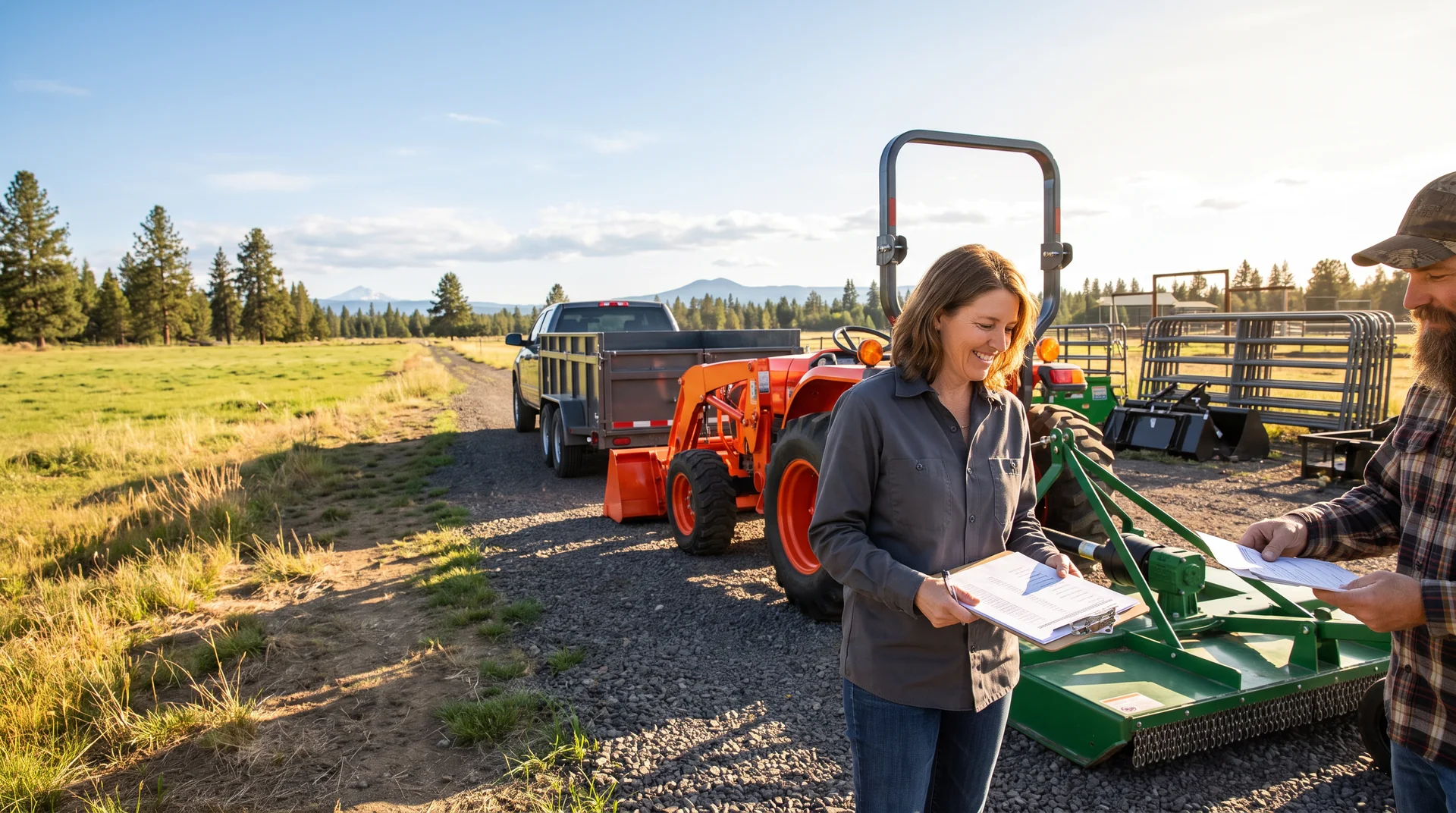

Renting, leasing, borrowing, lending, or sharing a tractor, baler, mower, drill, tillage tool, skid steer, trailer, or other implement can make good operational sense for an Oregon farm or ranch. It also changes the insurance conversation. The machine may be owned by another business, used by a different operator, moved on a public road, delivered to another property, paired with an unfamiliar attachment, or subject to a contract that allocates responsibility in ways a farm operator did not expect. Begin with the site's farm and ranch insurance resources, then use the actual agreement and policy to guide a more specific review.
This article is educational information, not insurance, legal, contract, safety, transportation, employment, equipment-operation, regulatory, valuation, tax, or claim advice. It does not decide who is liable, who is an authorized operator, whether any equipment is covered, whether a contract is enforceable, what ODOT or OSHA requires for a particular operation, or how a claim will be resolved. Policies, declarations, endorsements, limits, deductibles, exclusions, equipment schedules, contract terms, equipment condition, operator training, route, location, ownership, and the facts of a loss control.
Why Equipment That Changes Hands Needs a Different Review
A machine can look the same at a farm shop, in a rental yard, on a neighbor's field, and on a trailer headed toward a customer. The insurance and contract questions may not be the same. Oregon DFR explains that business property can include owned or leased machinery and that actual-cash-value and replacement-cost approaches differ.[1] That is a reason to document values and ask precise questions—not a statement that every rented machine or loss is insured.
| Equipment situation | Questions to bring to the review | Records worth keeping |
|---|---|---|
| Short-term rental | Who owns the tractor and each attachment? Who may operate it? What does the rental agreement say about theft, overturn, transport, repair, downtime, and damage to property? | Signed agreement, checkout report, serial numbers, photos, attachment list, condition notes, dates, and contact information. |
| Long-term lease | Is the farm or individual listed correctly? Which equipment is leased, what values apply, who performs maintenance, and what happens at renewal, return, or early termination? | Lease, schedule, invoices, maintenance logs, replacement-cost information, certificates requested, and communications about changes. |
| Borrowed or shared machine | Is the arrangement informal or written? Who controls the machine, who may use it, where will it be used, and what responsibility follows a breakdown or damage? | Written sharing terms, handoff photos, pre-use inspection, serial number, operator list, hour-meter record, and return-condition report. |
| Equipment delivered to a customer | Who hauls it, what truck and trailer are used, where is it left, who accepts delivery, and who may move it after handoff? | Delivery ticket, route and driver details, securement notes, photos, receipt, certificate requests, and site contact. |
| Customer-owned equipment at the farm | Why is it there—repair, storage, installation, custom work, or a sale? Who has custody and which documents address loss or damage? | Work order, owner contact, intake photos, serial number, job scope, storage location, and release or return record. |
Start With a Written Equipment-and-Operator Map
Before a key changes hands, create one practical equipment map: make, model, serial number, attachments, replacement estimate, owner, lessee or renter, authorized operator, location, job, delivery method, return date, and emergency contacts. Include the condition of tires, guards, lights, hydraulics, PTO shielding, controls, and any existing damage. A photo record at pickup and return helps make the discussion more factual; it does not establish coverage or responsibility by itself.
This is especially important where a farm uses implements or pumps in remote locations. For related schedules, water-system records, and location questions, see the site's Oregon irrigation, wells, water systems, and remote-property guide. The exact equipment, location, cause of loss, and policy language determine what the insurer may consider.
A Rental Contract Is Not an Insurance Policy
Rental and lease paperwork can address payment, deposits, authorized users, prohibited uses, maintenance, damage, theft, return timing, delivery, indemnity, certificates, and insurance requirements. It may also say what happens if an attachment is damaged, a customer's property is affected, or the machine is used outside the agreed jobsite. Read the agreement before pickup, not only after a problem occurs.
Oregon Farm Corps' equipment-sharing resource points to agreements and templates for operating, maintaining, and administering shared machinery.[8] It is a useful prompt to define the arrangement, but it is not a substitute for a lawyer's advice or an insurer's review. Ask the rental company, lender, co-owner, or customer which contracts apply, then bring those documents to the insurance conversation.
Build the Equipment Schedule Before the Pickup Date
Prineville Insurance can help organize a policy-specific conversation around the rental or lease agreement, equipment list, values, attachments, locations, operators, delivery arrangements, customer requirements, and questions about limits, deductibles, exclusions, and endorsements.
Tractors, Implements, and Attachments: Value Is More Than the Base Machine
A rental schedule should identify attachments individually. A loader, mower, rake, drill, sprayer, pallet forks, bale spear, hydraulic hose, guidance component, enclosed cab feature, or specialized implement may have a different value, ownership history, repair path, or agreement requirement than the tractor itself. Ask whether the agreement and policy discussion identifies the machine only, every scheduled attachment, permanently attached equipment, loose tools, replacement parts, and transport gear.
For a farm shop that repairs, modifies, welds on, or holds machinery, the related questions can expand to tools, fire, customer property, and completed work. The site's Oregon farm shop and on-farm fabrication guide is a useful companion. Its topics do not answer the rental question by themselves; each arrangement and policy must be reviewed on its own terms.
Customer Damage, Care, Custody, and Control: Do Not Fill in the Blanks
A renter may be using a machine owned by another party. A farm may be repairing a customer's implement. A dealer or rental operation may store equipment overnight before delivery. Those facts can create questions about possession, care, custody, control, contractual liability, property damage, and the cause of loss. Oregon DFR notes that liability insurance can help protect against claims arising from a business's actions, but the form, exclusions, limits, and circumstances matter.[2]
Bring the agreement and the facts to the review: Who owned the equipment? Who had it when the damage happened? Was it being transported, stored, repaired, operated, or left at a jobsite? Was another person's property involved? What did the pre- and post-use photos show? Instead of assuming a general policy responds, consider a policy-specific conversation about your commercial general liability and farm or specialty coverage options.
Authorized Operators, Training, and the Specific Machine
An experienced ranch hand may still need orientation on a different tractor, attachment, control layout, or rental-company rule. Oregon OSHA's agriculture resources include guidance on tractor hazards, rollover protective structures, and power take-off hazards.[4] Oregon State University recommends that operators be trained for the particular machinery, that machines be serviced, that safety devices be used, and that a policy identify who is authorized to operate a tractor.[7]
Oregon Department of Agriculture notes that farmers and ranchers employing minors under 18 must hire people who completed and passed tractor-safety training, while also pointing adults to tractor safety and maintenance resources.[5] These sources are not a complete compliance analysis for every farm, rental business, employee, or machine. They are a reason to make authorized operators, current training, condition checks, and handoff documentation part of the operating plan.
Delivery, Trailers, Road Use, and Off-Premises Movement
Equipment delivery can add a truck, trailer, driver, road, and loading exposure to an equipment question. Oregon DFR says commercial-auto needs can depend on who owns or leases the vehicle, who drives it, and its primary use; it also notes that some commercial policies may address rented and other nonowned vehicles.[3] That is not a promise that a farm truck, trailer, rental unit, or attached implement is covered.
Oregon ODOT explains that operating requirements can vary based on factors including vehicle weight, for-hire activity, and interstate use.[6] For example, its current guidance lists different requirements for some vehicles above 10,000 pounds and describes other requirements that can apply to interstate for-hire and private operations.[6] Confirm the current requirements for the actual vehicle and trip with ODOT. Then review the insurance side through commercial auto insurance and the site's Oregon livestock hauling guide, which has related trailer, driver, and trip-document questions.
Lease, Rental, and Shared-Equipment Scenarios to Separate
Farm rents a tractor with implements
Confirm the agreement, operator list, equipment and attachment schedule, jobsite, delivery, return condition, loss-reporting instructions, and repair authorization process.
Neighbor-to-neighbor borrowed machinery
Write down who owns it, where it will be used, permitted operators, maintenance expectations, pre-existing condition, fuel, return date, and what happens if it breaks.
Farm leases a machine for a season
Review named insureds, leased equipment, values, any certificates requested, transport, storage, drivers, attachments, and changes at the end of the lease.
Farm provides machinery to a customer
Clarify whether it is rental, custom work, delivery, sale, service, or shared use; identify the customer, custody, jobsite, return process, and the contract terms.
Farm holds customer-owned equipment
Document why the equipment is in your possession, how and where it is stored, who may work on it, its condition at intake, and the release or pickup process.
Farm rents a unit for a field project
Update the equipment map if the unit moves between properties, crosses roads, changes operators, carries attachments, or is used beside a water, livestock, or fire exposure.
Build Equipment Continuity Into the Farm Plan
If a rented or leased machine is unavailable during haying, planting, feeding, irrigation repair, harvest, or a custom job, the operational impact can be bigger than the invoice. Document the substitute-equipment plan, vendor contacts, delivery windows, operator availability, rental extension options, repair authorization process, and any obligations to customers. For storage, repair, and processing facilities that depend on machinery, the site's Oregon seed production, cleaning, and farm storage guide offers related questions about equipment, records, storage, and downtime.
Property insurance can help protect business equipment against certain physical damage or theft, and DFR notes that business property can include owned or leased machinery.[1] Business-interruption, equipment-breakdown, inland-marine, hired-and-nonowned, cargo, or other coverage discussions may also depend on a carrier's forms and the facts. Ask about the exact policy, not a category label. A conversation about commercial property insurance can help organize the owned-versus-leased machinery questions alongside the farm policy review.
What to Bring to a Farm Equipment Rental or Leasing Review
Bring the signed rental, lease, borrowing, or sharing agreement; a full equipment and attachment list; serial numbers; pre- and post-use photos; values and invoices; existing policy declarations and schedules; required certificates; the authorized-operator list; training and maintenance records; delivery and trailer information; customer work orders; jobsite locations; storage details; any loss-reporting instructions; and questions about physical damage, customer property, liability, auto, transport, deductibles, exclusions, endorsements, and return-condition obligations.
The goal is not to force every farm arrangement into one template. It is to make the policy and contract discussion match the way the equipment will actually be owned, scheduled, operated, transported, stored, maintained, and returned. That produces better questions before the tractor leaves the yard.
Frequently Asked Questions
Does a farm policy automatically cover a rented or leased tractor?
Do not assume so. The answer can depend on the policy, equipment type, ownership, lease or rental agreement, location, operator, use, value, deductible, exclusions, endorsements, and carrier requirements. Read the agreement and request a policy-specific review before the equipment is picked up, delivered, or used.
Who is responsible if a borrowed implement is damaged?
A handshake, a rental contract, a lease, and an insurance policy are different things. Responsibility can turn on the written agreement, possession, authorized operator, maintenance history, damage facts, and policy terms. Document the equipment’s condition and serial number at handoff, then ask the owner, renter, and insurer how the actual documents allocate responsibility.
Can an employee or seasonal worker operate rented equipment?
That is an equipment, employment, safety, contract, and insurance question—not a conclusion this article can make. Oregon tractor-safety resources address operator training and equipment hazards. Confirm who is authorized by the agreement, who is trained for the specific machine and attachment, and what the actual employment and insurance documents require.
Does general liability insurance pay for every loss involving customer equipment?
Not necessarily. General liability, property, inland-marine, auto, umbrella, workers’ compensation, equipment-rental, and other policies can have different insuring agreements, exclusions, definitions, limits, deductibles, and conditions. Customer equipment, your care-custody-control position, and the cause of loss should be reviewed against the actual policy rather than assumed.
What should an Oregon farm ask before delivering rented machinery?
Confirm the trailer and towing setup, driver, destination, route, weight, permits or operating requirements, certificate requests, equipment condition, securement plan, delivery receipt, and contract duties. ODOT notes that operating requirements can vary with factors such as weight, for-hire use, and interstate activity, so verify current rules with ODOT or other qualified advisers for the actual trip.
References
- Oregon Division of Financial Regulation — Property Insurance
- Oregon Division of Financial Regulation — Liability Insurance
- Oregon Division of Financial Regulation — Commercial Auto Insurance
- Oregon OSHA — Agriculture Resources
- Oregon Department of Agriculture — Tractor Training
- Oregon Department of Transportation — Motor Carrier Requirements to Operate in Oregon
- Oregon State University — Tractor Safety Resources
- Oregon Farm Corps — Equipment Sharing