



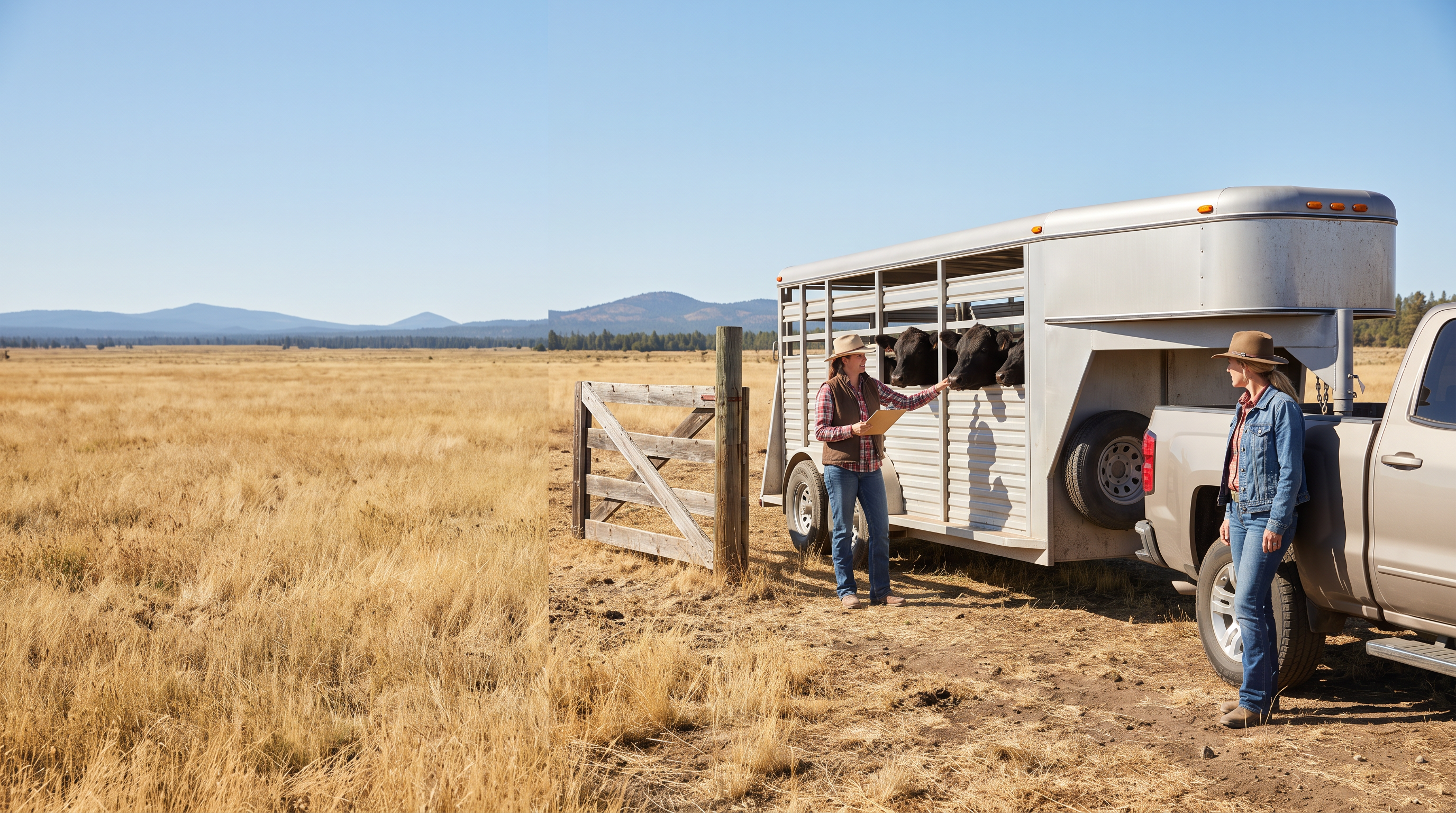

A livestock trailer can be part of daily ranch work, a sale-day run, an emergency evacuation, a show or clinic trip, a breeding pickup, or a paid hauling job for another producer. Those trips can look similar from the driver’s seat, but the insurance, ownership, vehicle, animal-health, and operating questions can be very different. Start by mapping the entire operation around your farm and ranch insurance program—not just the pickup and trailer.
This guide is educational information, not insurance, legal, transportation, veterinary, animal-health, tax, or regulatory advice. It does not establish that a policy applies, that a driver or trip is compliant, that a vehicle qualifies for a farm use, or that an insurer will pay a claim. Policy forms, endorsements, exclusions, limits, deductibles, valuation terms, livestock ownership, contract language, vehicle weight and use, route, authority, animal-health records, and the facts of a loss all matter. Before a new trip or service, consult the insurer, Oregon Department of Transportation (ODOT), Oregon Department of Agriculture (ODA), destination jurisdiction, veterinarian, and qualified legal or transportation advisers as appropriate.
Start With the Real Question: Whose Animals, Whose Trailer, and Whose Job?
“I haul livestock” is not enough information for a useful policy review. A rancher moving their own cattle from a Prineville pasture to a Redmond sale barn may present a different set of questions than a horse professional hauling a client’s mare to a Sisters clinic, a contractor moving a neighbor’s calves for payment, or a driver taking a mixed load across state lines. One trip could involve owned animals, another producer’s animals, a borrowed trailer, a leased truck, an employee, a family member, a hired driver, customer tack, feed, panels, tools, and a written hauling agreement.
Oregon’s Guide to Farm Trucking in Oregon describes permitted own-farm uses of farm-registered vehicles and limited documented labor-exchange uses. It separately describes a person who holds themselves out to provide transportation for compensation as a for-hire operator.[1] That distinction is a useful prompt—not a conclusion about your trip. Record the owner, payer, driver, truck, trailer, animals, purpose, pickup point, destination, and whether the work is recurring or publicly offered before asking how the arrangement should be insured or regulated.
| Trip fact to document | Why it changes the conversation | Questions to organize |
|---|---|---|
| Animal ownership and purpose | Owned cattle, a customer’s horse, breeding stock, show animals, a sale load, or an evacuation load can be treated differently in the contract and policy review. | Who owns the animals? Who is paying? Is the movement farm work, a favor, a documented labor exchange, or an offered hauling service? |
| Truck and trailer | The towing vehicle, gooseneck/bumper-pull trailer, lease terms, physical-damage values, permanently attached gear, and loose gear may not be handled by one coverage provision. | Who owns or leases each unit? Who is named on the policy? Is the trailer scheduled? What equipment travels inside or attached? |
| Driver and people involved | An owner, employee, family driver, independent contractor, volunteer, and hired hauler can each create different questions about authorization, training, injury, and liability. | Who drives? Who loads? Who gives instructions? What employment, contract, and certificate records exist? |
| Route and movement records | An Oregon-only trip and a crossing into Washington, Idaho, Nevada, or California can create different animal-health and carrier questions. | What species, origin, destination, state requirements, animal identification, ownership documents, veterinary contacts, and emergency stops apply? |
| Loss scenario | A collision, rollover, animal escape, trailer theft, injury during loading, roadway delay, heat/cold event, wildfire evacuation, or damage to third-party property can involve different facts. | Which policy sections, exclusions, limits, deductibles, valuation rules, and reporting duties should be reviewed before a loss? |
Truck, Trailer, Livestock, and Equipment: Do Not Assume One Policy Answers Every Part
A commercial-auto discussion is often a starting point for a business-owned or business-used truck, but it is not the only question. Oregon’s Division of Financial Regulation explains that commercial-auto policy considerations include who owns or leases the vehicle, who drives it, and how it is primarily used; its guidance also notes that commercial policies may address rented or non-owned vehicles and permanently attached items.[7] That is a reason to disclose the actual setup, not a reason to guess at coverage.
List every unit by ownership and use: pickups, semis, flatbeds, goosenecks, bumper-pull stock trailers, horse trailers, portable panels, generators, winches, water tanks, saddles, tack, veterinary supplies, portable scales, and feed. Compare the inventory with your commercial auto insurance conversation, then ask separately about trailer physical damage, loose or attached equipment, theft, hired/non-owned use, roadside assistance, towing, and the handling of animals or other property in transit. The answer should come from the actual policy wording, declarations, endorsements, and described operation.
The same care applies to people and property outside the truck. A loading gate, ranch driveway, sale-barn lane, boarding facility, public road, or customer property can raise third-party injury or property-damage questions. Review general liability insurance as one part of the program, but do not assume it replaces commercial auto, animal-related coverage, workers’ compensation, a contract requirement, or another policy section.
Hauling for Hire Is a Business Change, Not Just a Bigger Trailer
A neighbor may ask you to haul a few cattle. A horse trainer may be asked to take client horses to a show. A ranch may add delivery or pickup service. The request can feel informal; the risk description may not be. ODOT’s farm-trucking guide says for-hire hauling occurs when a trucker holds themselves out to provide transportation to the public for compensation, and it describes different Oregon conditions for certain intrastate for-hire use.[1] ODOT’s Commerce and Compliance Division also explains that certain motor-carrier operations have insurance filing requirements, including public-liability/property-damage coverage and, in some situations, cargo insurance.[2]
Those sources should prompt you to ask the right parties which rules apply to your facts. They are not a checklist that decides your status. Before accepting paid work, clarify in writing who is the carrier, who contracts with the owner, the pickup and delivery scope, animal count and description, loading responsibilities, emergency veterinary authority, route, driver, vehicle, trailer, cancellation plan, and certificates that may be requested. Then have your insurer explain whether the policy was written and rated for that exact work. A new hauling service could require more than changing a vehicle description.
Get the Hauling Details Into One Insurance Conversation
Prineville Insurance can help you prepare a policy-specific discussion around cattle trailers, horse trailers, stock trailers, vehicle ownership, paid hauling, drivers, equipment, and the records you carry on livestock trips.
Interstate Trips Need Current Animal-Health and Ownership Records
Interstate hauling is not only a trucking question. Oregon Department of Agriculture states that each state may have additional animal-movement requirements, and directs animal owners leaving Oregon to check the destination state’s requirements and work with a local veterinarian.[3] For animals entering Oregon, ODA says that nearly all species need at least a Certificate of Veterinary Inspection (CVI), subject to species-specific requirements and circumstances.[3] Requirements can also change in response to disease conditions.
USDA APHIS provides species-specific interstate information for cattle, horses, swine, sheep, and goats. For example, it describes animal-identification and certificate considerations that can vary by type of animal and movement purpose, and it directs readers to state animal-health officials for exceptions and current requirements.[5] For cattle leaving Oregon, ODA’s livestock-identification page says ownership/brand inspection is required in several situations, including before shipment out of state; ODA also describes optional annual and lifetime horse inspections.[4] Those records do not create insurance coverage, but they can make a trip, a loss report, and a conversation about ownership more organized.
Keep a trip folder—paper, digital, or both—containing origin and destination contacts, animal owner/consignor and consignee, animal identification, veterinary and movement documentation when applicable, brand or ownership records, route, roadside service contacts, driver details, vehicle/trailer information, emergency-feed and water plan, and veterinarian authority. The right documents depend on the animals and trip. Confirm current requirements directly with the destination state, ODA, USDA resources, and qualified veterinary professionals before travel.
Horses, Boarding Businesses, and Client Animals Add Another Layer
Horse hauling commonly involves more than an animal and a trailer. A trip can include a boarding barn, trainer, lesson program, client horse, school horse, tack, medication, show entry, overnight stay, or emergency evacuation. A person who routinely transports a client horse should describe that service alongside their equine insurance and farm boarding, breeding, and training insurance discussions.
The question is not simply whether a horse is “insured.” Ask what the contract says about loading, transport, care, custody or control, emergency decisions, veterinary authorization, tack and equipment, driver/hauler selection, trailering conditions, and incident reporting. For an Oregon facility that boards, trains, teaches, or transports, the more detailed guide to horse boarding, training, and lesson barn insurance can help surface facility-specific questions before a new haul becomes a recurring service.
Drivers, Employees, and Limits of Liability Capacity
Loading, driving, backing, roadside repair, animal handling, and cleanup are not only property concerns. An owner-operator, paid ranch hand, employee, working student, independent contractor, or hired driver may each create different questions. Do not assume a job title or informal agreement decides employment, workers’ compensation, coverage, or regulatory status. Review your operation’s actual payroll, control of work, driver training, equipment authorization, loading duties, and incident procedures with appropriate advisers. The site’s workers’ compensation resource is a starting point for work-injury questions; it is not a classification decision.
A collision or animal escape can also test whether the liability capacity in the underlying policies matches the contracts, vehicles, people, and property your operation now involves. An umbrella liability insurance review may be worth discussing separately from primary coverage. Availability and fit are carrier- and operation-specific, and an umbrella does not cure a missing description, exclusion, or uninsured exposure.
Build a Roadside and Wildfire-Season Continuity Plan
Livestock cannot simply be left at the shoulder while a trailer or truck problem is sorted out. Before departure, document basic trailer inspection and maintenance, tire and brake condition, animal count, loading plan, weather, route constraints, fuel, water, feed, panels, emergency contacts, veterinary authority, alternate pickup equipment, and a safe temporary destination. In Central Oregon, also consider heat, cold, smoke, wildfire, road closures, high wind, and long rural response times.
That same plan is valuable during an evacuation. A ranch may need to move cattle, horses, sheep, goats, or pigs to a temporary location on short notice. Keep animal and ownership records, trailer capacity, driver contacts, medication instructions, destination agreements, and veterinary contacts current. The site’s wildfire insurance resource can help frame broader preparedness questions, but a policy review should remain separate from the operational evacuation plan.
After a Collision, Injury, Escape, or Delay: Preserve Facts, Not Assumptions
First protect people and animals and follow emergency, veterinary, law-enforcement, and road-authority directions. When safe, preserve facts: photos of the truck, trailer, animals, loading area, roadway, gates, equipment, and conditions; animal identification and ownership records; names of people involved; witness information; route and destination; current agreements; and a time-stamped account of what occurred. Do not alter or discard relevant property, equipment, records, or communications before the insurer or appropriate authority gives direction.
Notify the insurer or agent promptly and provide accurate information. A clean trip record can help organize the conversation, but it does not establish liability, coverage, compliance, value, or payment. After the immediate issue, use the event to review whether a vehicle, trailer, driver, animal owner, destination, hauling arrangement, or contract had changed since the last renewal.
A Practical Pre-Trip and Renewal Checklist
Before the next livestock trip—or before adding paid hauling—bring together the truck and trailer schedule, ownership/lease documents, driver list, maintenance and safety records, animal ownership and identification records, current contract or hauling agreement, route and destination information, interstate documents when applicable, loss history, revenue from hauling, payroll, certificate requests, equipment list, and continuity plan. Ask the insurer to identify what provisions, limits, deductibles, endorsements, exclusions, valuation terms, and reporting duties apply to the operation you will actually run.
This is also a useful time to compare your current description with a full commercial property insurance review. Barn-based equipment, portable panels, tack, computers, scales, tools, pumps, feed, records, and other business property can matter even when the immediate concern is the road. The goal is a clear, current description of the whole livestock-hauling operation—not a guessed answer after a loss.
Frequently Asked Questions
Does a farm policy automatically cover hauling my cattle or horses in a trailer?
Do not assume that it does. A policy can distinguish among an owned truck, borrowed pickup, owned trailer, leased trailer, employee driver, business use, personal use, attached equipment, loose gear, owned animals, and animals owned by someone else. The trip, policy form, endorsements, exclusions, limits, deductibles, valuation terms, and facts of an incident all matter. Describe the actual truck-and-trailer operation to the insurer before a trip or renewal.
What changes when I haul another producer’s livestock for payment?
Transporting another party’s animals for compensation can create a different insurance and regulatory conversation than moving animals you own for your own farm or ranch. Oregon’s farm-trucking guide describes a for-hire operation as holding oneself out to provide transportation to the public for compensation, and it describes separate requirements for certain operations. Ask ODOT’s Commerce and Compliance Division, qualified counsel, and your insurer how the actual arrangement is treated before accepting the work.
Does cargo insurance mean a livestock loss is automatically covered?
No. A cargo policy, inland-marine form, commercial auto policy, farm policy, endorsement, or contract can all use different defined terms, exclusions, limits, causes of loss, valuation provisions, and conditions. Animals, tack, feed, equipment, another party’s property, and a trailer can each raise separate questions. Ask for the applicable policy language and examples tied to the operation you actually run.
What records should I organize before hauling livestock across state lines?
Start with current origin, destination, owner/consignor and consignee information; animal species and identification records; veterinary and movement documents when applicable; brand or ownership records; route and emergency contacts; driver, truck, trailer, and insurance details; and destination-state instructions. Oregon Department of Agriculture and USDA APHIS guidance make clear that requirements can vary by species, purpose, origin, destination, and current disease conditions. Confirm the current rules with the destination state and qualified animal-health professionals.
Does the livestock ELD exemption remove all transportation rules?
No. FMCSA currently states that livestock and insect haulers are not required to have an electronic logging device until further notice. That statement concerns ELDs; it is not a complete legal or operating guide and does not decide licensing, authority, insurance, vehicle safety, driver qualification, animal-health, tax, or state-specific requirements. Check current rules for the particular operation before travel.
Put the Truck, Trailer, Animals, and Trip Plan in One Review
Livestock hauling can grow from an occasional ranch task into a regular client service quickly. A new trailer, driver, route, show schedule, hauling agreement, paid trip, customer horse, interstate destination, or wildfire plan can change the questions that belong in your insurance conversation. Update the description before the change, not only after an incident.
Prineville Insurance can help Central Oregon farms, ranches, horse operations, and agricultural businesses organize a policy-specific review. Bring your truck and trailer details, driver/owner roles, animal and equipment records, hauling agreements, destination plans, and renewal documents so the conversation reflects the operation you run in real life.
References
- Oregon Department of Transportation — Guide to Farm Trucking in Oregon
- ODOT Commerce and Compliance Division — Insurance Requirements
- Oregon Department of Agriculture — Traveling with Animals
- Oregon Department of Agriculture — Livestock Identification and Inspection
- USDA APHIS — Interstate Movement of Cattle, Horses, Swine, Sheep and Goats
- Federal Motor Carrier Safety Administration — Livestock and Insect Haulers
- Oregon Division of Financial Regulation — Commercial Auto Insurance


