



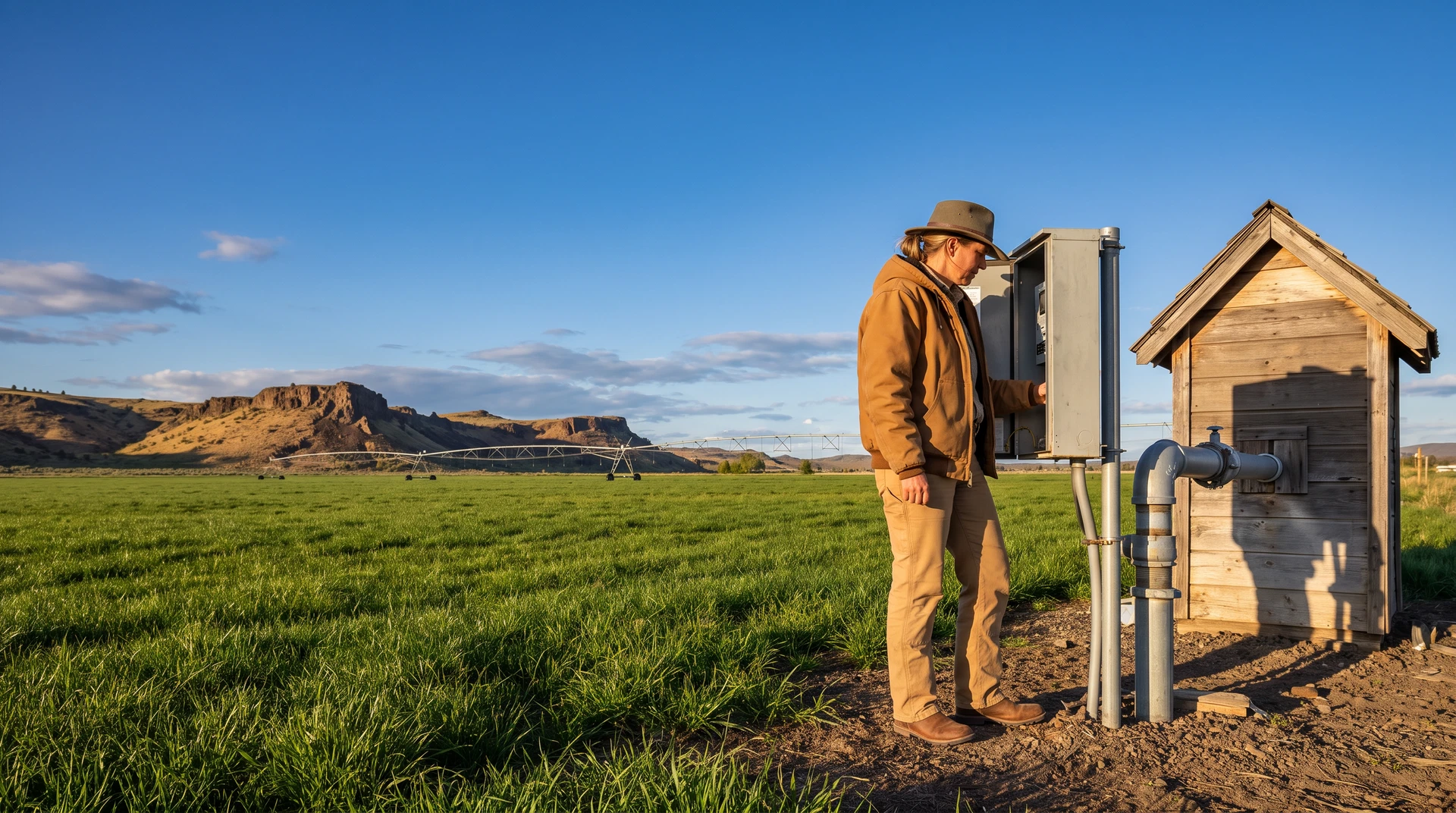

On an Oregon farm or ranch, the water system is rarely just one pump. It may include a water right, private or irrigation well, pump house, electrical service, controls, pressure tank, filters, pipe, pivot, stock-water system, tank, generator, remote-access road, and equipment spread across more than one parcel. When something fails, the operational question is immediate: how do you protect livestock, crops, buildings, and people? The insurance question must be more precise: what property is listed, what cause of loss occurred, and what does the actual policy say?
This guide is educational, not water-rights, engineering, legal, environmental, agricultural, or insurance-coverage advice. Oregon water rules, well safety, equipment maintenance, and insurance are related but different subjects. Coverage, limits, deductibles, valuation, eligibility, exclusions, endorsements, and claim outcomes depend on the specific policy, insurer, equipment, location, maintenance, and cause of loss. The goal is to help Oregon farm and ranch owners ask better questions before a remote-system failure becomes an emergency.
Start by Separating the Water Question From the Insurance Question
Owning land with a creek, pond, groundwater, or an existing well does not automatically answer the water-right question. Oregon Water Resources Department explains that, with some exceptions, users must obtain authorization to use surface water or groundwater; a landowner does not automatically obtain the right to use water merely because it is on, under, or next to the property.[2] OSU Extension specifically cautions that irrigation of crops intended for sale generally needs a legal water right, including smaller production for a farmers' market or CSA.[1]
An insurance policy does not grant a water right, confirm that a well use is authorized, or substitute for agricultural, environmental, engineering, or legal advice. Treat these as parallel files. Keep water-right and operating documents with your farm records, then separately review how pumps, pivots, water equipment, structures, and remote locations are described on your farm and ranch insurance program.
| System or property item | Planning question | Insurance-review question |
|---|---|---|
| Irrigation right or source | What authorization, source, priority, seasonal use, and records apply? | A policy is not a water right. What physical equipment—not water use—is described, scheduled, or insured? |
| Private well and pump | Who maintains it, tests it, services it, and knows the shutoff and electrical layout? | Is the pump, well house, pressure tank, electrical equipment, and attached property accurately listed and valued? |
| Pivot, wheel line, or drip system | Where is each component, who services it, and what are the shutdown, winterization, and access procedures? | How are movable or permanently installed components treated under the actual policy? |
| Remote pump station | How is access maintained, who receives alarms, and what happens after a power or communications interruption? | Does the policy identify the remote location and equipment? Are breakdown, service-line, theft, and vandalism questions addressed? |
| Well house, shed, or outbuilding | Are utilities, combustible materials, backup systems, and emergency access managed? | Is the structure described accurately, and are its contents, improvements, and location current? |
| Generator and controls | Who tests, maintains, and documents the backup system? | Are generators, transfer equipment, panels, controllers, and fuel systems included in the property discussion? |
1. Build a Water-System Inventory Before You Need It
A productive insurance review begins with an accurate operation map. Walk the property and record where water begins, how it moves, and what equipment keeps it moving. Include the well or intake, pump model and serial information, pressure tank, filters, electrical panels, pump controls, generators, tanks, pivots, wheel lines, drip controls, valves, buried pipe maps if available, well house, pump shed, access roads, gates, bridges, and every satellite location.
Pair that list with current photographs, purchase documents, installation and service records, invoices, repair history, property locations, and seasonal shutdown procedures. Our farm insurance resource can help frame the broader property-and-liability conversation; this equipment inventory makes the conversation specific. Values, classifications, scheduled-property requirements, and coverage treatment vary, so a list is evidence for a conversation—not proof that an item is insured.
2. A Private Well Is a Home-System and Farm-Operations Question
Oregon DEQ says private well owners are responsible for maintaining, testing, and safely operating their wells. DEQ and OHA recommend regular testing, generally every one to two years, and property-transfer rules may also apply.[3] That does not turn a domestic well into an irrigation source or tell you how a policy will respond to a water-system failure. It does mean that well records, testing history, access to shutoffs, pump-service information, and reliable contacts are part of sensible rural-property stewardship.
If your well, pump, well house, or septic-related system serves a home, rental, shop, ranch operation, or more than one use, compare this article with our private well and septic insurance guide. Be direct with your agent about the property's actual use. Household water, livestock, irrigation, a farm stand, employee housing, a detached shop, and commercial activity can create different operational and underwriting questions.
3. Remote Locations Need a Remote-Failure Plan
Distance changes the stakes. A pump station that is one mile from the house, a pivot beyond a locked gate, or a water tank on a seasonal road may take longer to inspect after an outage, freeze, theft, wildfire closure, or mechanical alarm. Develop a written response sequence for the people who may actually receive the call: who has gate access, who knows the shutoffs, who can contact the pump contractor, where the records are stored, how livestock water is protected, and who can notify your insurer if a loss may be involved.
Check whether your rural operation includes off-grid or backup systems. A generator, solar-powered pump, battery bank, remote-control platform, satellite connection, or cellular alarm can be valuable operationally, but each should be described accurately. Our off-grid property insurance resource and rural property insurance guide offer related discussion points for properties where access, utilities, storage, and location differ from a typical in-town risk.
Turn Your Equipment List Into a Farm Coverage Review
Before the irrigation season, a freeze, a wildfire evacuation, or a remote-system failure adds time pressure, Prineville Insurance can help you organize questions for the insurers you work with. Bring photos, schedules, equipment values, locations, use details, service records, and current policy documents.
4. Ask How the Policy Treats Equipment, Not Just “Whether It Is Covered”
“Is my pump covered?” is an important opening question, but it is too broad to produce a reliable answer. Tell your agent what the item is, where it sits, whether it is permanently installed or mobile, who owns it, what it does, its current replacement value, and what happened. A fire, wind event, freeze, electrical surge, mechanical breakdown, theft, vandalism, vehicle impact, water damage, or gradual wear issue can lead to different policy questions.
Ask whether equipment should be scheduled, whether it falls under a building, farm personal property, mobile equipment, or another property category, and whether the policy has applicable sublimits, deductibles, valuation terms, or endorsements. If the operation uses tractors, portable pumps, trailers, rented equipment, or equipment away from the premises, bring the entire use pattern into the discussion. See our farm equipment insurance overview for the broader questions to prepare.
5. Do Not Skip Power, Controls, and Buried-System Questions
A water-system loss may begin with a component that does not look like “irrigation equipment”: a motor starter, electrical panel, breaker, control wire, pressure switch, monitoring device, transfer switch, battery, generator, or pipe beneath the ground. Remote systems often have multiple dependencies, so list them. Ask whether the policy includes terms relevant to equipment breakdown, electrical damage, service lines, remote equipment, or loss of business income. Those features are policy-specific and may not be included automatically.
When a licensed professional makes an installation or repair, retain the scope of work and invoice. This is useful for property records and future planning, but it does not change a policy by itself. For farm operations that depend on cold storage, pumps, processing, or other electrical equipment, a careful review can also be part of a larger continuity conversation with your accountant, lender, agricultural adviser, and equipment professionals.
6. Protect the Water System as Part of Rural Wildfire Readiness
A well house, pump shed, power equipment, tank, outbuilding, driveway, and propane system all affect whether you can inspect or operate a rural water system during a wildfire event. Oregon State Fire Marshal emphasizes defensible space, including roof and gutter debris removal, reduced combustibles near structures, clearance around propane tanks, and emergency driveway access.[4] Those recommendations are practical property-resilience steps. They do not make a system fireproof or promise coverage, eligibility, renewal, or pricing.
Review our fire mitigation resource and Oregon wildfire insurance guide alongside your farm plan. Include water-system locations in evacuation and property maps, but do not count on entering an area during an emergency. Safety directions from local authorities always come first.
A Pre-Season Irrigation and Remote-Property Checklist
| Before the season | What to organize | Question for your advisor team |
|---|---|---|
| Map the system | Equipment locations, utility information, shutoffs, gates, access roads, photographs, and emergency contacts. | Do our equipment schedule, property values, and locations reflect the system we operate today? |
| Check records | Service invoices, well information, water tests, pump and generator records, manuals, and recent upgrades. | Which records should be retained for operations, safety, lending, and a potential insurance discussion? |
| Review source and use | Water-right documentation, lease arrangements, well use, livestock needs, crop use, and local contacts. | Which water-law or compliance questions belong with OWRD, a watermaster, or another qualified adviser? |
| Assess remote access | Keys, gate codes, maps, contractor contacts, alarm contacts, and alternate power or water plans. | Who has authority and ability to respond if the owner is unreachable or the road is closed? |
| Review resilience | Wildfire defensible-space tasks, pump-shed conditions, roof/gutter maintenance, propane clearance, and driveway access. | What property details should we share with our insurer, and what questions are policy-specific? |
| Set review dates | Renewal date, irrigation-season start, well testing, service intervals, value updates, and major purchases. | When should we contact our agent before an acquisition, installation, or material change? |
Frequently Asked Questions
Does a farm insurance policy automatically cover an irrigation pump, well, pivot, water tank, or underground water line?
Do not assume it does. Whether a particular item is covered can depend on the policy form, property schedule, valuation, ownership, location, cause of loss, maintenance, exclusions, deductible, and endorsements. A pump, pivot, well house, tank, electrical panel, underground line, and control system may raise different questions. Review the actual policy and current equipment list with your insurer or independent agent before relying on coverage.
Does farm insurance cover drought, water curtailment, or a water-right issue?
Those are not questions to answer from a general blog. Water rights, water availability, crop yield, business-income loss, and property damage are separate issues that may involve different laws, programs, contracts, and policy terms. Oregon Water Resources Department and legal or agricultural advisers should address water-right questions, while your insurance agent can help you identify what the actual policy says about the insured property and listed causes of loss.
Why should I keep private-well records if I own a rural Oregon property?
Well-service invoices, test results, pump and pressure-tank information, photos, repair records, and contact information can help you understand and maintain the system. Oregon DEQ notes that private-well owners are responsible for maintenance, testing, and safe operation, and it recommends regular testing. Those records do not create insurance coverage, but they can make a property, maintenance, or insurance discussion more organized.
What should I review before a remote pump station or water-system failure?
Start with operational readiness: access, shutoffs, electrical and control components, pump records, winterization, backups, vendor contacts, property photos, and an up-to-date inventory. Then review the policy-specific questions: which equipment is scheduled, where it is located, which causes of loss are addressed, what deductibles apply, whether equipment breakdown or service-line features are available, and how a claim should be reported. Availability and terms vary by insurer and policy.
Can wildfire mitigation improve my farm’s insurance options?
Wildfire hardening and defensible-space work can be sensible resilience steps, particularly around a home, well house, pump shed, outbuilding, propane tank, and access road. They do not make a structure fireproof and do not guarantee policy availability, eligibility, renewal, pricing, or claim outcomes. Ask your insurer or agent which property details and documentation are relevant to its current underwriting review.
The Bottom Line for Oregon Farm and Ranch Owners
Water systems are critical, interconnected property systems—but there is no one-size-fits-all answer to how an insurance policy responds. The most useful preparation is specific: understand the property and water system you operate, maintain records, keep values and locations current, involve the right regulatory and technical professionals, and review your policy before a loss. Contact Prineville Insurance when you are ready to organize the insurance questions for your carrier; the policy and insurer determine the actual answer.


