



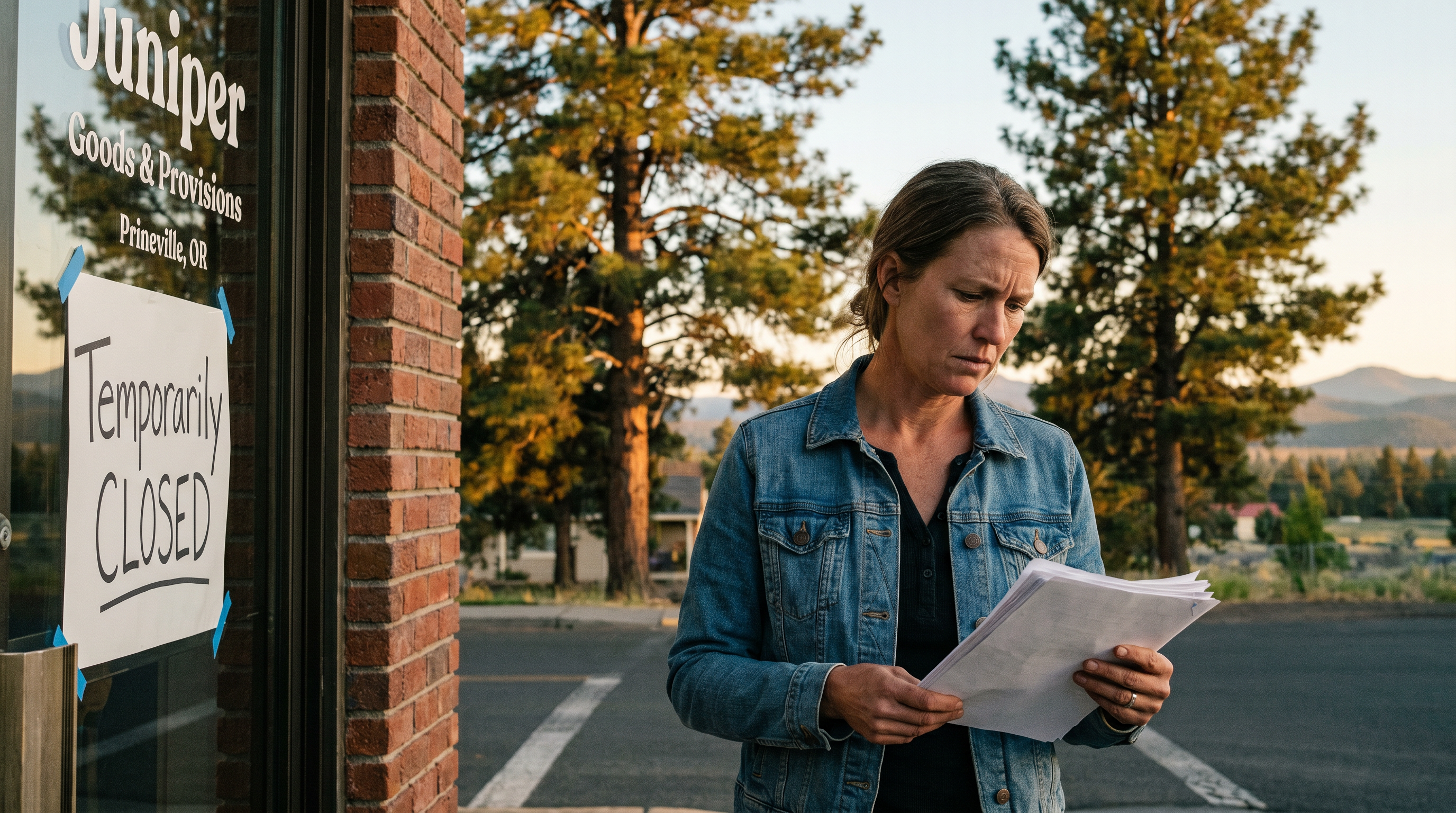

Ask most Oregon business owners what their commercial insurance covers, and they'll describe their general liability policy and their commercial property policy. Ask them about business income insurance, and you'll often get a blank stare — or worse, a confident but incorrect answer. Business income insurance is the coverage that most business owners think they understand, discover they don't when they file a claim, and wish they had understood better when they bought their policy.
This guide explains how business income insurance actually works, what it covers and what it doesn't, the most common misconceptions we see among Central Oregon business owners, and how to calculate the right limits for your specific situation.
What Business Income Insurance Actually Covers
Business income insurance (also called business interruption insurance) replaces the income your business loses when a covered physical loss forces you to suspend or reduce operations. It is not a standalone policy — it is typically a coverage part within your commercial property insurance package, triggered by the same covered perils that trigger your property coverage.
When a covered loss occurs — a fire, a windstorm, a burst pipe, vandalism — and your business cannot operate normally during the repair or rebuilding period, business income insurance pays:
- Net income that your business would have earned if the loss had not occurred
- Continuing normal operating expenses — payroll, rent, utilities, loan payments, insurance premiums — that continue even though your business is closed
The coverage period begins after a waiting period (typically 72 hours from the date of loss) and continues until your property is restored to its pre-loss condition, or until the maximum period of restoration in your policy expires — whichever comes first.
The Five Most Common Misconceptions
After years of helping Central Oregon businesses navigate business income claims, these are the five misconceptions we encounter most often:
Misconception 1: "My business income coverage will pay for as long as I'm closed." Business income coverage has a maximum period of restoration — typically 12 months in standard policies. If your building takes 18 months to rebuild (not unusual for complex commercial structures, especially with contractor shortages in Central Oregon), you'll run out of coverage six months before you reopen. Extended period of restoration endorsements are available and often essential.
Misconception 2: "My coverage limit is high enough because it matches my annual revenue." Business income limits should be based on net income plus continuing operating expenses — not gross revenue. If your business has high variable costs (cost of goods sold, sales commissions, raw materials) that would stop during a closure, your actual business income exposure is significantly lower than your gross revenue. Overestimating your limit wastes premium; underestimating it leaves you exposed.
Misconception 3: "Business income insurance covers any reason my business loses money." Business income insurance requires a direct physical loss to your property caused by a covered peril. It does not cover economic slowdowns, loss of a key customer, supply chain disruptions, or government-ordered closures not caused by a covered physical loss. The COVID-19 pandemic exposed this misconception for millions of businesses nationwide.
Misconception 4: "Once my building is repaired, my business income coverage stops — and that's fine." Even after your building is repaired, it may take months to rebuild your customer base, rehire and retrain staff, and return to pre-loss revenue levels. An extended period of indemnity endorsement extends coverage beyond the physical restoration period — typically 30, 60, or 90 days — to account for this ramp-up period. For businesses with long customer acquisition cycles or seasonal revenue patterns, this endorsement is essential.
Misconception 5: "My business income coverage covers cyber attacks." Standard business income insurance does not cover income loss from ransomware attacks, system failures, or other cyber events. Cyber-caused downtime requires a separate cyber business interruption endorsement or standalone cyber liability policy. As Central Oregon businesses increasingly rely on digital systems, this gap is becoming more significant.
Is Your Business Income Coverage Adequate?
Get a free business income insurance review from Prineville Insurance — we'll help you calculate the right limits for your business.
Eight Business Income Coverage Components to Review
A comprehensive business income program for an Oregon business should address both the income replacement and the operational continuity dimensions of a covered loss.
Net Income Replacement
Replaces the net income your business would have earned during the restoration period. Calculated based on your financial records — the more accurate your records, the stronger your claim.
Continuing Operating Expenses
Pays fixed expenses that continue even when your business is closed — payroll, rent, utilities, loan payments, insurance premiums. Keeps your business financially viable during the restoration period.
Extra Expense Coverage
Pays costs above normal operating expenses to continue operating or speed up restoration — temporary space rental, equipment leasing, expedited shipping, overtime pay for contractors.
Extended Period of Indemnity
Extends coverage beyond the physical restoration period to account for the time needed to rebuild your customer base and return to pre-loss revenue levels. Essential for businesses with long customer acquisition cycles.
Contingent Business Income
Covers income loss when a key supplier, customer, or dependent business suffers a covered loss that disrupts your operations — even though your own property was not damaged.
Utility Services Interruption
Covers income loss when a utility service (power, water, gas, telecommunications) is interrupted by a covered cause of loss to the utility's property. Requires a specific endorsement — not included in standard business income coverage.
Civil Authority Coverage
Covers income loss when a government authority prohibits access to your premises due to a covered loss at a nearby property — a fire in an adjacent building, a chemical spill, or a road closure that blocks customer access.
Cyber Business Interruption
Standard business income insurance does not cover cyber-caused downtime. A separate cyber business interruption endorsement or standalone cyber policy is required to cover income loss from ransomware attacks or system failures.
Don't Let a Covered Loss Become a Business Failure
Prineville Insurance helps Central Oregon businesses calculate accurate business income limits and identify coverage gaps before a loss occurs.
How to Calculate Your Business Income Limit
The most common mistake in setting business income limits is using the wrong starting number. Here is the correct calculation:
- Start with gross revenue for the most recent 12 months.
- Subtract variable costs that would stop during a closure — cost of goods sold, raw materials, sales commissions, and other costs directly tied to production or sales volume.
- Add back all continuing fixed expenses — payroll (especially key employees you'd retain during a closure), rent, utilities, loan payments, insurance premiums, and other fixed costs.
- This is your monthly business income exposure. Multiply by the number of months in your estimated period of restoration.
- Add a buffer for the extended period of indemnity — the time needed to rebuild your customer base after reopening.
For a Central Oregon restaurant with $1.2 million in annual revenue, $400,000 in food costs, and $600,000 in fixed expenses (payroll, rent, utilities, debt service), the monthly business income exposure is approximately $83,000. For a 12-month period of restoration, the limit should be approximately $1 million. Many restaurant owners would set this limit at $1.2 million (gross revenue) — overpaying premium — or at $200,000 (net income only) — dramatically underinsured.
For businesses in wildfire-prone areas of Central Oregon, the period of restoration estimate should account for contractor availability constraints. After a major wildfire event, local contractors are overwhelmed with work, and rebuild timelines can extend significantly. A 12-month standard period of restoration may be inadequate — consider 18 or 24 months for businesses in high-risk areas. See our guide on wildfire insurance in Central Oregon for more on this topic.
Frequently Asked Questions
Get a Free Business Income Insurance Review
Prineville Insurance helps Central Oregon businesses calculate accurate business income limits, identify coverage gaps, and build commercial insurance programs that actually protect their revenue.


