

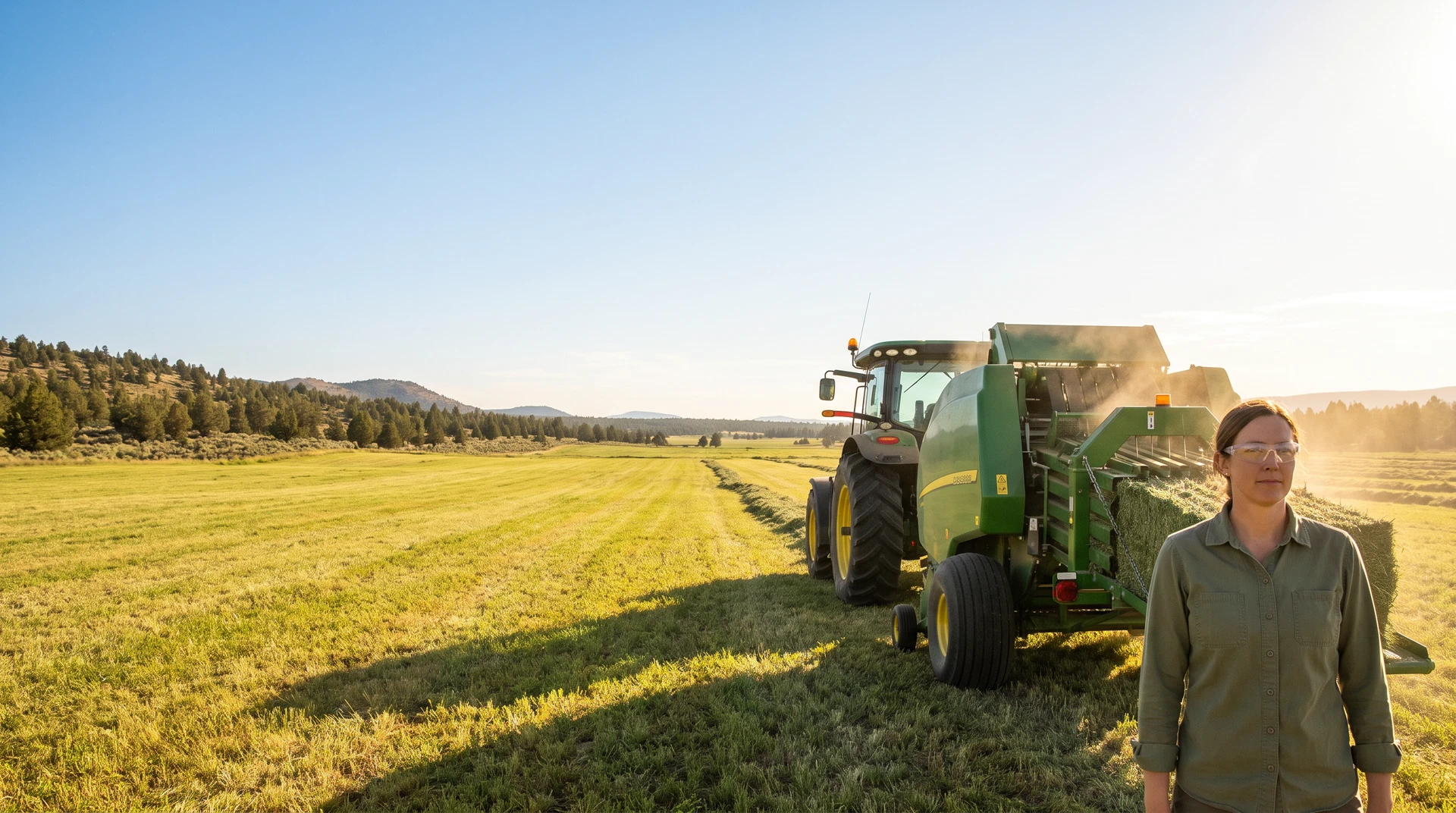

In Oregon, a custom operator may mow, rake, bale, chop, haul, spray, plant, or harvest for a neighboring producer without ever taking title to the crop. That practical arrangement can help both operations use specialized equipment and labor efficiently, but it also changes the insurance conversation the moment people, machinery, and responsibility cross another producer's gate. Start with the complete operating picture—not a short label—and compare it with your farm and ranch insurance program before the first job of the season.
This is an educational guide, not legal, tax, labor, safety, agricultural, licensing, or coverage advice. No general article can determine a worker's status, whether a labor-contractor license is required, who is legally responsible for a loss, or how an insurer will respond. Policy terms, limits, exclusions, deductibles, endorsements, insured locations, equipment schedules, contracts, actual job facts, and the cause of loss all matter. The goal is to help Oregon custom-farming and custom-haying operations ask organized questions early.
Start With the Job Description Before You Start With Insurance Labels
A custom farming arrangement is often described as the operator performing machine operations on an owner's land for a stated fee or rate, while the owner retains the crop and makes key input or marketing decisions.[1] Real jobs can be broader: hay cutting and baling, grain harvest, spraying, irrigation support, loading, hauling, storage, field scouting, repairs, or a crew that moves between several producers. The work may be seasonal, but the exposure is not generic.
Give your agent and attorney the same plain-language narrative: which fields are involved, who owns the crop and inputs, what work will be done, who decides timing, whether the operator may hire helpers, whether any equipment is borrowed, where material is moved, and who has authority to stop work. Your farm-insurance review should reflect the operation you actually run today—not last year's acreage, equipment list, or job mix.
| Job-file item | Write down the operating facts | Ask the insurance-review question |
|---|---|---|
| Fields and access | Field names, maps, acreage, roads, gates, bridges, slopes, overhead lines, irrigation hardware, and emergency access. | Are all working locations, use patterns, and access-related exposures accurately described in the policy discussion? |
| Scope and timing | Tasks, equipment, start and stop dates, weather delays, priority fields, quality expectations, and who may change the plan. | Does the form address the full service rather than only one part of the custom operation? |
| Machinery and property | Owned, leased, rented, borrowed, customer-owned, or jointly used equipment, plus crop, hay, stored material, and infrastructure. | How does the actual policy treat scheduled property, mobile equipment, property of others, and items in your care, custody, or control? |
| Trucks and hauling | Drivers, trucks, trailers, load types, route distances, loading points, roadside stops, and delivered destination. | Which policy addresses the truck, trailer, load, and related liability facts while equipment or hay is in transit? |
| People and supervision | Who hires, pays, directs, trains, transports, and records time for every worker and helper. | What payroll, workers' compensation, employment, independent-contractor, or labor-contractor questions need qualified review? |
| Contract and documentation | Payment basis, certificates, indemnity language, additional-insured requests, notices, photos, pre-existing damage, and loss reporting. | Do contract insurance requirements align with the actual policy language and current operations? |
1. A Written Scope of Work Helps Separate Expectations From Assumptions
Iowa State Extension recommends that custom-farming parties record the acres, locations, operations, timing, responsibilities, rates, and payment details in writing.[1] That advice is useful in Oregon as a practical business discipline. A concise agreement and job worksheet can identify the field, access route, known hazards, crop or hay ownership, equipment, payment formula, authority for weather delays, and what each party must report if property is damaged or a worker is hurt.
Insurance clauses deserve the same care. An agreement can request certificates, set notice procedures, allocate duties, or require certain insurance features, but it does not change policy terms or establish coverage by itself. For a related landowner-and-operator perspective, see our Oregon grazing lease insurance guide. Have qualified counsel review indemnity, additional-insured, waiver, and risk-transfer language before signing, particularly when the job includes higher-value equipment, stored crop, multiple locations, or a crew.
2. Equipment on Another Producer's Ground Raises Several Separate Questions
A baler, mower, windrower, combine, sprayer, tractor, loader, or portable fuel setup may be more mobile than the policy that insures it. Explain where equipment goes, how it gets there, whether it stays overnight, and whether it works on your ground, a customer's ground, rented ground, or several counties. Also disclose borrowed or rented equipment and any customer-owned item that you move or operate near. Those facts may affect how an insurer evaluates scheduled property, location, theft, collision, transit, equipment breakdown, or property-of-others questions.
Do not reduce the discussion to “Is the baler covered?” Instead, identify the item, ownership, value, use, location, transportation method, and the event you are worried about. Our farm-equipment insurance blind-spots guide offers a related inventory framework for equipment that leaves the home operation. An itemized equipment schedule and recent photos are practical records, but they are not proof of insurance or a substitute for the policy.
Make the Contract-Harvest Conversation Specific Before the Season Starts
Bring the agreement, field list, equipment schedule, crew and hauling facts, certificates you have received, and current policy declarations to Prineville Insurance. We can help you organize the insurance questions to take to the insurers you work with.
3. Landowner Liability, Contractual Risk, and Certificates Are Different Files
A producer hiring custom work may reasonably ask for evidence that the operator maintains insurance, and a custom operator may reasonably ask what conditions are known at the field. Those requests do not mean either party can assume that one policy automatically protects the other. The producer's liability concerns can include premises, roads, gates, visitors, irrigation equipment, livestock, and activities on the property. The custom operator's concerns can include operations liability, contractual obligations, equipment, employees, and property being handled for a customer.
Treat a certificate of insurance as a starting document, not a coverage decision. Verify names, dates, described operations, limits, and any requested status with the issuing agent or insurer when appropriate. A request to be an additional insured, a waiver, or a particular endorsement should be reviewed against the actual contract and policy. Ask who will keep the certificate and who will notify the other party if insurance is canceled or materially changed. An Oregon agricultural attorney and insurance professionals should address legal and policy wording questions.
4. Trucks, Trailers, Hay Loads, and Road Miles Need Their Own Review
Custom haying may be a field operation until a bale is loaded, but loading, towing, hauling, and delivery introduce road exposure. Discuss the pickup or truck, trailer, driver, cargo or hay load, loading equipment, route, distance, and destination rather than assuming a farm policy and auto policy answer the same questions. The boundary between farm use and commercial activity, driver use, vehicle type, cargo, and travel can matter to an insurer.
Start with our commercial auto insurance overview for the general vehicle conversation, then compare the farm-specific questions in our Oregon farm and ranch trucking insurance guide. Your agent can help identify whether the vehicles, trailers, drivers, territory, use, and limits presented to the insurer match the work planned for the season.
5. Crews, Classification, and Labor-Contractor Questions Cannot Be Solved by a Label
A custom-farming agreement may call someone an independent contractor, but Oregon BOLI says a worker's status is determined by the reality of the work relationship, not the title used.[3] Control over the work, payment, equipment, duration, initiative, investment, and other facts can matter. Likewise, payroll, paid travel between fields, setup and cleanup, waiting time, and the handling of another producer's crop can create issues that are outside the scope of a general insurance blog.
BOLI's agricultural guidance states that employees who handle or otherwise work on products not grown by their own employer may be subject to overtime after 40 hours in a workweek, and it describes joint-employment considerations where a labor contractor provides a crew.[2] BOLI also says that persons or entities that recruit, solicit, supply, or employ workers for farm-crop production must hold a valid Farm/Forest Labor Contractor License.[4] Those points do not decide any reader's situation. They are a reason to involve labor counsel, payroll professionals, and BOLI early—before workers are assigned, transported, or paid.
6. Field Safety and Remote-Emergency Planning Belong in the Contract-Harvest File
Oregon OSHA's agriculture resources address tractor and PTO hazards, personal protective equipment, pesticide and chemical safety, heat, wildfire smoke, worker orientation, and medical emergencies in rural areas.[5] Build a pre-job exchange around conditions the operator and landowner need to know: who has gate access, where emergency responders should enter, who knows the field roads, whether there are soft shoulders, overhead lines, bridges, irrigation risers, chemicals, livestock, smoke exposure, or communications gaps.
Safety planning is operationally valuable, but it does not guarantee legal compliance, insurance availability, or a claim outcome. Use local emergency instructions and occupational-safety guidance first. For property resilience planning, our fire mitigation resource and Oregon wildfire insurance guide can support a related discussion about access, defensible space, records, and emergency readiness. If irrigation or remote pump systems are involved in the job, keep our farm irrigation and remote-property guide with the job records as well.
Pre-Season Custom Farming and Contract-Harvest Checklist
| Before work begins | Organize the facts | Ask the adviser team |
|---|---|---|
| Map each job | Field acreage, location, access routes, gates, hazards, roads, contacts, and emergency entry points. | Do the contract and insurance discussion reflect every place and operation actually planned? |
| Inventory equipment | Ownership, values, photos, serial records, attachments, hired or borrowed items, trailer use, and overnight storage. | How does the actual policy treat each item at the farm, in transit, and at another producer's location? |
| Clarify the work | Tasks, pricing, scheduling, weather delays, crop or hay ownership, quality expectations, and change authority. | Are the agreement's insurance requirements realistic and coordinated with policy terms? |
| Review people and payroll | Who hires, supervises, pays, trains, transports, records hours, and provides safety equipment. | Which labor, payroll, workers' compensation, classification, or licensing questions require professional advice? |
| Exchange documentation | Contract, certificates, requested endorsements, contact list, pre-existing-condition photos, and incident reporting plan. | Who confirms certificates and policy requirements, and who handles a potential loss notice? |
| Plan continuity | Alternate equipment, repair contacts, weather plan, smoke/heat plan, remote communications, and emergency response steps. | Which risks belong with the insurer, attorney, accountant, labor adviser, safety professional, or agricultural adviser? |
Frequently Asked Questions
Does a farm policy automatically cover custom haying, baling, harvesting, or field work I perform for another producer?
Do not assume it does. The answer can depend on the policy form, the services performed, revenue from the work, the equipment used, where the work happens, who employs the crew, contractual obligations, and endorsements. A policy written for the insured’s own farm can address custom work differently. Share the full scope with your insurer or independent agent before the season rather than relying on a general description such as “farm work.”
If I hire a custom operator, is that operator’s insurance enough to protect my farm?
Not necessarily. The producer, landowner, and custom operator can each have different property, liability, contractual, and operational responsibilities. A certificate of insurance can help document that a party has represented certain insurance, but it is not the policy and does not by itself change either party’s coverage. Review the agreement, actual policy documents, requested certificate wording, and your own farm program with qualified advisers.
When does an Oregon custom-harvest crew become a labor-contractor or employee issue?
That is fact-specific and should not be decided from a blog. Oregon BOLI states that worker status turns on the reality of the relationship, not the label used in an agreement. BOLI also states that a person or entity that recruits, solicits, supplies, or employs workers for farm-crop production must hold a valid Farm/Forest Labor Contractor License. Consult qualified labor, payroll, and legal advisers early if your operation supplies or employs crews, transports workers, or works across more than one producer’s crop.[3] [4]
Should a custom operator list customer-owned hay, crops, equipment, gates, or irrigation property in the insurance discussion?
Yes. Bring an itemized description of what may be handled, moved, stored, loaded, hauled, or worked around. Damage to property you own, rent, borrow, control, or handle for another party can raise different policy questions. Ownership, custody, location, valuation, cause of loss, contract terms, deductibles, and exclusions all matter. A clear list improves the insurance conversation; it does not create coverage.
Does a custom-farming contract replace a policy review?
No. A written contract can clarify business expectations, but it cannot rewrite an insurance policy or guarantee a legal, licensing, employment, or claim outcome. Use the agreement, equipment inventory, certificate requirements, and job records as part of a coordinated review with the appropriate legal, tax, labor, safety, and insurance professionals.
The Bottom Line for Oregon Custom Operators and Producers
Custom farming and contract harvesting can be a valuable way to share capacity, but it adds facts that must be disclosed and reviewed: another producer's land and crop, mobile equipment, access roads, trucks and trailers, crew arrangements, field safety, certificates, written contracts, and incident records. Keep those records current, distinguish operational questions from legal and coverage questions, and review the actual policy before the season creates a deadline. Contact Prineville Insurance when you are ready to organize an Oregon custom-farming or custom-haying insurance review with your carrier; the insurer and policy determine the actual answer.
References
- Iowa State University Extension — Custom Farming: An Alternative to Leasing
- Oregon Bureau of Labor & Industries — Minimum Wage and Overtime in Agriculture
- Oregon Bureau of Labor & Industries — Employee or Independent Contractor
- Oregon Bureau of Labor & Industries — Farm/Forest Labor Contractors
- Oregon Occupational Safety and Health — Agriculture resources
- USDA Risk Management Agency — Partnership Program and farm risk-management education