



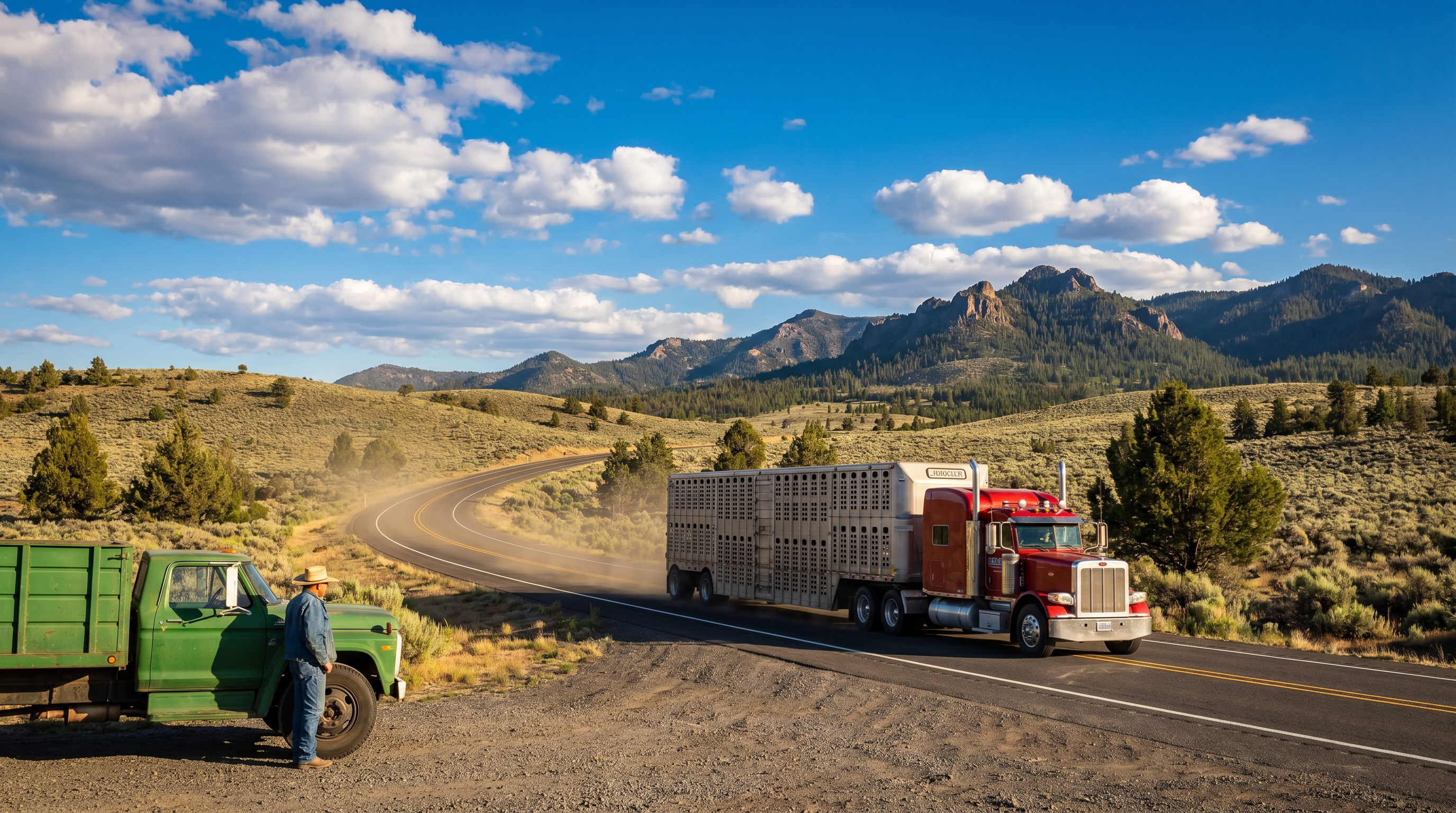

Every Central Oregon ranch operation has trucks. A Peterbilt with a livestock trailer for moving cattle to the Madras Livestock Auction. A grain truck for hauling wheat to the Ochoco Grain elevator in Prineville. A flatbed for moving hay. A pickup pulling a gooseneck to a summer grazing allotment. These vehicles are as essential to the operation as the cattle and the land — and they are among the most underinsured assets on most Central Oregon farms and ranches.
The insurance question is not simply whether the truck is covered. It is whether the truck is covered for the specific use it is being put to at the moment of an accident. A farm auto policy and a commercial trucking policy are fundamentally different products, and the gap between them can mean the difference between a covered claim and a personal financial catastrophe. This guide explains Oregon's farm trucking regulatory framework, the coverage lines every farm and ranch operation needs, and the eight most common trucking insurance gaps on Central Oregon operations.
Is Your Farm Truck Properly Insured for Every Use?
Most Central Oregon ranchers discover trucking coverage gaps only after an accident. A free farm and ranch insurance review can identify every gap — for-hire exposure, livestock transit, cargo limits, and hired auto — before a claim occurs.
Get a Free Farm & Ranch Insurance ReviewOregon Farm Plates and the FMCSA Covered Farm Vehicle: What the Exemptions Actually Cover
Oregon's farm plate system — governed by ORS 805.390 and administered by ODOT's Commerce and Compliance Division — provides significant regulatory benefits for qualifying farm operations. Farm-plated vehicles pay lower registration fees, are exempt from Oregon's weight-mile tax when used for qualified farm operations, are exempt from CCD insurance requirements (though DMV insurance requirements still apply), and are exempt from some motor carrier safety regulations.
The federal counterpart is the "covered farm vehicle" (CFV) designation under 49 CFR 390.5. A CFV is a farm-registered vehicle operated by the owner or operator of a farm or ranch (or their employee or family member), used to transport agricultural commodities, livestock, machinery, or supplies to or from a farm, and not used in for-hire operations. CFVs are exempt from CDL requirements, drug and alcohol testing, hours of service rules, and federal inspection requirements. Vehicles at or below 26,000 lbs can use these exemptions anywhere in the United States; vehicles above 26,001 lbs can use them within Oregon or within 150 air miles of the farm.
What the exemptions do not cover is equally important. Farm plates and CFV status do not exempt a vehicle from Oregon DMV minimum insurance requirements. They do not exempt a vehicle from federal Part 393 equipment requirements (lights, brakes, reflectors). And critically, they do not make a farm auto insurance policy cover uses that the policy excludes — including for-hire hauling.
Farm Auto Policy vs. Commercial Auto Policy: The Critical Distinction
A farm auto policy covers vehicles used in the farm's own operations — hauling the farm's own cattle, grain, hay, and equipment. It is priced and underwritten on the assumption that the truck is being used to support a single farming operation, not to haul for others. A commercial auto policy (or commercial trucking policy) covers vehicles used in commercial transportation operations, including for-hire hauling.
The distinction matters most in two scenarios. First, when a farm truck hauls grain, hay, or livestock for another person for compensation — even occasionally, even for a neighbor, even for a small fee — that is a for-hire operation that falls outside the farm auto policy. Second, when a farm operation grows into a custom harvesting or custom hauling business, the vehicles used in that business need commercial trucking coverage, not farm auto coverage.
Oregon law requires a Class 1A permit from ODOT CCD (one-time $300 fee) for farm-plated vehicles to legally haul for-hire within Oregon. For-hire operations are also subject to weight-mile tax enrollment, motor carrier safety regulations, and commercial insurance requirements. Operating for-hire without the proper permit and insurance is both a regulatory violation and an uninsured exposure.
The Interstate Commerce Trap for Grain Haulers
One of the most counterintuitive rules in farm trucking is that hauling grain from an Oregon field to an Oregon elevator can be interstate commerce — even though both points are in Oregon. Under FMCSA's interpretation, if the grain is later commingled at the elevator and some of it is shipped out of state, the entire movement from field to elevator is part of an interstate transaction. When grain is commingled and there is no way to know which grain went where, FMCSA takes the position that it is more likely to be interstate commerce.
This matters for insurance because interstate commerce operations may be subject to additional federal safety regulations that do not apply to purely intrastate operations. Wheat farmers in Crook County hauling to the Ochoco Grain elevator in Prineville should discuss their specific operations with their agent to confirm that their coverage is structured correctly for the nature of their haul.
Livestock Transit Insurance: The Gap That Costs the Most
A farm property policy covers livestock on the farm premises. It does not cover animals during transport. The moment cattle are loaded onto a truck, the farm property coverage for those animals ends — and without a separate livestock transit policy or endorsement, there is no insurance protection for the animals while they are being hauled.
Livestock transit insurance covers death and crippling of animals during the course of transit — including loading, the actual haul, and unloading. Coverage can be written on a named perils basis (limited mortality, covering specific causes such as collision, overturn, and fire) or an all-risk basis (full mortality, covering death from any cause during transit). For Central Oregon cattle operations hauling registered bulls, bred heifers, or high-value breeding stock, all-risk transit coverage is strongly recommended. A registered Angus bull worth $15,000 that dies in a truck accident is a total loss without transit coverage.
The same gap applies to livestock being hauled to summer BLM grazing allotments, to feedlots in eastern Oregon or Idaho, or to custom backgrounding operations. Every haul of significant livestock value should be evaluated for transit coverage needs. Review your farm insurance program with your agent to confirm that livestock transit coverage is in place.
The 8 Most Common Farm & Ranch Trucking Insurance Gaps in Central Oregon
Farm Auto Policy Used for For-Hire Hauling
This is the most dangerous gap. The moment a farm truck hauls grain, hay, or livestock for another person for compensation, it becomes a for-hire operation. Farm auto policies explicitly exclude for-hire transportation. If an accident occurs while hauling for hire under a farm policy, the insurer will deny the claim — leaving the driver and the farm operation personally exposed for all damages.
No Livestock Transit Insurance
A farm property policy covers livestock on the farm premises. It does not cover animals during transport. If cattle die in a truck accident, a rollover, or from heat stress during a haul to the Madras Livestock Auction or a summer grazing allotment, there is no coverage without a separate livestock transit policy or endorsement. This gap is especially costly for operations hauling registered bulls or bred heifers.
Cargo Coverage Too Low for Actual Load Value
Oregon's minimum cargo insurance for commercial carriers is $10,000 under ORS 825.160 — but a single semi load of wheat at current prices can be worth $80,000 or more. Many farm operations carry the minimum or a low limit that made sense years ago. Review cargo limits against the actual value of a typical load and update accordingly.
No Hired and Non-Owned Auto Coverage
When a farm employee drives their personal pickup to pick up parts, deliver a document, or run a farm errand, the farm has a non-owned auto liability exposure. When the farm rents a semi or leases a grain truck during harvest, it has a hired auto exposure. Both are common on Central Oregon operations. If the farm policy does not include HNOA coverage, these exposures are uninsured.
Umbrella Does Not Extend Over Commercial Auto
A farm umbrella policy sits over the farm property and farm liability policies. But if a farm also has a separate commercial auto policy for trucking operations, the umbrella may not automatically extend over the commercial auto. A semi-truck accident can easily generate a claim exceeding $1 million in primary limits. Confirm that your umbrella is scheduled over every underlying auto policy.
Agreed Value vs. ACV on Older Trucks
Farm trucks are often older, high-mileage vehicles that have been maintained well but have low book value. If a 2005 Peterbilt is insured on an actual cash value basis and is totaled in an accident, the ACV payout may be $15,000–$20,000 less than what it costs to replace it with a comparable truck. Agreed value coverage eliminates depreciation and pays the stated value — a critical difference for operations that depend on specific equipment.
Interstate Commerce Trap for Grain Haulers
Hauling wheat from an Oregon field to an Oregon elevator can be interstate commerce if the grain is later commingled and shipped out of state. When grain is commingled at an elevator, FMCSA takes the position that the entire movement — from field to elevator — may be interstate commerce. This can affect which safety regulations apply and whether your farm auto policy covers the haul. Grain haulers should discuss their specific operations with their agent.
Custom Harvester's Trucks Not Covered Under Farm Policy
When a custom harvester brings their own trucks and equipment to harvest your grain, those vehicles are not covered under your farm policy. The custom harvester needs their own commercial trucking policy. But if the harvester does not have adequate coverage and an accident occurs on your property, your farm liability policy may be drawn into the claim. Require certificates of insurance from every custom operator before they begin work.
Review Your Farm Trucking Insurance Program
Prineville Insurance specializes in farm and ranch insurance for Central Oregon operations — including livestock haulers, grain truckers, and custom harvesters. Call us at (541) 447-6372 to review your farm auto policy, commercial trucking needs, livestock transit coverage, and cargo limits.
Call (541) 447-6372Cargo Insurance: The Minimum Is Not Enough
Oregon's minimum cargo insurance requirement for commercial carriers is $10,000 under ORS 825.160. That minimum was set years ago and bears no relationship to the actual value of agricultural cargo being hauled on Central Oregon roads today. A single semi load of wheat at current prices can be worth $50,000 to $100,000 or more. A load of hay for a large operation can be worth $20,000 to $40,000. A load of cattle heading to a feedlot can be worth $100,000 or more.
If a farm operation is hauling commercially and its cargo coverage limit is $10,000, it is underinsured by a significant margin. Review cargo coverage limits against the actual value of a typical load — not the minimum required by law — and update limits accordingly. For livestock transit, the coverage limit should reflect the actual market value of the animals being hauled, including any premium value for registered or breeding stock.
Hired and Non-Owned Auto: The Invisible Exposure
Two trucking exposures that most farm operators do not think about until after a claim are hired auto and non-owned auto. Hired auto coverage protects the farm when it rents or leases a vehicle — such as renting a semi to haul cattle when the farm's own truck is in the shop, or leasing a grain truck during a heavy harvest season. Non-owned auto coverage protects the farm when employees use their personal vehicles for farm business — driving to the parts store, delivering a document to a neighboring ranch, or running any other farm errand in their own pickup.
Both exposures are common on Central Oregon farms and ranches, and both are often not included in a standard farm policy. The hired auto gap is especially significant when a farm rents a large vehicle — a semi or a heavy flatbed — because the liability exposure from a rented heavy vehicle is identical to the exposure from an owned one. Ask your agent whether your farm policy includes hired and non-owned auto (HNOA) coverage, and add it if it does not. The premium is modest relative to the exposure.
Farm Trucking Coverage Comparison
| Scenario | Farm Auto Policy | Commercial Policy | Key Note |
|---|---|---|---|
| Hauling own cattle to sale barn | ✓ Covered | ✓ Covered | Farm auto sufficient; add livestock transit for animals |
| Hauling own grain to elevator | ✓ Covered* | ✓ Covered | *May be interstate commerce — discuss with agent |
| Hauling neighbor's grain for pay | ✗ Not covered | ✓ Covered | For-hire = commercial policy required; Class 1A permit needed |
| Renting a semi during harvest | ✗ Gap without HNOA | ✓ Covered | Hired auto endorsement needed on farm policy |
| Employee driving personal truck for farm | ✗ Gap without HNOA | ✓ Covered | Non-owned auto endorsement needed on farm policy |
| Cattle die in truck accident | ✗ Not covered | ✗ Not covered | Livestock transit insurance required |
| Grain lost in truck accident | Limited | ✓ With cargo coverage | Check cargo limit vs. actual load value |
| Truck totaled — older vehicle | ACV only | Agreed value available | Agreed value eliminates depreciation gap |
Umbrella Coverage and Heavy Trucks
A semi-truck accident is one of the most financially devastating events that can happen to a farm operation. A collision involving a loaded livestock trailer or a grain truck can result in multiple fatalities, catastrophic injuries, and claims that easily exceed $1 million in primary liability limits. A commercial umbrella policy sitting over your farm auto and commercial auto policies is not optional for operations with heavy trucks — it is essential.
The critical detail is that the umbrella must be scheduled over every underlying auto policy. If a farm has a farm auto policy and a separate commercial trucking policy, the umbrella must list both as underlying policies. An umbrella that only covers the farm auto policy provides no excess protection for claims arising from the commercial trucking operations. Review your umbrella's schedule of underlying policies with your agent to confirm complete coverage.
Workers' Compensation for Truck Drivers
If a farm operation employs drivers — whether full-time, seasonal, or part-time — those drivers are subject to Oregon's workers' compensation requirements under ORS 656. A driver injured in a truck accident while working for the farm is a workers' compensation claim, not just an auto liability claim. Farm operations with employed drivers must carry workers' compensation coverage and confirm that their policy covers the trucking operations specifically.
When to Review Your Farm Trucking Insurance
Farm trucking operations change over time — new trucks are purchased, old ones are retired, operations expand into custom hauling, employees are added, and the mix of owned, rented, and borrowed vehicles shifts from season to season. Any of the following events should trigger a review of your farm trucking insurance program with your Prineville Insurance agent: purchasing or selling a truck, adding a driver, beginning any for-hire hauling, renting a vehicle for the first time, adding a livestock transit haul to a new location, or increasing the value of cargo being hauled.
Central Oregon's agricultural economy depends on trucks. The cattle that leave Crook County ranches for the Madras Livestock Auction, the wheat that moves from Jefferson County fields to the Ochoco Grain elevator, the hay that travels from Powell Butte to feeding operations across the region — all of it moves on trucks. Making sure those trucks are properly insured for every use is not a bureaucratic exercise. It is the difference between a manageable claim and a financial crisis.
Frequently Asked Questions: Oregon Farm & Ranch Trucking Insurance
Don't Let the Wrong Policy Leave Your Trucks Uninsured
Prineville Insurance works with Central Oregon farm and ranch operations to build trucking insurance programs that cover every use — from hauling your own cattle to the sale barn to custom grain hauling operations. Get a free review today.
Get a Free Trucking Insurance Review

