

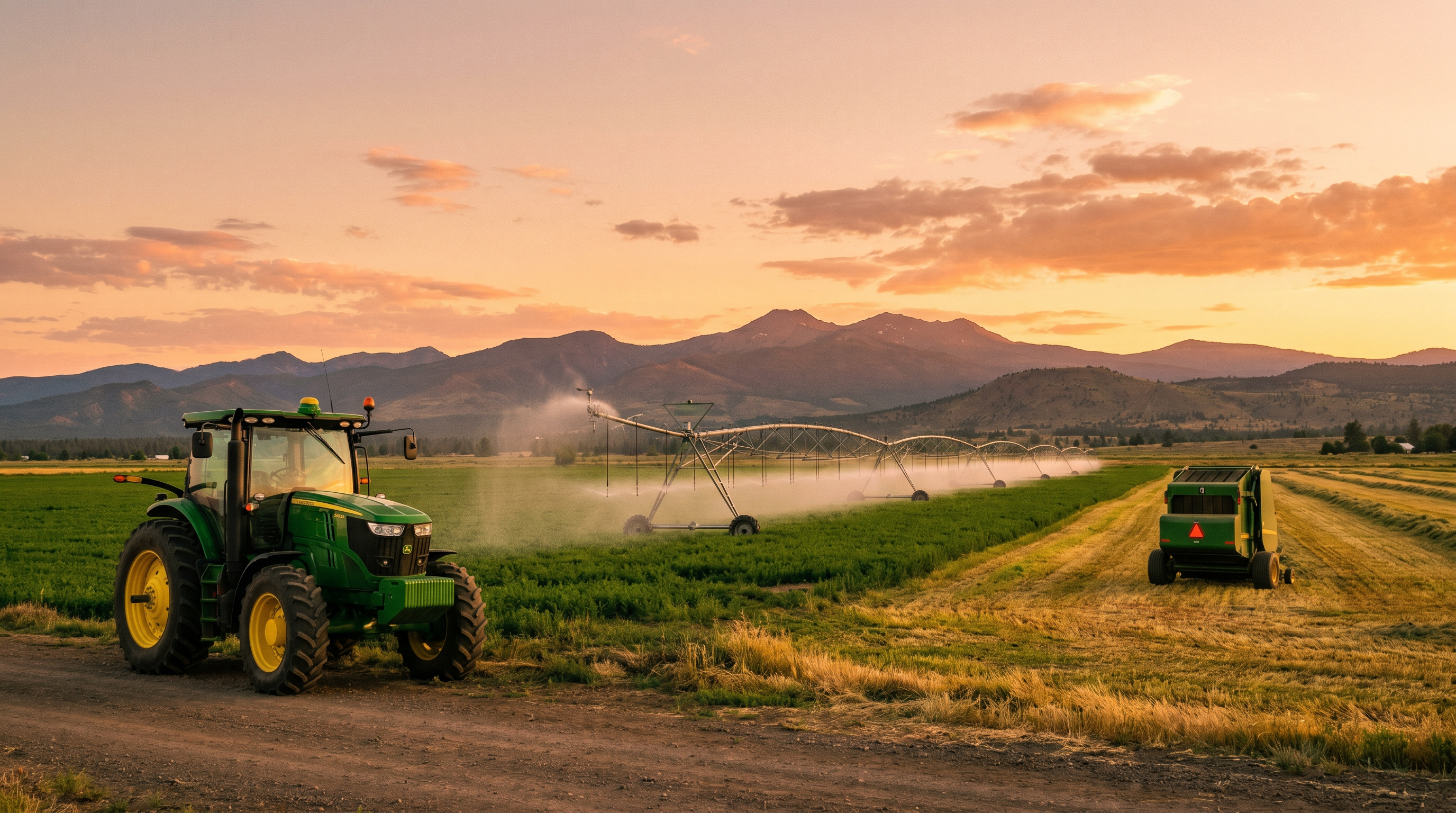
Ask any rancher in Crook, Harney, Wheeler, or Malheur County what their most valuable asset is, and most will point to their land. Ask their insurance agent, and the answer is often different: it's the equipment. A modern 200-horsepower tractor runs $229,500 new. A center-pivot irrigation system covering 160 acres costs upwards of $113,000 installed. A new large round baler can top $190,000. A combine harvester — if you run one — starts at $631,000 and climbs past a million. For the hay and cattle operations that define the high desert economy from Prineville to Burns to Ontario, farm equipment is not a line item. It's the operation.
And yet, farm equipment is among the most misunderstood assets when it comes to insurance. Most ranchers assume their farm and ranch policy covers everything on the property. In reality, equipment moved to a leased grazing allotment, borrowed or rented machinery, center-pivot irrigators with their pump stations and underground lines, and custom harvest equipment brought in seasonally all fall into coverage gray zones that cost families dearly when a claim hits. This post fills a gap that no carrier's marketing materials bother to address plainly — and it's written specifically for the cattle and hay operations of Crook, Harney, Wheeler, and Malheur counties in Oregon, and their counterparts in Twin Falls and Canyon County, Idaho, and Morrow and Umatilla counties in Washington.
Eight Coverages Every High Desert Rancher Should Understand
Farm Equipment Schedule
The foundation of farm equipment coverage — lists each piece of equipment by make, model, year, and value. Covers fire, theft, and specified perils at the farm location. Must be updated annually as equipment values change.
Inland Marine / Mobile Equipment Floater
Covers scheduled equipment anywhere it goes — at the farm, in transit on a trailer, at a remote pasture, or at a custom harvest job. The most comprehensive solution for operations that move equipment between locations.
Non-Owned Equipment Endorsement
Covers borrowed or rented equipment up to a specified limit when there is no written rental agreement. Protects you when a neighbor's tractor is damaged while in your care, custody, or control.
Center Pivot Inland Marine Policy
A standalone policy specifically for center-pivot irrigation systems. Covers the pivot arm, towers, pump station, transformer, and underground lines as a complete system — not just the above-ground rotating equipment.
Equipment Breakdown Coverage
Covers sudden and accidental mechanical or electrical breakdown of farm equipment — including motors, gearboxes, and control systems. Standard farm policies cover fire and theft but typically exclude mechanical failure.
Off-Premises / Adjacent County Coverage
Extends your equipment coverage to adjacent counties, leased pastures, BLM grazing allotments, and other off-farm locations. Critical for ranchers who move equipment to summer grazing allotments in the Ochoco or Malheur National Forests.
Custom Farming Liability Endorsement
Covers liability arising from custom farming operations — either work you perform for others or work performed on your property by hired custom operators. Required if you earn more than $1,000 per year through custom farming.
Commercial Auto for Equipment Transport
Covers your truck and trailer while hauling farm equipment on public roads. Your farm policy covers equipment at the farm; your auto policy covers the truck. A commercial auto policy bridges the gap for equipment in transit.
Is Your Farm Equipment Actually Covered?
Prineville Insurance has served ranchers across Crook County and the Oregon high desert since 1935. We'll review your current farm policy, identify the gaps, and build a program that covers your equipment wherever it goes — at the farm, in transit, and at remote grazing allotments.
1. The Off-Premises Gap: When Your Equipment Leaves the Farm
The single most common farm equipment coverage gap in Central Oregon is the off-premises gap. Standard farm equipment schedules cover equipment used "on the described premises" — meaning the farm location listed on your policy declarations page. The moment you load that tractor onto a trailer and drive it to a leased pasture in Wheeler County, a BLM grazing allotment in the Ochoco National Forest, or a neighbor's field for a custom baling job, you may be operating in uncovered territory.
This is not a hypothetical concern. Ranchers across Crook, Harney, and Malheur counties routinely move equipment between their deeded ground and their leased or permitted grazing allotments. A tractor that breaks down, catches fire, or is stolen at a remote allotment may generate a claim denial — not because the insurer is acting in bad faith, but because the policy was written for on-premises use and the rancher never asked about off-premises coverage.
The fix is straightforward: ask your agent how your equipment is classified. There are typically four classification levels — on-premises only, adjacent counties, custom hire for others, and statewide or nationwide. Each level carries a different premium. The difference in annual premium between on-premises and adjacent county coverage is often modest; the difference in coverage when a claim hits is enormous. If you regularly move equipment to remote locations, you need at minimum adjacent county coverage — and ideally an inland marine mobile equipment floater that covers your equipment anywhere it goes.
2. The Center-Pivot Blind Spot: Personal Property, Fixture, or Both?
Center-pivot irrigators occupy a unique and often misunderstood position in farm insurance. Under Oregon law — specifically ORS 307.398 — a center pivot is explicitly classified as personal property, not real property. The statute states plainly: "A center pivot constitutes personal property." This means your pivot is not part of your land; it is equipment, and it should be scheduled on your farm equipment policy accordingly.
Here is where the blind spot emerges. The pivot arm, towers, and above-ground rotating components are personal property under Oregon law. But the pump station, transformer, underground pipelines, and riser — the infrastructure that delivers water to the pivot — may be treated differently by your insurer. Many farm policies schedule only the pivot itself, leaving the pump station and transformer unscheduled. A single lightning strike can destroy a $15,000 pump station and an $8,000 transformer. If those components are not specifically scheduled, the claim may be denied or paid at a fraction of replacement cost.
The best practice, as recommended by specialized agricultural insurers, is a standalone inland marine pivot policy that schedules the complete system: the pivot arm and towers, the pump station, the transformer, the underground lines, and any ancillary equipment. When submitting for coverage, document the system thoroughly — manufacturer, model, year, number of towers, linear footage, serial numbers, and photos. Older systems may require a letter of good standing from your maintenance vendor confirming the equipment is in reliable operating condition.
There is also the question of who owns the pivot when land is leased. On leased cropland, the tenant often owns the pivot while the landlord owns the pump and underground infrastructure. If you are a tenant operating a pivot on leased ground, confirm with your agent that your policy covers the components you own — and that the landlord has separate coverage for the components they own. Gaps in ownership documentation create claim disputes that can take months to resolve.
3. What Farm Equipment Coverage Costs — and What It Replaces
The table below illustrates typical equipment replacement values for high desert ranch operations alongside representative annual insurance costs. The premium column reflects approximate costs for a well-structured policy — not the minimum coverage that leaves gaps.
| Equipment | Replacement Value (2025) | Approx. Annual Premium |
|---|---|---|
| 200 HP Tractor (new) | $229,500 | $900–$1,800 |
| High-HP Tractor (9R series) | $482,000–$592,000 | $1,900–$3,500 |
| Center Pivot (160 acres, complete system) | $113,000–$140,000 | $600–$1,200 |
| Large Round Baler | $80,000–$190,000 | $400–$900 |
| Combine Harvester (new) | $631,000–$1,133,000 | $2,500–$6,000 |
| Hay Swather / Windrower | $60,000–$120,000 | $300–$700 |
| Wheel Line Irrigation System | $15,000–$40,000 | $150–$400 |
| Complete Operation ($1M+ equipment) | Varies | $3,000–$8,000+ |
4. Borrowed and Rented Equipment: The Neighbor's Tractor Problem
Borrowing equipment from a neighbor is as much a part of high desert ranching culture as branding and hay season. When the baler breaks down in June and the neighbor's machine is sitting idle, you borrow it. When you need a larger tractor for a one-time job, you rent one from the equipment dealer in Prineville or Burns. These are normal, practical arrangements — and they carry a coverage gap that most ranchers don't discover until something goes wrong.
Standard farm and ranch policies cover equipment you own and have scheduled on the policy. Borrowed or rented equipment is typically excluded. If you borrow a neighbor's $229,000 tractor and it is damaged in a rollover or fire while in your care, your farm policy will likely not pay the claim. You are personally liable for the repair or replacement cost. The neighbor's insurer, after paying their policyholder, may also pursue subrogation against you — meaning they sue you to recover what they paid.
The solution is a Non-Owned Equipment endorsement — sometimes referenced as the FP-04-23 form or a similar designation depending on the carrier. This endorsement extends coverage to borrowed or rented equipment up to a specified limit, typically $50,000 to $100,000, when there is no written rental agreement. For equipment rented under a formal written agreement, the rental company typically requires you to carry specific coverage or purchase their damage waiver. Either way, talk to your agent before you borrow or rent — not after the damage is done.
5. Equipment in Transit: The Highway 26 Gap
Here is a scenario that plays out more often than it should across Central and Eastern Oregon. A rancher loads their hay baler onto a flatbed trailer and heads down Highway 26 toward a leased pasture near Mitchell. Somewhere between Prineville and Mitchell, another vehicle rear-ends the trailer. The baler is destroyed. The truck's auto insurance covers the truck. The farm policy covers the baler at the farm. Nobody covers the baler on the trailer.
This is the transit gap. Farm equipment policies are written for equipment at the farm location. Auto policies cover the vehicle and, in some cases, the trailer — but not the equipment being hauled. The gap between these two policies is the moment the equipment leaves the farm gate and arrives at the destination. For ranchers who regularly move equipment between locations — which describes virtually every operation in Crook, Harney, Wheeler, and Malheur counties — this gap is a real and recurring exposure.
An inland marine mobile equipment floater eliminates this gap by covering scheduled equipment anywhere it goes — at the farm, on the trailer, at a remote pasture, or at a custom harvest job. The premium difference between a standard farm equipment schedule and a mobile equipment floater is modest relative to the replacement values involved. For operations that move equipment regularly, the floater is not optional — it's the only way to ensure continuous coverage from the moment equipment leaves the farm to the moment it returns.
Farm Equipment Coverage Checklist for High Desert Ranchers
- Review how each piece of equipment is classified — on-premises, adjacent county, or statewide
- Confirm your center-pivot policy schedules the pump station, transformer, and underground lines — not just the pivot arm
- Add a Non-Owned Equipment endorsement before borrowing or renting equipment from a neighbor or dealer
- Ask about inland marine mobile equipment floater coverage if you move equipment to remote pastures or allotments
- Verify your commercial auto policy covers equipment trailers and the loads they carry on public roads
- Document all equipment with photos, serial numbers, and current replacement values — update annually
- Confirm custom farming liability coverage if you hire custom harvesters or perform custom work for others
- Review equipment breakdown coverage — standard policies cover fire and theft but not mechanical failure
- Check whether your wheel lines and movable set lines are scheduled separately from your center pivot
- Ask your agent to walk through a claim scenario for each piece of major equipment — before you need to file one
6. Custom Harvest Equipment: When the Combine Isn't Yours
Many hay and grain operations in Eastern Oregon and southern Idaho rely on custom harvesters — operators who bring their own combine, swather, or baler and work your fields for a per-acre fee. This arrangement makes economic sense for operations that don't run enough acres to justify owning a combine outright. It also creates a set of insurance questions that most ranchers have never thought through.
The custom harvester's equipment is covered by their policy, not yours. If their combine catches fire in your field, their insurer pays for the combine. But if that fire spreads to your standing crop, your field infrastructure, or your irrigation equipment, that loss is yours — and it falls under your farm policy's coverage for crops and structures. If a custom harvester's employee is injured on your property, the workers' compensation question becomes complicated: is the harvester an independent contractor, or does your operation have any employer liability exposure? The answer depends on how the work arrangement is structured and documented.
Before hiring a custom harvester, verify that they carry adequate general liability insurance and workers' compensation coverage. Ask for a certificate of insurance naming your operation as an additional insured. Review your own farm liability limits — if a custom operator's equipment damages your neighbor's property or injures a bystander on your land, your farm liability coverage may be the first line of defense. And if you perform custom work for others — earning more than $1,000 per year doing custom baling, harvesting, or field work — ask your agent about a custom farming liability endorsement on your own policy.
Talk to a Farm Equipment Insurance Specialist in Prineville
Prineville Insurance has served ranchers across Crook County and the Oregon high desert since 1935. We understand the equipment, the operations, and the coverage gaps that matter to hay and cattle producers in Central and Eastern Oregon. Call us or stop by our Prineville office for a no-obligation equipment coverage review.
7. Equipment Breakdown: The Coverage That Standard Policies Skip
Standard farm equipment policies cover named perils — fire, theft, lightning, windstorm, and in some cases collision. What they typically do not cover is mechanical or electrical breakdown: the moment a gearbox seizes, a motor burns out, or a control board fails. For modern farm equipment loaded with electronics and precision components, mechanical breakdown is not a rare event — it is a routine operational risk.
Equipment breakdown coverage — sometimes called boiler and machinery coverage or mechanical breakdown insurance — fills this gap. It covers the cost of repairing or replacing equipment that fails due to sudden and accidental mechanical or electrical breakdown, including motors, gearboxes, hydraulic systems, and electronic control systems. For a center-pivot irrigator with a sophisticated control panel, or a modern tractor with GPS guidance and precision agriculture electronics, this coverage can mean the difference between a manageable repair bill and a catastrophic out-of-pocket expense.
Equipment breakdown coverage is typically written as an endorsement to a farm policy or as a standalone policy. Premiums are modest relative to the potential claim values. Given that a single gearbox failure on a center pivot can cost $8,000 to $15,000 to repair, and a motor failure on a large tractor can run $20,000 or more, this coverage pays for itself quickly. Ask your farm and ranch insurance agent whether your current policy includes equipment breakdown coverage — and if not, what it would cost to add it.
8. Idaho and Washington Operations: The Same Gaps, Different State Lines
The equipment coverage gaps described in this post are not unique to Oregon. Ranchers and hay producers in Twin Falls and Canyon County, Idaho — where the Snake River Plain supports some of the most intensive hay and dairy operations in the West — face identical challenges. The same is true for operations in Morrow and Umatilla counties in Washington, where wheat and hay operations regularly move equipment across county and state lines.
Prineville Insurance is licensed in Oregon, Idaho, and Washington. We work with carriers that write farm equipment coverage across all three states, and we understand the specific operational patterns of high desert and Snake River Plain agriculture. If your operation spans state lines — or if you're moving equipment between Oregon and Idaho for seasonal work — we can build a program that covers your equipment wherever it goes, without the gaps that standard policies leave behind.
The 2024 Snake River Plain curtailments — which cut off irrigation water to more than 500,000 acres across southern Idaho — demonstrated how quickly an agricultural operation can face compounding losses. When water stops and hay production drops, the last thing a rancher needs is to discover that their equipment coverage has gaps too. A comprehensive equipment program, reviewed annually and matched to how your operation actually works, is the foundation of a resilient ranch business.
Frequently Asked Questions: Farm Equipment Insurance in Oregon and Idaho
Related Insurance Resources
Your Equipment Works Hard. Make Sure It's Covered the Right Way.
From center-pivot irrigators to borrowed tractors to custom harvest operations, Prineville Insurance understands the equipment exposures that matter to high desert ranchers. We've been serving Crook County and Eastern Oregon since 1935 — and we'll build a program that covers your operation wherever it goes.