

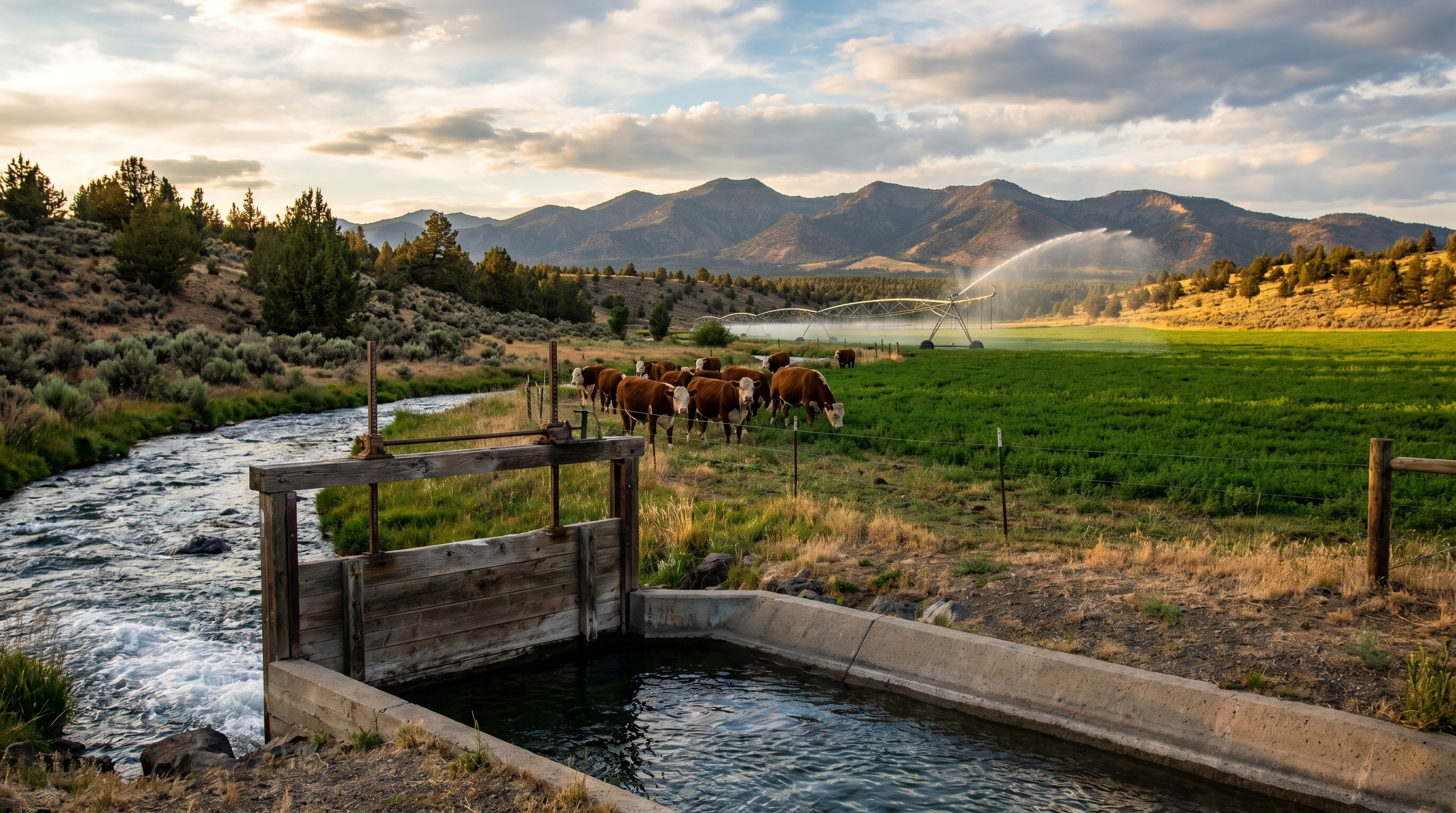
It took Crook County farmers and ranchers 35 years of lobbying before Congress finally authorized the Crooked River Project. Thirty-five years of petitions, delegations to Washington, D.C., and arguments about the economic future of the high desert before Bowman Dam was completed on the Crooked River in 1961 and the Prineville Reservoir began storing water for the Ochoco Irrigation District. The people who built this agricultural community understood, from the very beginning, that water in Central Oregon is not a given. It is something you fight for.
Today, that precariousness has a new dimension. Drought-forced irrigation curtailments across the Deschutes Basin, the Ochoco Irrigation District, and Idaho's Snake River Plain are creating farm losses that most standard farm policies simply do not cover. The question facing Central Oregon hay growers, cattle ranchers, and irrigated grain farmers is no longer just "do I have enough water?" — it is "what happens to my operation financially when the water stops, and does my insurance actually help?"
Prineville Insurance has been part of the Ochoco Irrigation District community since 1935 — 91 years of serving the farm and ranch families who depend on that water. This post is our attempt to give those families a clear, honest answer to the insurance question.
Eight Insurance Tools for Oregon's Irrigated Farm Operations
USDA PRF Insurance
Area-based rainfall index coverage for perennial pasture, rangeland, and forage. Pays automatically when NOAA precipitation data falls below your coverage threshold — no claim required.
Multi-Peril Crop Insurance (MPCI)
USDA crop insurance covering yield losses on insured crops from drought, flood, hail, and other perils. Available for hay, grain, and other crops grown under irrigation in Central Oregon.
Livestock Risk Protection (LRP)
USDA price-based coverage for cattle and other livestock. Protects against price declines — important when a curtailment forces early sale of cattle at unfavorable market prices.
Livestock Mortality Insurance
Covers death of cattle, horses, and other livestock from accident, disease, or natural causes. Critical when drought stress, poor forage quality, or heat events increase livestock mortality risk.
Farm & Ranch Property Coverage
Covers physical damage to irrigation equipment, pump systems, pivots, and infrastructure. Equipment breakdown coverage can be added for pump motors and irrigation system components.
Whole Farm Revenue Protection (WFRP)
USDA coverage that insures the total revenue of your entire farm operation — all commodities together. Provides a revenue safety net when multiple crops or livestock are affected simultaneously.
Farm Business Interruption
Covers lost income when a physical peril (fire, equipment breakdown, windstorm) interrupts farm operations. Note: does not cover curtailment losses — a physical trigger is required.
Agribusiness Liability
Covers bodily injury and property damage claims arising from farm and ranch operations. Important for operations that sell direct, host agritourism, or have employees working near irrigation infrastructure.
Is Your Farm Operation Protected Against Water Curtailment?
Prineville Insurance has served the Ochoco Irrigation District community for 91 years. We understand the specific risks facing Central Oregon irrigated farms — and we'll help you build a coverage program that addresses the gaps most standard policies leave open.
1. Oregon's Prior Appropriation System: First in Time, First in Right
Oregon's water law is built on the doctrine of prior appropriation — a system common throughout the arid West that allocates water rights based on the date they were first claimed. The oldest water rights have the highest priority. During times of limited supply, the Oregon Water Resources Department (OWRD) administers curtailments in strict priority order: junior rights (newer dates) are cut off first, while senior rights (older dates) continue to receive their full allocation.
In the Ochoco Irrigation District, priority dates range from 1869 to 1986 — a 117-year spread that creates enormous variation in curtailment risk across neighboring operations. A rancher with an 1880s priority date may receive full water delivery in a drought year while their neighbor with a 1960s date is cut to zero. This is not a malfunction of the system. It is the system working exactly as designed.
The Deschutes Basin Board of Control — which includes the Ochoco Irrigation District along with Arnold, Central Oregon, North Unit, Swalley, Three Sisters, and Tumalo irrigation districts — serves over 7,600 farms and ranches. In the summer of 2023, despite heavy spring rainfall, the majority of Deschutes and Crook counties remained in severe drought according to the U.S. Drought Monitor, and districts relying on live flow faced water shortages as early as mid-July. The snowpack that winter had not translated into meaningful snowmelt runoff. It was a preview of what curtailment looks like in practice.
2. The Ochoco Irrigation District: 110 Years of Fighting for Water
The Ochoco Irrigation District was organized in 1916, though plans to irrigate the Ochoco Valley date to 1905. Ochoco Dam was constructed from 1918 to 1921 using private funds — hydraulic fill methods, water cannons washing soil and rock debris into forms. The original plan called for 22,000 irrigated acres. Drought and the Great Depression forced the project to be refinanced and the irrigated acreage reduced to 8,500 acres. The dam was declared unsafe in 1947 and had to be rehabilitated by the Bureau of Reclamation.
In the 1950s, District Manager LaSelle Coles and local farmers began lobbying for the Crooked River Project — a dam on the Crooked River that would dramatically expand the district's water storage capacity. It took 35 years of sustained lobbying before Congress authorized the project. Bowman Dam was completed in 1961. The Prineville Reservoir, with a total capacity of 153,000 acre-feet, was turned over to the Ochoco Irrigation District in 1962. The district purchased 59,600 acre-feet of storage from the Bureau of Reclamation, allowing irrigated lands to expand to over 20,000 acres.
Today the Ochoco Irrigation District manages an average annual diversion of 80,000 acre-feet and serves 898 irrigators across approximately 20,062 acres. Principal crops are grain, hay, pasture, garlic, carrot seed, and mint. The district maintains 122 miles of canals and laterals and 8 pumping plants. This infrastructure — built over more than a century at enormous cost and effort — is the foundation of Crook County's agricultural economy. And it is increasingly vulnerable to drought.
3. What Standard Farm Insurance Covers — and What It Doesn't
This is the question that matters most, and the answer is not what most farmers want to hear: standard farm and ranch insurance does not cover income losses caused by irrigation curtailment.
A standard farm and ranch policy covers physical damage to your property — your home, barn, outbuildings, farm equipment, irrigation infrastructure, and livestock. If a fire destroys your hay barn, your farm policy pays to rebuild it. If a windstorm damages your center-pivot irrigation system, your farm policy pays to repair it. If lightning kills a registered bull, your livestock mortality coverage pays the insured value.
What a standard farm policy does not cover is the economic loss of a failed hay crop caused by a water shortage, the reduced weight gain of your cattle herd because you couldn't irrigate your pasture, or the cost of purchasing hay at drought-inflated prices because your own fields produced nothing. These are income losses, not physical losses — and they fall outside the scope of standard farm property coverage.
Farm business interruption insurance covers lost income when a physical peril interrupts operations — fire, windstorm, equipment breakdown. A water curtailment order from the Oregon Water Resources Department is a regulatory action, not a physical loss. It does not trigger business interruption coverage.
The coverage gap is real, it is significant, and it is the reason USDA crop insurance programs — particularly PRF — exist.
4. Coverage Comparison: What Each Tool Covers for Oregon Irrigated Farms
| Coverage Tool | Covers Curtailment Loss? | Covers Drought Loss? | Notes |
|---|---|---|---|
| Farm & Ranch Policy | No | No | Covers physical damage only |
| Business Interruption | No | No | Requires physical peril trigger |
| PRF Insurance | No | Partially | Pays on rainfall index, not irrigation water |
| MPCI (Crop Insurance) | Partially | Yes | Covers yield loss on insured crops |
| Whole Farm Revenue (WFRP) | Partially | Yes | Covers total farm revenue decline |
| Livestock Risk Protection | No | Indirectly | Covers price risk on forced early sales |
| Livestock Mortality | No | Indirectly | Covers death from drought-related stress |
| Emergency Loan (FSA) | Yes | Yes | USDA disaster loan, not insurance |
5. PRF Insurance: What It Pays and What It Doesn't
The USDA's Pasture, Rangeland, and Forage (PRF) insurance program is the most widely used risk management tool for Oregon ranchers with pasture and rangeland. Oregon is among the states where all eligible acres are enrolled. But many ranchers who carry PRF coverage do not fully understand what it pays — and more importantly, what it doesn't.
How PRF works: PRF is an area-based, rainfall-index policy. You choose at least two 2-month intervals when precipitation is most critical for forage growth on your operation. USDA's Risk Management Agency (RMA) uses NOAA Climate Prediction Center (CPC) data to calculate normal precipitation and deviations from normal for each grid area. If the interpolated precipitation for your grid falls below your coverage level (you can choose 70% to 90% of the expected index) during a covered interval, you receive a payment. Losses are calculated automatically — you do not need to file a claim or document individual losses.
The critical limitation: PRF pays based on precipitation data — not on irrigation water availability. If your irrigation allotment is curtailed during a year when precipitation in your grid area is normal or above normal, PRF will not pay. The program measures rainfall, not the water coming out of your headgate. This distinction is fundamental, and it is the source of enormous confusion among ranchers who assume their PRF coverage will respond to any water shortage.
There is also an area-basis risk: because PRF is area-based, your payment depends on what happened across your entire grid, not on your specific ranch. If your ranch received less rain than the grid average, you may not receive a payment even if your pasture was damaged. Conversely, you might receive a payment even if your specific ranch had adequate moisture.
PRF is a valuable tool, but it is not a substitute for understanding your specific water rights situation, your curtailment risk, and the other coverage tools available to you. Talk to your farm insurance agent about how to layer PRF with MPCI, Whole Farm Revenue Protection, and other USDA programs to build a more complete safety net.
6. The Snake River Plain: A Warning for the Deschutes Basin
In the summer of 2024, Idaho state water officials issued a curtailment order cutting off groundwater pumping to approximately 500,000 acres of farmland in southeastern Idaho — roughly a quarter of all irrigated land in the region. The trigger was a dispute between surface water users (senior rights holders drawing from the Snake River) and groundwater users (junior rights holders pumping from the Eastern Snake Plain Aquifer), whose pumping had been depleting the aquifer and reducing springflow into the river for decades.
For farmers who had already invested in seed and fertilizer, the curtailment was potentially catastrophic. One third-generation barley, wheat, and alfalfa farmer near Blackfoot described losses of at least $1,500 per acre across 2,700 acres — "the end of our farm, frankly." The curtailment was eventually paused after political intervention, but the underlying conflict between senior surface water rights and junior groundwater rights remains unresolved.
The Snake River Plain situation is not unique to Idaho. The same dynamic — declining aquifers, competing water rights, and the prior appropriation system's strict priority hierarchy — exists across the West, including in the Deschutes Basin. The Idaho curtailment is a preview of what large-scale water conflict looks like in practice. And the insurance lesson from Idaho is stark: most of those 500,000 curtailed acres had no coverage that responded to the loss. Standard farm policies didn't pay. Business interruption didn't pay. PRF didn't pay because precipitation was normal. The only financial tools that helped were USDA emergency loans and whatever MPCI coverage individual farmers had on their specific crops.
Know Your Water Rights. Know Your Coverage Gaps.
Prineville Insurance has served Ochoco Irrigation District farm families for 91 years. We'll review your current farm coverage, help you understand your water rights curtailment risk, and identify the USDA crop insurance tools that can fill the gaps your standard policy leaves open.
7. MPCI and Whole Farm Revenue Protection: The Crop Insurance Tools That Can Help
Multi-Peril Crop Insurance (MPCI) is the USDA program that most closely addresses yield losses from drought and water shortage. Unlike PRF, MPCI is based on your individual farm's actual yield — if your insured crop produces less than your coverage level due to drought, water shortage, or other covered perils, MPCI pays an indemnity. Coverage levels range from 50% to 85% of your Actual Production History (APH) yield.
For Central Oregon hay growers, MPCI is available for alfalfa hay, grass hay, and other forage crops. For grain farmers, it covers wheat, barley, and other irrigated crops. The key requirement is that the loss must be caused by a covered peril — drought and failure of the irrigation water supply are both covered perils under MPCI. This means that if your irrigation allotment is curtailed and your hay yield falls below your coverage level, MPCI can pay — unlike PRF, which only responds to the rainfall index.
Whole Farm Revenue Protection (WFRP) takes a different approach: instead of insuring individual crops, it insures the total revenue of your entire farm operation. If your total farm revenue falls below your coverage level due to any combination of covered losses — drought, curtailment, price declines, or other perils — WFRP pays an indemnity. This is particularly valuable for diversified operations that grow multiple crops or combine crop and livestock production.
Both MPCI and WFRP have sales closing deadlines that vary by crop and county. In Oregon, most spring-planted crop deadlines fall in March and April. Missing the sales closing deadline means waiting another year. If you are not currently enrolled in MPCI or WFRP, the time to act is before the next drought season — not during it.
8. What Central Oregon Irrigators Should Do Right Now
The Deschutes Basin Board of Control has been clear: the frequency and intensity of drought events pose extraordinary difficulties for farmers, fish, wildlife, and community members. The districts are investing in canal piping and water conservation infrastructure, but those projects take years to complete. In the meantime, the risk of curtailment is real and growing.
Here is what irrigated farm operations in Central Oregon and Eastern Oregon should do to assess and address their risk:
Irrigation Risk & Insurance Checklist for Oregon Farm Operations
- Know your water right priority date — it determines your curtailment risk relative to your neighbors
- Contact your irrigation district to understand the current storage levels and curtailment protocols
- Review your PRF policy intervals — make sure they align with your critical forage growth periods
- Understand the PRF rainfall index limitation — it does not respond to irrigation curtailment
- Enroll in MPCI for your insured crops before the sales closing deadline (typically March–April in Oregon)
- Consider Whole Farm Revenue Protection if you operate a diversified farm with multiple crops or livestock
- Add equipment breakdown coverage to your farm policy for pump motors and irrigation system components
- Ensure your livestock mortality coverage is adequate — drought stress increases livestock death risk
- Ask your agent about Livestock Risk Protection (LRP) to hedge against forced early cattle sales at low prices
- Review your farm policy's irrigation equipment coverage — pivots, pumps, and headgates are expensive to replace
9. Diversification, Agritourism, and the Insurance Implications
One response to irrigation uncertainty that many Central Oregon farm families are exploring is diversification — adding direct-to-consumer sales, farm stays, u-pick operations, or other agritourism activities that generate revenue independent of irrigated crop yields. These activities can provide meaningful income in drought years when crop revenue falls short.
But diversification brings new insurance considerations. A standard farm and ranch policy typically does not cover liability arising from agritourism activities — hosting visitors on your farm for u-pick, farm stays, or educational events requires a specific agritourism insurance endorsement or standalone policy. If a visitor is injured on your property during a farm tour or u-pick event, your standard farm liability may not respond.
Similarly, if you add a farm stand, a CSA operation, or direct sales of farm products, you may need a commercial general liability policy in addition to your farm policy. The line between "farm activity" and "commercial activity" matters enormously for insurance purposes. Talk to your agent before you open your gates to paying visitors.
Frequently Asked Questions: Irrigation, Water Rights, and Farm Insurance in Oregon
Related Insurance Resources
91 Years Serving the Ochoco Irrigation District Community
Prineville Insurance has been part of this agricultural community since 1935 — longer than most of the irrigation infrastructure itself. We understand the water rights system, the curtailment risks, and the insurance tools available to Central Oregon farm families. Let us help you build a coverage program that actually protects your operation when the water stops.