



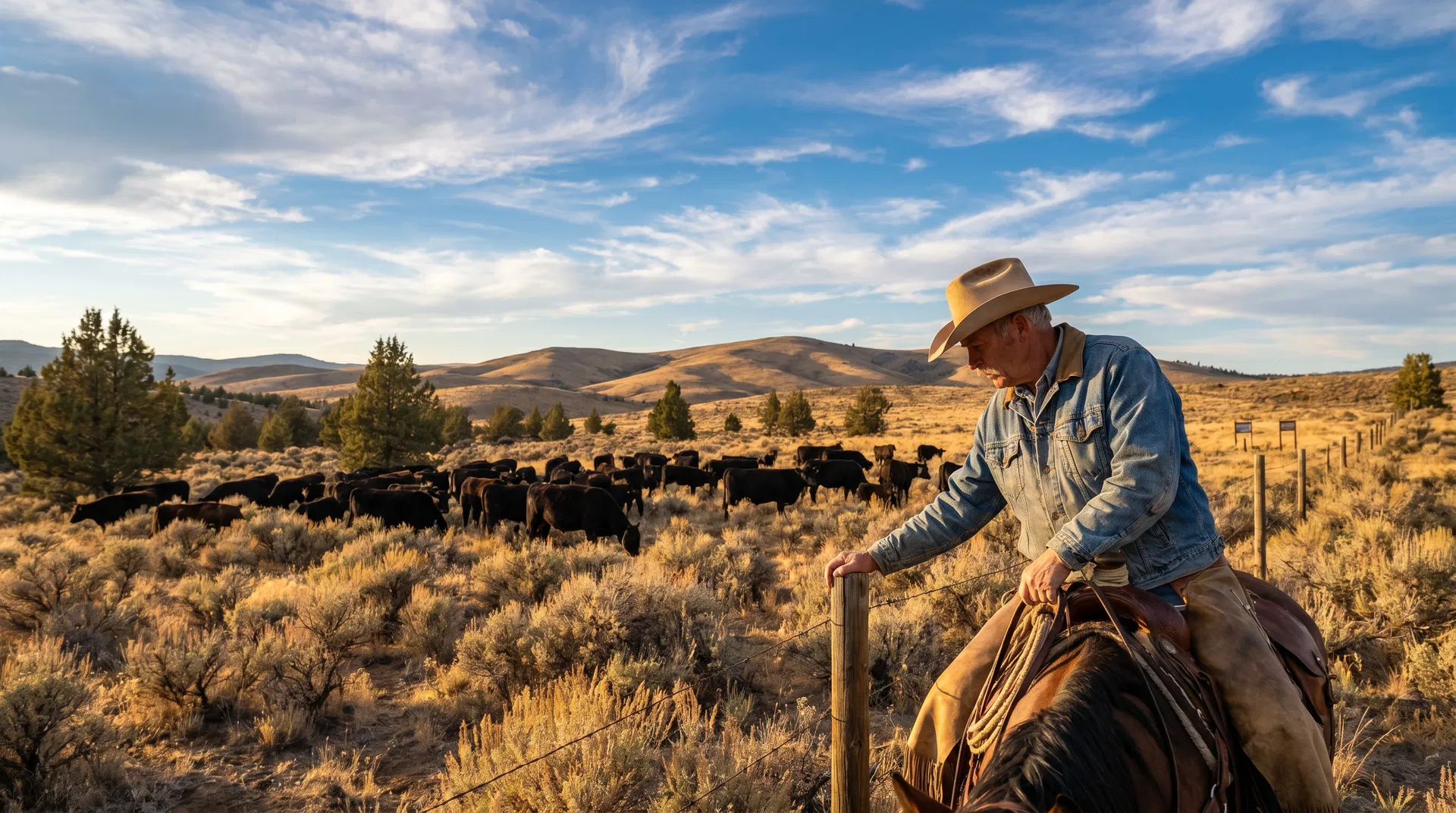

In Crook, Jefferson, Wheeler, and Lake counties, grazing leases are as common as irrigation ditches. A landowner with 500 acres of high desert pasture leases grazing rights to a neighboring cattle operation for the summer. A rancher holds a BLM allotment permit that covers thousands of acres of federal land adjacent to his deeded ground. A retired couple lets a family friend run a small cow-calf pair on their property in exchange for fence maintenance. These arrangements are the fabric of Central Oregon's agricultural economy — and almost none of them are properly insured.
The question of who is liable when something goes wrong on leased grazing land is not simple. Oregon's open range law, the terms of BLM grazing permits, the language of farm insurance policies, and the presence or absence of a written lease all interact in ways that can leave both landowners and grazing tenants with no coverage when they need it most. This guide explains the law, the coverage gaps, and what a properly structured grazing lease and farm insurance program should look like.
Is Your Grazing Operation Properly Insured?
Most Central Oregon ranchers and landowners discover grazing lease coverage gaps only after a loss. A free farm and ranch insurance review can identify every location gap, missing endorsement, and permit requirement before a claim occurs.
Get a Free Farm & Ranch Insurance ReviewOregon's Open Range Law: What It Actually Means
Oregon is an open range state in most of its rural counties. Under ORS 608.015, "open range" means an area where livestock may lawfully be permitted to run at large. In open range territory, the default rule is that livestock owners are not automatically liable if their cattle wander onto a neighbor's land — unless the neighbor's land was enclosed by an "adequate fence," judged by the customs and practices of good husbandry in that particular area.
This is the opposite of the rule in many eastern states, where livestock owners are strictly liable for any damage their animals cause. In Central Oregon's open range counties — Crook, Jefferson, Wheeler, Lake, and Harney — a landowner who wants to keep cattle out of their hay field is responsible for building and maintaining an adequate fence. If the fence is inadequate and cattle wander in and eat the hay, the cattle owner may not be liable.
However, open range does not mean no liability. ORS 607.044 governs livestock districts — areas of closed range formed under ORS 607 with a minimum of 2,000 acres. In livestock districts, a person who permits livestock to run at large is liable to the owner or possessor of land for damage caused. Parts of Deschutes County and some incorporated areas operate under livestock district rules. And even in open range areas, negligence can be argued: if a livestock owner knew a fence was broken and failed to repair it, or if cattle escaped onto a state highway and caused a vehicle collision, liability can attach regardless of the open range doctrine.
The Insured Location Problem
The most important insurance concept for grazing lease operations is the definition of "insured locations" in a farm policy. Standard farm and ranch insurance policies cover liability at specifically defined locations — typically the insured's owned land and any leased or rented premises that are specifically scheduled on the policy. A BLM grazing allotment, a private grazing lease, or a neighbor's pasture where you run cattle is not automatically an insured location.
If your cattle are involved in a liability incident at a location that is not listed on your policy — a visitor injured while checking on your cattle at a leased pasture, a vehicle collision after cattle escape from a BLM allotment, a neighboring landowner's crop damaged by your cattle — your farm liability coverage may not respond. The insurer will point to the policy's insured location definition and deny the claim.
The solution is straightforward but requires action: every location where your cattle operate must be reviewed with your agent and, if necessary, added to your policy as an insured location. This includes BLM allotments, Forest Service grazing permits, private grazing leases, and any other land you do not own but where your livestock are present. Review your farm policy's declarations page today and confirm that every operating location is listed.
BLM and Forest Service Grazing Permits: The Insurance Requirements Nobody Reads
BLM grazing permits are issued under 43 CFR Part 4100 for 10-year renewable terms. The permit authorizes grazing on a specific allotment under specific terms and conditions. Many ranchers in Central Oregon have held their BLM allotment permits for decades and have never read the terms and conditions carefully — including the insurance provisions.
While standard BLM grazing permits do not universally require liability insurance, many allotment-specific terms and conditions do include insurance requirements. Forest Service grazing permits commonly require a minimum of $1 million in liability coverage with the United States Forest Service named as an additional insured. BLM special recreation permits require liability insurance naming the US Government. If your permit requires insurance and you fail to maintain it, you are in violation of your permit terms — which can jeopardize renewal.
Pull out your BLM or Forest Service grazing permit and read the terms and conditions section. If it requires liability insurance, confirm that your farm policy meets the minimum limit, that the relevant federal agency is named as an additional insured, and that you have a current certificate of insurance on file with the agency. If you are not sure whether your permit requires insurance, contact the Prineville BLM Field Office or the Ochoco National Forest directly.
The Landowner's Side: Why Your Homeowners Policy Is Not Enough
If you own land in Central Oregon and lease grazing rights to a cattle operation — even informally, even for a small annual payment or in-kind consideration — your standard homeowners policy almost certainly does not cover you. A typical homeowners policy excludes commercial farming activities on the property. The moment cattle belonging to someone else are grazing your land under any kind of arrangement, you have a commercial farming exposure that falls outside homeowners coverage.
Landowners who receive grazing lease income need a farm liability policy or, at minimum, a farm landlord endorsement on their existing policy. This is true even if the grazing tenant carries their own farm liability insurance and names you as an additional insured. Additional insured status on someone else's policy covers liability arising from the tenant's operations — it does not cover liability arising from conditions of your land that you control as the landowner. A visitor injured by a hazard on your property (a broken gate, a collapsed corral, a hidden hole in the pasture) is a premises liability claim against you, not the grazing tenant.
Review your current coverage with an agent who understands farm and ranch insurance. If you are a landowner receiving any income from grazing leases, confirm that your policy covers commercial farming activities on your property and that your liability limits are adequate for the exposure.
The 8 Most Common Grazing Lease Insurance Gaps in Central Oregon
Leased Grazing Ground Not Scheduled as an Insured Location
This is the most common and most expensive gap. Standard farm policies cover liability at 'insured locations' — your owned land and specifically scheduled leased premises. If your cattle are running on a BLM allotment, a private grazing lease, or a neighbor's pasture that is not listed on your policy, a liability incident at that location may not be covered. Every location where your cattle operate must be reviewed with your agent and, if necessary, added to your policy.
Landowner Has Only a Homeowners Policy
A standard homeowners policy excludes commercial farming activities on the property. If you own land and lease grazing rights to a cattle operation, your homeowners policy will not cover liability arising from those grazing activities. Landowners who receive any income from grazing leases — even a small annual payment — need a farm liability policy or a farm landlord endorsement. This is one of the most overlooked gaps in rural Central Oregon.
No Additional Insured Endorsement for the Landowner
When a rancher brings cattle onto a landowner's property under a grazing lease, the landowner should be named as an additional insured on the rancher's farm liability policy. Without this endorsement, if a third party is injured by the cattle on the landowner's property and sues both the rancher and the landowner, the landowner has no protection from the rancher's policy. The additional insured endorsement must be specifically requested and added — it is not automatic.
BLM or Forest Service Permit Insurance Requirements Not Met
Many BLM and Forest Service grazing permits include specific insurance requirements in the permit's terms and conditions — requiring the permittee to carry a minimum liability limit and name the federal agency as an additional insured. Many permittees are unaware of these requirements, and many standard farm policies do not automatically satisfy them. Failure to meet permit insurance requirements can jeopardize your permit at renewal. Review your permit terms carefully and provide the required certificate of insurance to the agency.
Handshake Grazing Agreements With No Written Lease
In Central Oregon, handshake grazing agreements are common — a neighbor's cattle graze your pasture for a season, or you run your cattle on a relative's land without a formal lease. Without a written lease, there is no indemnification clause, no insurance requirement, no clarity on who is responsible for what, and no documentation if a dispute arises. A handshake agreement also makes it harder to establish that the grazing tenant's policy should cover a loss, since there is no written record of the arrangement.
Structures and Improvements on Leased Land
Grazing leases often involve structures on the leased land — water troughs, corrals, loading chutes, fencing, hay storage, and sometimes small shelters. A written lease should specify which party is responsible for insuring each structure. If the landowner's policy does not cover structures used primarily by the grazing tenant, and the tenant's policy does not schedule those structures, a fire or collapse leaves both parties arguing over who should have covered it.
Escaped Livestock on Public Roads
Under ORS 607.044, in livestock districts (closed range), a livestock owner who permits animals to run at large is liable for damages. Even in open range areas, a vehicle collision involving escaped cattle will likely result in a liability claim. Your farm liability policy should cover this — but only if the location where the cattle escaped is an insured location on your policy. If your cattle escaped from a leased pasture that is not scheduled on your policy, coverage may be denied.
Lapsed Insurance Notification to Landowner
If a grazing tenant's farm liability policy lapses — due to nonpayment, carrier non-renewal, or policy cancellation — and the landowner is not notified, the landowner may believe they are protected as an additional insured when they are not. A well-drafted grazing lease should require the tenant to notify the landowner immediately if coverage lapses, and should give the landowner the right to terminate the lease or purchase replacement coverage at the tenant's expense.
Review Your Grazing Lease Insurance Program
Prineville Insurance specializes in farm and ranch insurance for Central Oregon operations — including BLM allotment permittees, private grazing lease arrangements, and landowners who lease grazing rights. Call us at (541) 447-6372 to review your insured locations, permit requirements, and lease documentation.
Call (541) 447-6372What a Proper Written Grazing Lease Should Say About Insurance
A handshake grazing agreement is an insurance disaster waiting to happen. Without a written lease, there is no indemnification clause, no insurance requirement, no clarity on which party is responsible for which categories of loss, and no documentation to support a coverage claim if a dispute arises. Every grazing arrangement — regardless of how informal or how long-standing — should be documented in a written lease that includes the following insurance provisions:
| Lease Provision | Why It Matters | Who Benefits |
|---|---|---|
| Minimum liability limit (e.g., $1M per occurrence) | Sets a floor for the tenant's coverage that is adequate for the exposure | Landowner |
| Landowner named as additional insured on tenant's policy | Protects landowner from claims arising from tenant's cattle operations | Landowner |
| Certificate of insurance required before grazing begins | Confirms coverage is in place before cattle arrive | Both parties |
| Tenant must maintain coverage throughout lease term | Prevents gaps in coverage during the grazing season | Landowner |
| Immediate notice if coverage lapses | Allows landowner to act before an uninsured incident occurs | Landowner |
| Mutual indemnification clause | Clarifies which party is responsible for which categories of loss | Both parties |
| Specification of which party insures structures | Prevents disputes over corrals, water troughs, fencing | Both parties |
| Right to terminate if insurance lapses | Gives landowner a remedy if tenant fails to maintain coverage | Landowner |
A written grazing lease does not need to be a complex legal document. A one-page agreement that covers the parties, the land, the grazing season, the consideration, and the insurance provisions above is far better than nothing. For more complex arrangements — multi-year leases, BLM base property leases, leases involving significant improvements — consult an Oregon agricultural attorney.
Crop Share and Cash Rent Arrangements: Different Risks
Not all grazing lease arrangements are the same. A pure grazing lease — where the tenant pays a per-head or per-acre fee and provides all labor and management — is the simplest from an insurance standpoint. The tenant's farm liability policy covers the cattle operation; the landowner needs farm liability coverage for premises liability.
Crop share arrangements, where the landowner receives a portion of the livestock or crop yield, create a more complex insurance picture. When a landowner receives a share of the cattle or crop, they may be treated as a co-owner of the livestock operation for insurance purposes — which means they need farm liability coverage that reflects their role, not just a passive landlord endorsement. If you are in a crop share or livestock share arrangement, review your coverage with an agent who understands the distinction.
Agritourism and Grazing Leases: A Special Combination
Some Central Oregon landowners combine grazing leases with agritourism activities — allowing the public to visit the property for hunting, fishing, hiking, or farm experiences while cattle are grazing. This combination creates a significant liability exposure that neither a standard homeowners policy nor a basic farm liability policy may adequately cover. Visitors on your property while cattle are present create animal-related liability risks that require specific coverage. If you have any public access to your property, review your coverage with an agent who specializes in farm and ranch insurance in Oregon.
The Umbrella Policy Question
Farm liability policies typically provide $1 million per occurrence in liability coverage. For most small grazing operations, this is adequate. But for larger operations — ranchers running hundreds of head on multiple BLM allotments and private leases, or landowners with significant public exposure — a commercial umbrella policy provides an additional layer of protection above the farm liability limit. A $1 million umbrella over a $1 million farm liability policy costs relatively little and provides significant additional protection against catastrophic liability claims.
If you have employees — including seasonal workers, part-time help, or family members who are paid for ranch work — confirm that your workers' compensation coverage extends to all workers at all locations where they operate, including leased grazing land. Workers' compensation is required for all Oregon employers with one or more employees, and a worker injured at a BLM allotment or leased pasture is covered by the same rules as a worker injured on your deeded land.
Central Oregon's Grazing Lease Landscape
Crook County alone encompasses approximately 1.1 million acres, with a significant portion managed by the BLM's Prineville District. Jefferson County borders the Warm Springs Reservation and includes substantial BLM and private grazing leases. Wheeler County is among the most rural counties in Oregon, with large BLM allotments and very few livestock districts. Lake County — the largest county in Oregon by area — is almost entirely open range.
Many Central Oregon ranches operate on a combination of deeded land, private grazing leases, and BLM allotments. A typical operation might own 500 acres of deeded ground, lease grazing rights on an additional 1,000 acres of private land, and hold a BLM permit covering 5,000 acres of federal rangeland. Each of those three components requires separate attention in the insurance program — and most operations have reviewed only the deeded ground. If your operation includes leased or permitted land, contact Prineville Insurance for a comprehensive review of your insured locations.
Frequently Asked Questions
Don't Let a Handshake Agreement Leave You Uninsured
Prineville Insurance has served Central Oregon's agricultural community for decades. We understand BLM allotment permits, private grazing leases, and the coverage gaps that standard farm policies miss. A free review of your grazing lease insurance program takes 30 minutes and can prevent a coverage denial when you need it most.
Get a Free Grazing Lease Insurance Review

