

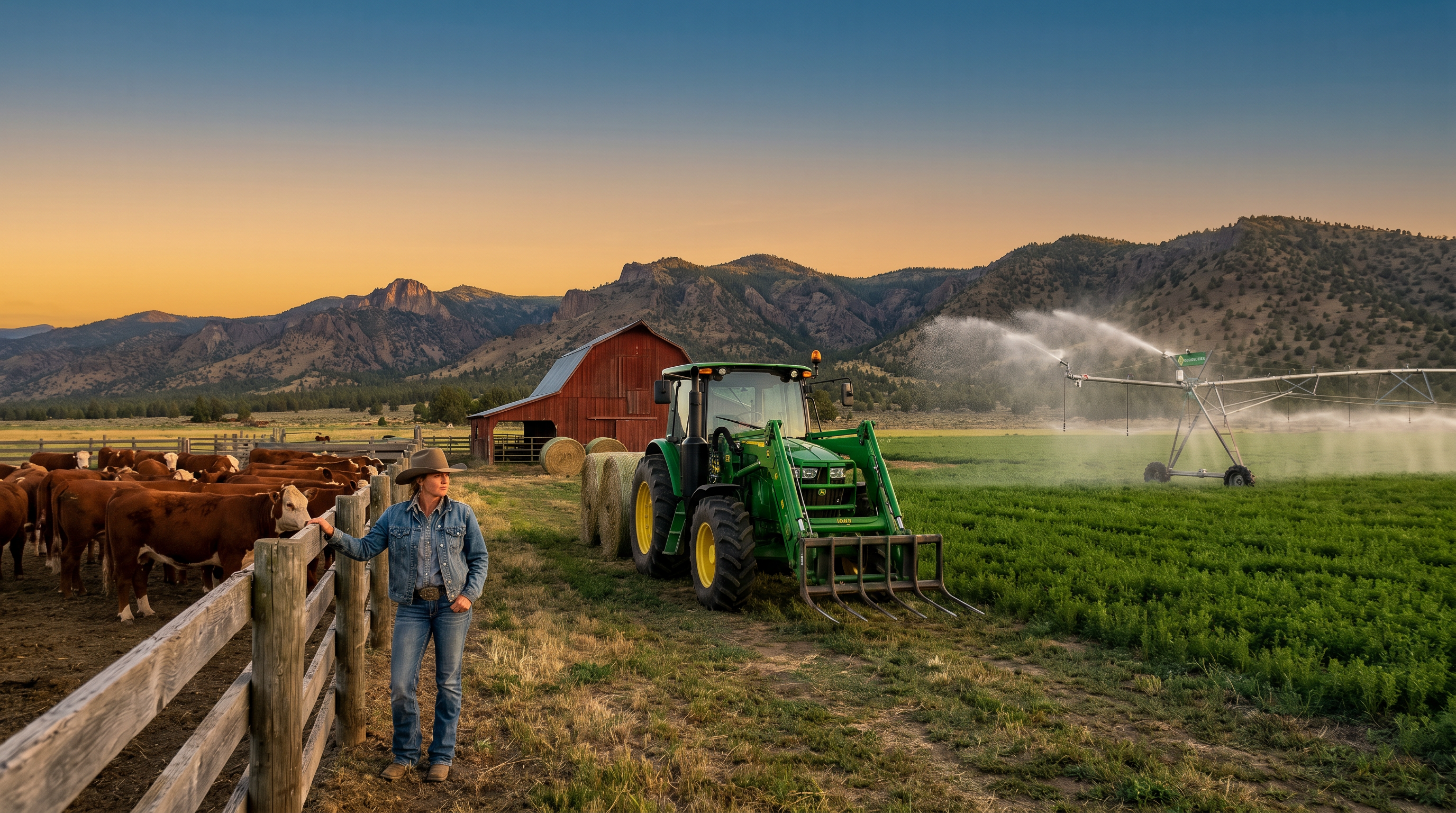
Crook County is cattle country. The 2022 USDA Agricultural Census counted 609 farms across 832,845 acres in Crook County — an average of 1,368 acres per operation. Of the $53.4 million in agricultural products sold that year, 63% came from livestock, poultry, and products. There are 47,878 cattle and calves on Crook County ranches, 2,068 horses and ponies, and 42,784 acres of forage — hay and haylage — making it the county's dominant crop by a wide margin. Jefferson County adds another layer: mint, wheat, and potato operations alongside cattle ranches that graze BLM allotments stretching into the high desert.
These are not hobby farms. They are commercial operations with equipment inventories worth hundreds of thousands of dollars, livestock representing years of breeding investment, and liability exposures that a standard homeowners or commercial property policy was never designed to address. Yet many ranchers in Crook and Jefferson Counties are running their operations on insurance programs that were designed for someone with a house in the suburbs — and they don't find out until a claim hits.
This guide walks through the eight layers of a complete commercial ranch insurance program — what each layer covers, what it doesn't, and why the gaps between layers are where ranchers lose the most money. Prineville Insurance has been serving the agricultural community in Crook County since 1935. We've seen every kind of claim, and we know exactly where the standard programs fall short.
The Eight Layers of a Complete Ranch Insurance Program
Farm Package Policy
The foundation: covers farm dwellings, outbuildings, barns, farm personal property (equipment and livestock), and general farm liability. The starting point for every ranch program.
Equipment Breakdown
Covers internal mechanical and electrical failures — motor burnout, short circuits, pressure vessel explosions — that standard farm property explicitly excludes. Critical for center-pivot irrigators and grain dryers.
Equipment Floater
Covers mobile equipment at remote pastures, BLM grazing allotments, in transit, and at temporary locations. Fills the geographic gap in your farm property policy.
Livestock Mortality
Covers death of high-value breeding stock, registered cattle, and horses at full insured value — far beyond the blanket livestock limits in a standard farm package.
Crop & Hay Insurance
MPCI (Multi-Peril Crop Insurance) and PRF (Pasture, Rangeland, and Forage) policies through USDA RMA. Covers hay, grain, and forage losses from drought, hail, and other perils.
Agritourism Liability
Covers bodily injury and property damage claims from paying visitors — farm stands, U-pick, hayrides, farm tours, educational programs. Standard farm liability often excludes paying visitors.
Workers' Compensation
Required for any ranch employee in Oregon. Covers medical expenses and lost wages for work-related injuries. Voluntary coverage available for family members working on the ranch.
Commercial Umbrella
Excess liability coverage of $1M to $5M above your farm package and auto policies. Essential for any operation with employees, public visitors, or significant livestock and equipment values.
Is Your Ranch Insurance Program Built for a Working Ranch?
Prineville Insurance has served Central Oregon's agricultural community since 1935. We work with multiple farm and ranch carriers to build layered programs that cover your livestock, equipment, and liability — not just your house and barn.
1. The Farm Package Policy: Your Foundation — and Its Limits
Every ranch insurance program starts with a farm package policy. This is the workhorse of agricultural insurance — it covers your farm dwelling and personal property, your outbuildings and barns, your farm structures, your farm personal property (equipment and livestock), and your general farm liability. For most operations, it also includes some coverage for farm income loss and medical payments.
The farm package is essential, but it has three critical limitations that every rancher should understand. First, it covers equipment at your scheduled farm location — equipment at remote pastures, BLM grazing allotments, or in transit between properties may not be covered. Second, it covers equipment for external physical damage (fire, lightning, theft, collision) but explicitly excludes internal mechanical and electrical breakdown — motor burnout, short circuits, and mechanical failure are not covered. Third, it covers livestock at actual cash value up to a blanket limit — typically $10,000 to $50,000 — which is rarely adequate for operations with high-value breeding stock or registered cattle.
These three gaps — geographic, mechanical, and value — are where most ranch insurance claims fall short. The layers that follow are specifically designed to fill them.
2. Equipment Breakdown: The Coverage Your Farm Policy Explicitly Excludes
Equipment breakdown coverage is one of the most misunderstood and underutilized coverages in agricultural insurance. It covers the failure of equipment from internal causes — motor burnout, electrical arcing, short circuits, mechanical breakdown, and pressure vessel explosions. These are exactly the failures that your farm property policy excludes by name.
For Crook County ranchers, the most critical application is center-pivot irrigation systems. The Ochoco Irrigation District serves 898 irrigators across 20,062 acres, and center-pivot systems are the dominant delivery method for much of that acreage. A center-pivot motor failure — one of the most common equipment failures on irrigated farms — is not covered by your farm property policy. A motor replacement can run $5,000 to $20,000. A full pivot replacement can cost $80,000 to $150,000. Equipment breakdown coverage pays for these internal failures, and it also covers the secondary losses: spoiled stored hay, lost production during downtime, and expedited expenses for rental equipment while yours is being repaired.
Equipment breakdown also covers grain dryers, feed augers, refrigeration compressors, and any other powered or pressurized system on your operation. The annual premium is typically $500 to $2,000 depending on the value of your equipment — a fraction of the cost of a single motor failure. This coverage is almost always available as an endorsement to your existing farm package, not a separate policy.
3. Equipment Floater: Covering Your Equipment Wherever It Goes
Your farm property policy covers equipment at your scheduled farm location. The moment that equipment leaves your property — to a remote grazing allotment, to a neighbor's field for custom work, to a BLM lease, or in transit on a flatbed trailer — the coverage becomes uncertain at best and absent at worst. An equipment floater fills this geographic gap.
For Crook and Jefferson County ranchers who graze cattle on BLM allotments in the Ochoco National Forest or on leased rangeland in the high desert, equipment floater coverage is not optional — it's essential. A tractor or loader that breaks down or is damaged at a remote allotment 40 miles from your home ranch is just as expensive to repair as one that breaks down in your barnyard. The floater covers it regardless of location.
Equipment floaters also typically cover borrowed and rented equipment that you are responsible for. If you rent a skid steer for a week to clean out your corrals and it's damaged while in your care, your farm property policy probably won't cover it. The floater will. Talk to your farm and ranch insurance agent about the difference between a scheduled floater (specific equipment listed by serial number) and a blanket floater (all mobile equipment up to a per-item limit) — for most ranch operations, a blanket floater is more practical.
4. What Does a Complete Ranch Insurance Program Cost in Oregon?
Costs vary significantly based on operation size, livestock values, equipment inventory, employee count, and whether agritourism activities are included. Here are typical annual cost ranges for Central Oregon ranch operations:
| Coverage Layer | What It Covers | Typical Annual Cost |
|---|---|---|
| Farm Package Policy | Structures, equipment, livestock (ACV), farm liability | $3,000–$8,000 |
| Equipment Breakdown | Motor burnout, electrical failure, mechanical breakdown | $500–$2,000 |
| Equipment Floater | Mobile equipment at remote locations, in transit, borrowed/rented | $800–$3,000 |
| Livestock Mortality | Full insured value for high-value breeding stock and registered cattle | 2–4% of insured value/year |
| Crop / PRF Insurance | Hay, grain, forage losses; PRF for pastureland rainfall index | Varies by acreage and coverage level |
| Agritourism Liability | Paying visitors, farm stands, U-pick, farm tours, hayrides | $500–$2,500 |
| Workers' Compensation | Employee medical and lost wages for work-related injuries | $2,000–$8,000+ (payroll-based) |
| Commercial Umbrella | Excess liability $1M–$5M above farm package and auto | $800–$2,500 |
5. Livestock Mortality: Full Value for Your Best Animals
The 2022 USDA Census counted 32,199 cattle and calves sold from Crook County operations — a $32.2 million market. Within that herd, the most financially significant animals are the breeding stock: registered bulls, purebred cows, and high-value replacement heifers. A single registered Angus bull can be worth $5,000 to $50,000 or more. Losing that animal to lightning, disease, a fence accident, or a predator encounter without adequate coverage is a serious financial blow.
Standard farm package policies cover livestock as farm personal property at actual cash value, subject to a blanket limit. That blanket limit — often $10,000 to $50,000 for the entire herd — is rarely adequate for operations with high-value breeding stock. Livestock mortality insurance covers individual animals at their full insured value, with premiums typically running 2% to 4% of insured value per year.
Central Oregon's climate creates specific livestock mortality risks that are worth discussing with your agent: lightning strikes during summer thunderstorms, wildfire smoke stress, predator encounters on remote grazing allotments, and cold-snap losses in early spring. Ask specifically about coverage for death caused by wildfire and smoke inhalation — as wildfire risk in Central Oregon continues to increase, this is a growing exposure for livestock operations.
6. Agritourism Liability: When Your Ranch Becomes a Destination
Central Oregon's ranching community has increasingly diversified into agritourism — farm stands, U-pick operations, farm tours, hunting and fishing access, educational programs, and ranch-based events. Jefferson County's proximity to Bend and the growing Central Oregon tourism economy makes agritourism a natural revenue supplement for many operations. But agritourism creates a liability exposure that standard farm policies were not designed to cover.
Oregon's Agritourism Inherent Risk Law (ORS 30.671–30.677) provides some protection for agritourism professionals when proper warning signs are posted at each entrance and activity site. The required sign language is specific: "WARNING: Under Oregon law, an agri-tourism professional is not liable for an injury to or the death of a participant in an agri-tourism activity if the injury or death results from the inherent risks of the agri-tourism activity." But this statute does not protect against gross negligence, willful misconduct, or defective equipment — and it does not pay your legal defense costs if you are sued.
More critically, standard farm liability policies often exclude paying visitors. If someone pays to pick berries, attend a farm tour, or participate in a hayride, they may not be covered under your standard farm liability. An agritourism liability endorsement or separate agritourism insurance policy specifically covers paying visitors and organized farm activities — and it must be disclosed to your insurer before you open your gates to the public.
Talk to a Central Oregon Agricultural Insurance Specialist
Prineville Insurance has served the agricultural community in Crook and Jefferson Counties since 1935. We work with multiple farm and ranch carriers to build layered programs that actually cover your operation — not just your house and barn.
7. Workers' Compensation: Oregon's Requirements for Ranch Employers
Oregon requires workers' compensation coverage for all employees, including agricultural workers. Ranch work is among the most physically demanding and injury-prone occupations in the state — equipment accidents, livestock handling injuries, falls from heights, and heat-related illness are all common claims. The Oregon Workers' Benefit Fund sets the rates, and premiums are calculated based on payroll and job classification.
The independent contractor question is a significant issue in agricultural operations. Oregon's test for independent contractor status is strict — a worker who does not meet all elements of the statutory test is considered an employee, and the ranch operator is liable for workers' comp coverage, payroll taxes, and potential penalties. Custom harvesters, seasonal hay crews, and fence contractors who work regularly for your operation may not qualify as independent contractors under Oregon law, regardless of how you've structured the relationship.
Voluntary workers' compensation is also available for family members working on the ranch — including spouses and children — who are not automatically covered under the mandatory program. Given the injury risks of ranch work, voluntary coverage for family members is worth the relatively modest additional premium.
8. Commercial Umbrella: The Capstone of Your Ranch Program
A commercial umbrella policy provides excess liability coverage above the limits of your farm package, commercial auto, and workers' compensation policies. For a working ranch with employees, equipment, livestock, and public visitors, the standard farm liability limit of $300,000 to $1,000,000 can be exhausted by a single serious injury claim — a worker injured in a tractor rollover, a visitor injured by livestock, or a vehicle accident involving a ranch truck on a public road.
A commercial umbrella policy of $1 million to $5 million adds a critical layer of protection at a relatively modest cost — typically $800 to $2,500 per year for a $1 million umbrella on a ranch operation. Given that a single serious injury lawsuit can easily exceed $1 million in damages, legal fees, and settlement costs, the umbrella is the most cost-effective coverage in the entire ranch program.
For operations that have added agritourism activities, the umbrella is especially important. Paying visitors who are injured on your property are more likely to pursue legal action than neighbors or family members, and the damages in agritourism injury cases can be substantial. Make sure your umbrella policy specifically covers your agritourism activities — some umbrella policies exclude commercial activities that are not listed in the underlying farm package.
Ranch Insurance Program Checklist for Central Oregon Operations
- Review your farm package livestock limits — blanket limits rarely cover the value of your breeding stock
- Add equipment breakdown coverage for your center-pivot, grain dryer, and other powered systems
- Get an equipment floater for any equipment that leaves your home ranch property
- Insure high-value bulls and registered breeding stock under a livestock mortality policy
- Disclose all agritourism activities to your insurer before opening your gates to paying visitors
- Verify your workers' comp classification for all seasonal and custom work crews
- Review your farm liability limits — $300,000 is rarely adequate for a commercial ranch operation
- Add a commercial umbrella of at least $1 million above your farm package and auto policies
- Check your PRF enrollment and coverage levels before the March 15 sales closing date
- Schedule an annual policy review as equipment values, livestock inventory, and operations change
9. Why 91 Years in Crook County Makes a Difference
Prineville Insurance has been part of the Ochoco Irrigation District community since 1935. We've written farm and ranch policies through drought years and wet years, through the Crooked River Project lobbying campaign that took 35 years to succeed, through the wildfire seasons that have reshaped Central Oregon's risk landscape, and through the agricultural transitions that have changed how ranches operate.
That history matters when you're building a ranch insurance program. We know that a Crook County hay operation has different exposures than a Jefferson County mint farm. We know that BLM grazing allotments in the Ochoco National Forest create equipment and livestock exposures that a standard farm policy doesn't address. We know that the western lifestyle community in Central Oregon has specific coverage needs that generic agricultural programs miss.
We also know that the best ranch insurance program is one that gets reviewed every year — because your operation changes, your equipment values change, your livestock inventory changes, and the insurance market changes. An annual review with an agent who understands your operation is the single most important thing you can do to make sure your program keeps pace with your ranch.
Frequently Asked Questions: Ranch Insurance in Central Oregon
Related Insurance Resources
Your Ranch Is a Business. Your Insurance Program Should Be Too.
609 farms. 832,845 acres. 47,878 cattle. This is Crook County agriculture — and it deserves an insurance program built for a working ranch, not a suburban homeowner. Prineville Insurance has been building ranch programs in Central Oregon since 1935. Let us build one for you.