



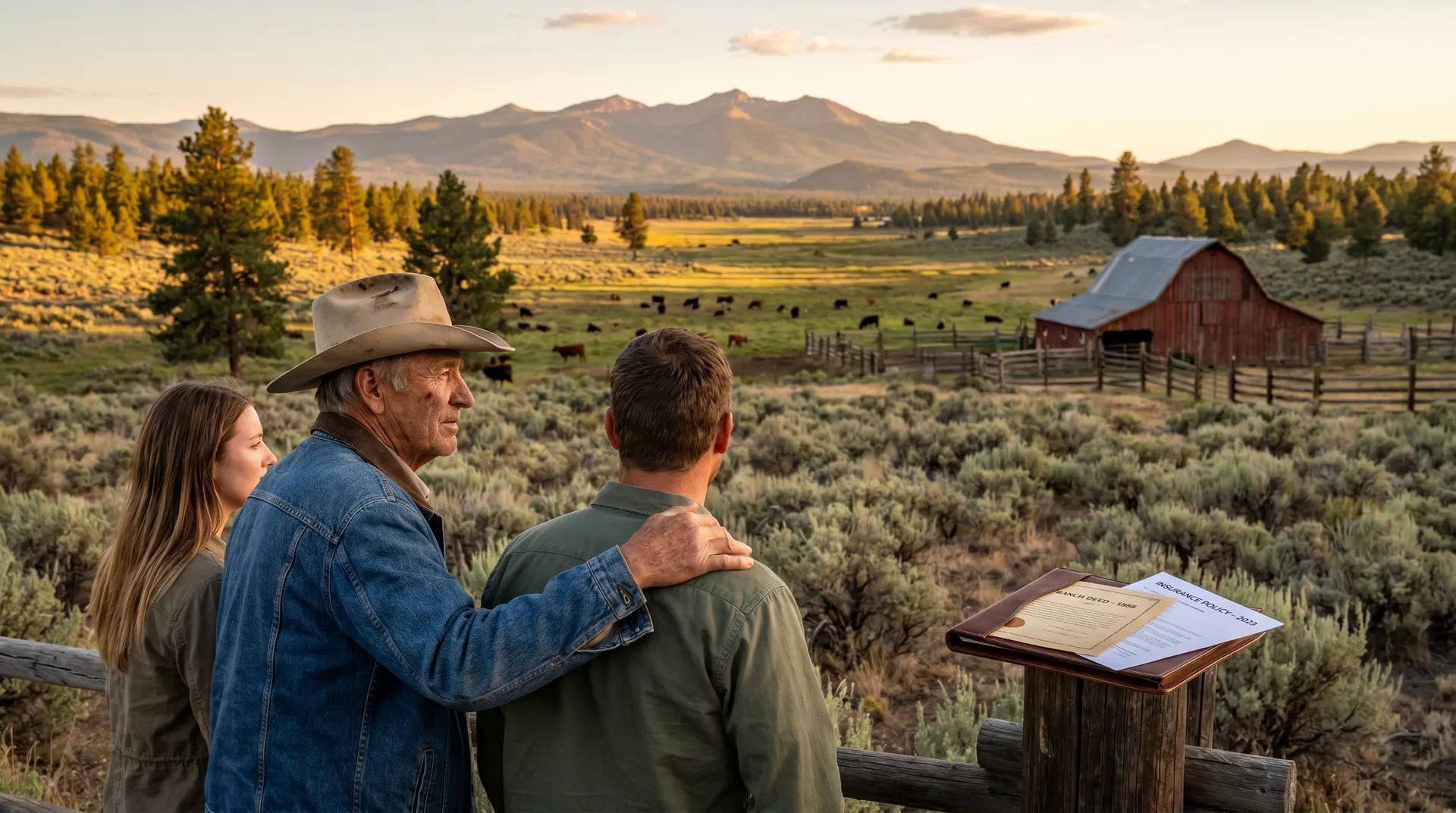

Every year, Central Oregon ranching families sit down with estate attorneys, accountants, and financial planners to work through the most complex financial event most of them will ever face: transferring a multi-generational ranch to the next generation. The meetings are long. The documents are thick. The tax strategies are sophisticated. And almost every time, the insurance agent is not in the room.
That absence is expensive. Multi-generational ranch transitions in Central Oregon involve insurance blind spots that accountants, attorneys, and financial planners are not trained — or licensed — to identify. Property transfers that void existing farm policies. Key person life insurance that was never purchased. Equipment floaters that lapse when ownership transfers to a new entity. Workers' compensation gaps that open the moment employees continue working under a new LLC. These are not hypothetical risks. They are the specific, predictable coverage failures that happen when insurance is treated as an afterthought in succession planning rather than a core component of it.
This guide covers the insurance side of ranch succession planning that the rest of your advisory team is not talking about — and why Prineville Insurance is uniquely positioned to help Central Oregon ranching families close these gaps before they become claims.
The Oregon Estate Tax Problem Most Ranches Don't See Coming
Before addressing the insurance gaps, it is worth understanding the financial pressure that makes succession planning so urgent for Central Oregon ranching families. Oregon has its own estate tax that kicks in at just $1 million — far below the federal threshold. Agricultural land in Crook County ranges from $2,000 to $10,000 per acre depending on soil quality and water availability. A 500-acre operating ranch with a home, outbuildings, equipment, livestock, and water rights can easily reach $3 million to $8 million in total value — well above the Oregon estate tax threshold.
Without proper planning, Oregon estate taxes can be substantial enough to force heirs to sell ranch assets to pay the bill. Oregon SB 498, effective July 1, 2025, provides an exemption of up to $15 million for qualifying natural resource property, including farms and ranches. The federal One Big Beautiful Bill Act raised the federal exemption to $15 million per person ($30 million per couple). These are significant improvements — but they require proactive planning to access. And even with these exemptions, the insurance gaps in the transition itself remain unaddressed.
Is Your Ranch Succession Plan Missing Its Insurance Layer?
Most succession plans are built without an insurance review. Before you finalize your trust, LLC, or buy-sell agreement, talk to Prineville Insurance about the coverage gaps your other advisors won't catch.
The Five Insurance Blind Spots in Ranch Succession Planning
1. Property Transfers to LLCs and Trusts Void Existing Policies
The most common and most dangerous insurance gap in ranch succession planning occurs when property is transferred to an LLC or trust without notifying the insurance carrier. Your existing farm or homeowners policy is written in your name as an individual. When the legal owner becomes an LLC or trust, the entity is not named on the policy — and the carrier may deny claims against it.
This is not a theoretical risk. Alliant Private Client documented a real case in which a California property owner transferred their home to an LLC without informing their insurer. When a workers' compensation claim arose from a contractor injury, the carrier denied coverage because the LLC was not named on the policy. The same scenario plays out on farms and ranches when equipment, livestock, or ranch property is transferred to a new entity as part of a succession plan.
The fix requires working with your insurance agent before the transfer — not after. The LLC or trust must be added as a named insured or additional insured on the existing policy, or a new commercial farm policy must be obtained for the operating entity. Note that a commercial operating entity with employees — a ranch LLC that employs workers — cannot be placed on a personal insurance policy and requires a separate commercial policy.
2. The Key Person Gap: What Happens When the Ranch Patriarch Dies
On most Central Oregon ranches, one person holds the operation together. They know where the water rights are filed. They have the relationship with the operating lender. They know which pastures flood in March and which ones dry out in July. They are the institutional memory of the ranch — and they are almost certainly uninsured as a key person.
Key person life insurance is a policy owned by the ranch business or the next-generation heir on the life of the primary operator. If the key person dies, the death benefit provides funds to cover revenue loss during the transition, satisfy loan obligations that may be called due at death, hire management, and give the family time to reorganize without financial pressure. For ranches where the primary operator is also the primary borrower on an operating line of credit, the lender may require key person coverage as a loan condition — and many families discover this requirement only after the key person has died.
Key person disability insurance is even more commonly overlooked. A two-year disability that prevents the primary operator from working can be as financially devastating as death — but most ranches carry no disability coverage on the key person. The ranch continues to incur operating costs, loan payments, and employee wages while the primary revenue generator is sidelined.
3. The Buy-Sell Agreement That Isn't Funded
Many Central Oregon ranching families have a buy-sell agreement — a legally binding contract that determines what happens to ranch ownership when a partner or co-owner dies. The on-farm heir will purchase the deceased's ownership interest from the estate, buying out off-farm siblings without forcing a sale of the ranch. It is a sound strategy. The problem is that most buy-sell agreements are not adequately funded with life insurance.
A buy-sell agreement without adequate life insurance funding is nearly worthless. If the on-farm heir does not have the cash — or a life insurance death benefit — to purchase the deceased's ownership interest, the estate may be forced to sell the ranch to satisfy the buy-sell obligation or to provide equal inheritance to off-farm heirs. Ranch values in Central Oregon have increased significantly in recent years, and buy-sell agreements funded with policies purchased five or ten years ago may be severely underfunded relative to current appraised values.
The Connelly v. United States Supreme Court decision (2024) added another complication: the value of a life insurance policy owned by a closely held business can be included in the deceased's taxable estate, potentially increasing estate tax liability. Proper structuring — often through an Irrevocable Life Insurance Trust — is essential to avoid this outcome. This is precisely the kind of issue that requires coordination between the estate attorney, accountant, and insurance agent — and it rarely happens because the insurance agent is not in the room.
4. Coverage Lapses During Probate and Estate Settlement
Oregon probate can take four to twelve months. During that period, the ranch is in a legal limbo — the deceased's estate owns the property, but the heirs are managing the operation. The farm insurance policy does not automatically transfer to heirs. The executor must notify the insurance carrier and continue paying premiums from estate funds to maintain coverage. If premiums lapse, the ranch is uninsured.
Vacancy clauses create an additional risk. If the ranch house sits unoccupied during probate — because the deceased lived alone or because heirs live elsewhere — most farm and homeowners policies have vacancy clauses that limit or deny coverage for claims on structures vacant for more than 30 to 60 days. A fire, vandalism, or water damage claim on a vacant ranch house during probate may be denied entirely.
Farm equipment scheduled on the deceased's policy is not automatically covered for new operators. If the on-farm heir begins operating equipment during estate settlement, they may be doing so without coverage. Livestock mortality coverage may lapse if ownership transfers to a new entity before the policy is rewritten. The executor should contact the insurance agent immediately after death — not weeks later — to review all active policies and prevent these gaps.
5. Workers' Compensation During the Transition
Ranch employees must remain covered by workers' compensation during estate settlement and ownership transition. Oregon's agricultural workers' compensation requirements apply regardless of the ownership structure — and they apply to the entity that employs the workers, not the individual who previously employed them. When a ranch transitions from an individual owner to an LLC or trust, the new entity must obtain its own workers' compensation policy. It cannot continue under the deceased's policy. If employees are injured during the gap between the deceased's policy lapsing and the new entity's policy taking effect, the ranch — and potentially the heirs personally — may be liable for the full cost of the claim.
8 Insurance Coverages Every Ranch Succession Plan Needs
Key Person Life Insurance
Covers revenue loss, loan obligations, and operating costs when the primary ranch operator dies or becomes disabled. Essential for ranches where the key person holds lender relationships, water rights knowledge, and operational expertise that cannot be quickly replaced.
Buy-Sell Agreement Life Insurance
Funds the cross-purchase or entity-purchase buy-sell agreement that allows on-farm heirs to buy out off-farm siblings at the key person's death — without forcing a ranch sale. Policy amounts must be reviewed annually as ranch values increase.
Farm / Ranch Policy — Entity Update
When ranch property transfers to an LLC or trust, the existing policy must be updated to name the new entity as insured. Failure to do so voids coverage for claims against the entity. A commercial farm policy may be required for operating entities with employees.
Disability Income Insurance
Covers the key ranch operator's income if they become disabled and cannot work — often the most overlooked succession risk. A two-year disability can be as financially devastating as death, yet most ranches carry no disability coverage on the primary operator.
Life Insurance in an ILIT
An Irrevocable Life Insurance Trust (ILIT) owns the life insurance policy, keeping the death benefit out of the taxable estate. Provides tax-free funds to pay Oregon and federal estate taxes — preventing heirs from being forced to sell ranch assets to cover the tax bill.
Workers' Compensation Continuity
Ranch employees must remain covered during estate settlement and ownership transition. The new LLC or trust must obtain its own workers' comp policy — it cannot continue under the deceased's policy. Oregon agricultural workers' comp requirements apply regardless of ownership structure.
Equipment & Livestock Coverage Transfer
Farm equipment scheduled on the deceased's policy is not automatically covered for new operators or entities. Livestock mortality coverage may lapse when ownership transfers. All scheduled equipment and livestock must be rewritten in the new entity's name.
Commercial Umbrella — Entity Coverage
Extends excess liability coverage to both the individual and the LLC or trust. Standard umbrella policies often cover only the named individual — not a new operating entity. Confirm that your umbrella policy names all entities involved in the ranch operation.
Request a Ranch Succession Insurance Review
Prineville Insurance works with Central Oregon ranching families and their estate attorneys, accountants, and financial planners to identify and close the insurance gaps that succession plans typically miss. One conversation can prevent a claim denial that costs more than the ranch.
The Insurance Agent's Unique Role in Succession Planning
Ohio State University's Farm Office put it plainly: "Think about your key farm advisors. You likely have regular conversations with your agronomist, veterinarian, equipment dealer, and grain buyer throughout the year. But when was the last time you spoke with your insurance agent?" The answer, for most ranching families, is: not recently enough, and almost never in the context of succession planning.
Accountants, estate attorneys, and financial planners are essential. They structure the trust, draft the buy-sell agreement, minimize estate taxes, and navigate the legal complexities of transferring a multi-generational ranch. But they are not licensed to sell or advise on insurance products. They will not identify the farm policy that no longer covers the new LLC. They will not notice that the equipment floater lapses when ownership transfers. They will not flag the workers' compensation gap that opens when employees continue working during estate settlement.
The insurance agent is the only member of the succession planning team who can identify and close these specific gaps. And the most important time to have that conversation is before the succession plan is finalized — not after the deed has been transferred to the LLC, not after the buy-sell agreement has been signed without adequate life insurance funding, and not after the ranch owner has died and the executor is trying to figure out why the farm policy is denying a claim.
Prineville Insurance has deep roots in Central Oregon's agricultural community. We work with farm and ranch operations across Crook County, Jefferson County, and the surrounding region, and we understand the specific insurance challenges that come with multi-generational ranch transitions in this landscape. Whether you are working with an estate attorney on a trust structure, a financial planner on a buy-sell agreement, or an accountant on Oregon's natural resource property tax exemption, we can help ensure that the insurance layer of your succession plan is as solid as the legal and financial layers.
A Succession Planning Insurance Checklist for Central Oregon Ranches
Before finalizing any succession plan, review these insurance items with your agent. Each one represents a specific coverage gap that commonly occurs during ranch transitions.
| Item | Action Required | When |
|---|---|---|
| Farm/Ranch Policy Entity Update | Add LLC/trust as named or additional insured; obtain commercial policy if entity has employees | Before property transfer |
| Key Person Life Insurance | Purchase policy on primary operator; review amount against current ranch value and loan obligations | Now — before health changes make it uninsurable |
| Buy-Sell Agreement Funding | Confirm life insurance death benefit equals current appraised ranch value; review annually | Before buy-sell agreement is signed |
| ILIT Structure Review | Ensure life insurance is held in ILIT to keep death benefit out of taxable estate | Before policy is purchased |
| Disability Income Insurance | Purchase on primary operator; review benefit period and elimination period | Now |
| Workers' Comp Continuity | New entity must obtain own workers' comp policy before employees begin working under new ownership | Before ownership transfer |
| Equipment & Livestock Transfer | Rewrite all scheduled equipment and livestock coverage in new entity's name | At time of ownership transfer |
| Umbrella Policy — Entity Coverage | Confirm umbrella policy names all entities involved in ranch operation | Before property transfer |
| Probate Coverage Review | Executor notifies insurer immediately at death; continues premium payments from estate funds | Immediately at death |
| Vacancy Clause Review | If ranch house will be vacant during probate, obtain vacancy endorsement or vacant property policy | Before or immediately at death |
Internal Links: Related Coverage and Resources
Ranch succession planning touches nearly every line of coverage your operation carries. Review these related resources to ensure your entire insurance program is succession-ready:
- Farm & Ranch Insurance — Overview of core farm and ranch coverage in Central Oregon
- Workers' Compensation Insurance — Oregon agricultural workers' comp requirements and transition coverage
- Employment Practices Liability Insurance — Covers employment claims during ownership transitions
- Commercial Umbrella Insurance — Extends excess liability to both individuals and operating entities
- Employee Housing Insurance Risks — Covers liability and property risks for ranch worker housing
- Farm Tech Insurance — Covers drones, autonomous tractors, and precision agriculture equipment
- Insuring Rural Oregon — What Crook County residents need that city policies miss
- Contact Prineville Insurance — Schedule a ranch succession insurance review
Frequently Asked Questions
Don't Let Insurance Be the Part of Your Succession Plan That Fails
Prineville Insurance has been serving Central Oregon's agricultural community for decades. We work alongside your estate attorney, accountant, and financial planner to ensure the insurance layer of your succession plan is complete — before the deed transfers, before the buy-sell agreement is signed, and before it's too late to fix the gaps.
Get a Free Ranch Succession Insurance Review

