



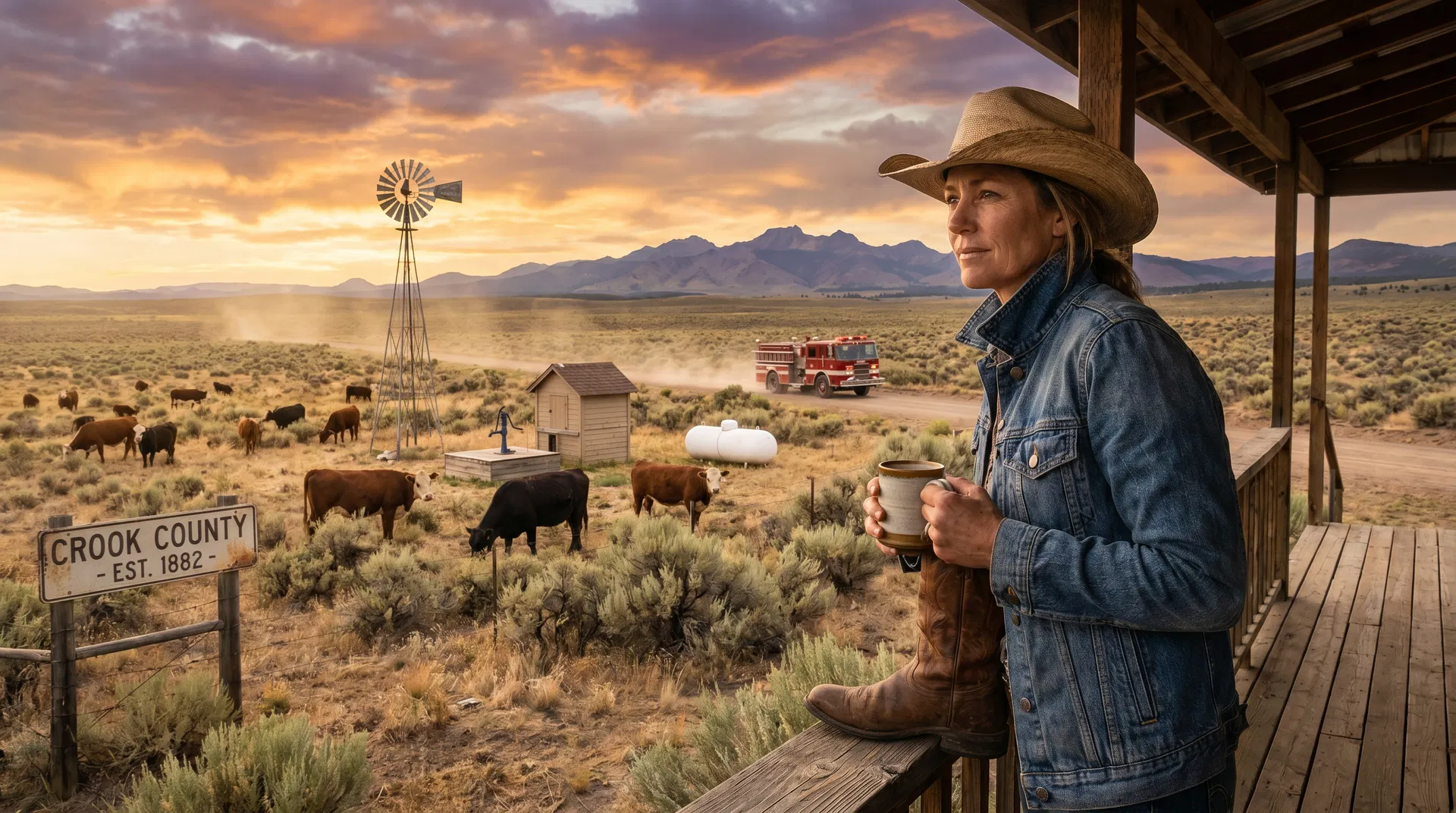

When an insurance agent in Portland or Eugene writes a homeowners policy, they are thinking about a house on a city lot with municipal water, public sewer, a fire station six blocks away, and no livestock in the backyard. That policy — and the assumptions baked into it — follows the same template whether it is issued in Beaverton or Prineville. The problem is that rural Crook County is nothing like Beaverton. And the gaps between what a standard policy covers and what a rural Crook County resident actually needs can be financially devastating.
Crook County covers 2,991 square miles of high desert, ranch land, timber country, and mountain terrain. The county seat of Prineville sits at 2,868 feet elevation, surrounded by the Ochoco Mountains and the Crooked River canyon. Outside of Prineville, the county is sparsely populated — ranches and rural homesteads separated by miles of sagebrush, juniper, and ponderosa pine. Private wells and septic systems are the norm, not the exception. Livestock grazes on tens of thousands of acres. Farm equipment worth hundreds of thousands of dollars sits in fields and barns. And when something goes wrong — a wildfire, a well pump failure, a barn fire, a livestock loss — the nearest help may be 20, 30, or 45 minutes away.
This guide covers the specific insurance gaps that affect rural Crook County residents, and what coverage you actually need to protect your property, your livestock, your water supply, and your family's financial security.
The Response Time Reality: Why Rural Insurance Is Different
The single most important fact that shapes rural insurance in Crook County is emergency response time. Crook County Fire & Rescue's 2024 Standard of Cover is unusually candid about this reality. The district covers a 450-square-mile fire district and a 3,000-square-mile ambulance service area. It operates from three stations: Station 1201 in Prineville, Station 1202 in Powell Butte, and Station 1203 in Juniper Canyon.
The district's deployment goal is to arrive on scene within 12 minutes of dispatch 80% of the time — and in 2023, it achieved that goal on 82.6% of calls. But that 12-minute benchmark applies to the district as a whole. For properties in "frontier risk areas" — defined as more than 8 miles from a station — the Standard of Cover states that response times are "dictated by availability and a minimum turnout and travel time of 45 minutes." In those areas, a structure fire is almost certainly a total loss before the first engine arrives.
This reality has direct insurance consequences. The ISO Public Protection Classification (PPC) system rates fire protection on a scale of 1 (best) to 10 (no protection). Properties more than 5 miles from a fire station and 1,000 feet from a hydrant are typically rated Class 8, 9, or 10. In frontier areas, properties may be rated Class 10 or "unprotected" — and many standard insurance carriers simply will not write coverage for unprotected properties. Those that do charge significantly higher premiums. This is why working with a Crook County insurance specialist who knows which carriers write rural and frontier properties is essential.
Is Your Rural Property Properly Covered?
Standard policies written for urban Oregon leave rural Crook County residents with dangerous gaps. Get a free rural coverage review from a Prineville Insurance specialist who knows Crook County.
The Well and Septic Gap: A $30,000 Surprise Nobody Talks About
Approximately 90% of rural Crook County properties rely on private wells for water and septic systems for waste treatment. These systems are expensive to install, expensive to repair, and almost entirely excluded from standard homeowners insurance policies.
A standard homeowners policy covers sudden and accidental damage to your well and septic systems from covered perils — a fire, lightning strike, or vehicle impact. What it does not cover is the most common and costly failures: well pump burnout from power surges or wear, pressure tank failure, water line breaks from freezing or ground movement, septic tank cracking, and drain field failure from root intrusion or soil saturation. These are the failures that actually happen, and they are expensive.
In Crook County, replacing a well pump typically costs $2,000–$8,000 depending on depth and pump type. Drilling a new well runs $8,000–$25,000 or more. Septic system replacement — including tank, distribution box, and drain field — typically costs $10,000–$30,000 in rural Central Oregon, where rocky soil and remote access add to contractor costs. If your well fails during a drought year and you need to haul water while waiting for a new well to be drilled, those costs add up quickly.
The solution is adding well and septic coverage through equipment breakdown and service line endorsements. These endorsements are relatively inexpensive — typically $100–$300 per year — and cover the mechanical and electrical failures that standard policies exclude. Prineville Insurance can add this coverage to most homeowners and farm policies.
Livestock: The Coverage Gap That Surprises New Rural Residents
Every year, people move from urban Oregon to rural Crook County and buy a property with a few acres, a barn, and some cattle or horses. They call their existing insurance company, add the new address to their homeowners policy, and assume they are covered. They are not — not for their livestock.
Standard homeowners insurance policies do not cover livestock. Cattle, horses, sheep, goats, pigs, and poultry are classified as farm personal property under insurance industry standards, and they require a farm or ranch insurance policy to be covered. If a wildfire sweeps through your property and kills your cattle herd, or a predator attack kills your horses, or your animals escape onto a highway and are struck by vehicles — a standard homeowners policy will not pay a cent for the animal losses.
Livestock mortality insurance covers death from accident, illness, and disease. Livestock transit coverage protects animals while being transported to auction, veterinary care, or summer grazing. For high-value animals — registered breeding stock, performance horses, or dairy animals — individual scheduled mortality policies are available with per-animal limits that reflect actual market value. For commercial cattle operations, blanket livestock coverage provides protection across the entire herd.
Beyond the animals themselves, farm liability coverage is essential for anyone with livestock. If your cattle escape through a fence and cause a vehicle accident on Highway 26 or Combs Flat Road, you face significant liability exposure. Standard homeowners liability policies typically exclude livestock-related claims and farm operations. Farm liability coverage is designed specifically for these risks.
Farm Equipment: The Six-Figure Gap in Standard Policies
A modern Central Oregon ranch operation might have $200,000–$500,000 or more in farm equipment: tractors, balers, swathers, sprayers, irrigation equipment, ATVs, trailers, and specialized implements. None of this is covered by a standard homeowners policy. Homeowners policies cover personal property inside the home — not farm equipment in the field or barn.
Farm equipment insurance covers tractors and implements against fire, theft, vandalism, collision, and rollover. Inland marine coverage extends protection to equipment while it is being transported on public roads or used at remote locations away from the home farm. Equipment breakdown coverage addresses sudden mechanical failure — a blown hydraulic system, a seized engine, an electrical failure — that standard property policies exclude.
For Crook County ranchers who rely on irrigation systems, center-pivot coverage is particularly important. A single center-pivot irrigation system can cost $50,000–$150,000. Standard farm policies may cover the pivot structure against fire and windstorm, but equipment breakdown coverage is needed for the electrical and mechanical failures that are far more common than fire.
8 Coverage Types Rural Crook County Residents Need
Standard urban policies miss most of these. A rural specialist can build the right package.
Rural Homeowners & Dwelling Coverage
Standard homeowners policies often undervalue rural properties. Replacement cost coverage must account for remote site access, contractor travel costs, and extended rebuild timelines — all of which are higher in rural Crook County than in Bend or Portland.
Well & Septic System Coverage
Equipment breakdown and service line coverage for private well pumps, pressure tanks, water lines, septic tanks, and drain fields. Standard homeowners policies exclude these systems — a $15,000–$30,000 gap for most rural Crook County homeowners.
Wildfire & High-Risk Property Coverage
Specialty wildfire coverage for properties in Crook County's Wildland-Urban Interface zones. Includes replacement cost dwelling, extended replacement cost endorsements, and additional living expense coverage for the extended rebuild timelines common after rural total losses.
Farm Equipment & Inland Marine
Coverage for tractors, balers, irrigation equipment, ATVs, and other farm machinery — on and off the farm. Standard homeowners policies exclude farm equipment entirely. Inland marine coverage protects equipment during transport and at remote locations.
Livestock & Animal Mortality
Coverage for cattle, horses, sheep, goats, and other livestock against death from accident, illness, wildfire, predator attack, and transit losses. Livestock are excluded from standard homeowners policies — farm or ranch coverage is required.
Farm & Ranch Liability
Protects against bodily injury and property damage claims arising from farm operations, livestock escapes, equipment accidents, and visitors on your property. Standard homeowners liability policies exclude farm operations and livestock-related claims.
Extended Additional Living Expense
Standard ALE coverage limits are often inadequate for rural Crook County total losses, where rebuilding can take 18–36 months. Extended ALE coverage provides housing and living expenses for the full duration of your rebuild — not just 12 months.
Commercial Farm Auto
Covers farm trucks, trailers, and vehicles used in agricultural operations. Personal auto policies exclude commercial farm use. If you haul livestock, grain, or equipment for your operation, you need commercial farm auto coverage.
Request a Rural Crook County Insurance Review
Prineville Insurance has been serving Crook County since 1935. We know the ranches, the roads, the fire districts, and the carriers who actually write rural Oregon coverage. Let us review your current policy and find the gaps.
Wildfire Risk: The Coverage Crisis in Crook County's WUI Zones
Crook County sits in the heart of Oregon's wildfire country. The Ochoco National Forest, the Maury Mountains, the Paulina area, and the juniper-covered hills surrounding Prineville all create significant wildfire exposure for rural properties. The 2020 Labor Day fires — which burned over one million acres across Oregon in a single weekend — changed the insurance market for rural Central Oregon permanently.
Since 2020, multiple major insurance carriers have non-renewed policies or stopped writing new coverage in Crook County's Wildland-Urban Interface (WUI) zones. Oregon's Department of Financial Regulation has documented the trend: homeowners in high-risk areas are being dropped by standard carriers and forced into the surplus lines market or Oregon's FAIR Plan — both of which are more expensive and provide less comprehensive coverage.
For rural Crook County homeowners in WUI zones, wildfire insurance strategy requires working with a specialist who has access to the carriers still writing coverage in high-risk areas. Home hardening — Class A roofing materials, ember-resistant vents, metal gutters, non-combustible siding, and 30 feet of defensible space — can significantly improve insurability and reduce premiums. Some specialty carriers offer premium discounts of 10–30% for documented home hardening measures.
Replacement cost coverage is critical — and it must be set correctly. Construction costs in rural Crook County are 20–40% higher than in Bend or Portland because contractors must travel to remote sites, materials must be hauled farther, and the labor pool is smaller. Many rural homeowners are significantly underinsured because their policy limits were set years ago and have never been updated. After a total loss in a frontier area, rebuilding can take 18–36 months — making extended additional living expense (ALE) coverage just as important as the dwelling coverage itself.
The Underinsurance Problem: When Your Policy Limit Is the Wrong Number
One of the most common and preventable insurance disasters in rural Oregon is underinsurance — having a policy limit that is far below the actual cost to rebuild your home or replace your property. This problem is widespread in Crook County for several reasons.
First, many rural properties were insured years or decades ago at values that have not kept pace with construction cost inflation. Since 2019, construction costs in Central Oregon have increased 40–60%, driven by lumber price spikes, supply chain disruptions, labor shortages, and increased demand. A home that cost $200,000 to rebuild in 2018 may cost $300,000–$350,000 to rebuild today — but the policy limit may still reflect the 2018 estimate.
Second, rural properties often have outbuildings, barns, shops, and other structures that are undervalued or not scheduled separately on the policy. A well-built horse barn or equipment shop can cost $100,000–$300,000 to replace, but many policies cover outbuildings at only 10% of the dwelling limit — which may be far less than the actual replacement cost.
Third, farm equipment and livestock are often not insured at all on rural homeowners policies, as discussed above. The solution is an annual insurance review — comparing your current policy limits against current construction costs, equipment values, and livestock values. Prineville Insurance recommends a coverage review every year for rural properties, and any time you add significant improvements, equipment, or livestock. Learn more about how inflation is impacting property insurance values across Oregon.
Workers' Compensation for Farm Employees
Many Crook County ranches and farms employ seasonal or year-round workers — irrigators, fence builders, harvest crews, and ranch hands. Oregon law requires employers to carry workers' compensation insurance for all employees, including agricultural workers. The penalties for non-compliance are severe: Oregon OSHA can issue stop-work orders, and uninsured employers are personally liable for all medical and wage replacement costs for injured workers.
Farm workers face significant injury risks — equipment accidents, livestock handling injuries, falls, and heat-related illness. Workers' compensation for agricultural operations is a specialized line of coverage that requires an agent familiar with Oregon's agricultural workers' comp rules, including the specific exemptions and requirements for family members and seasonal H-2A visa workers. If you have employee housing on your farm or ranch, additional liability and property coverage is required.
Frequently Asked Questions
Serving Crook County Since 1935
Prineville Insurance has been protecting Crook County farms, ranches, and rural families for nearly 90 years. We know which carriers write rural Oregon coverage, what the gaps are in standard policies, and how to build a program that actually protects what you have built. Call us or request a free rural coverage review today.


