



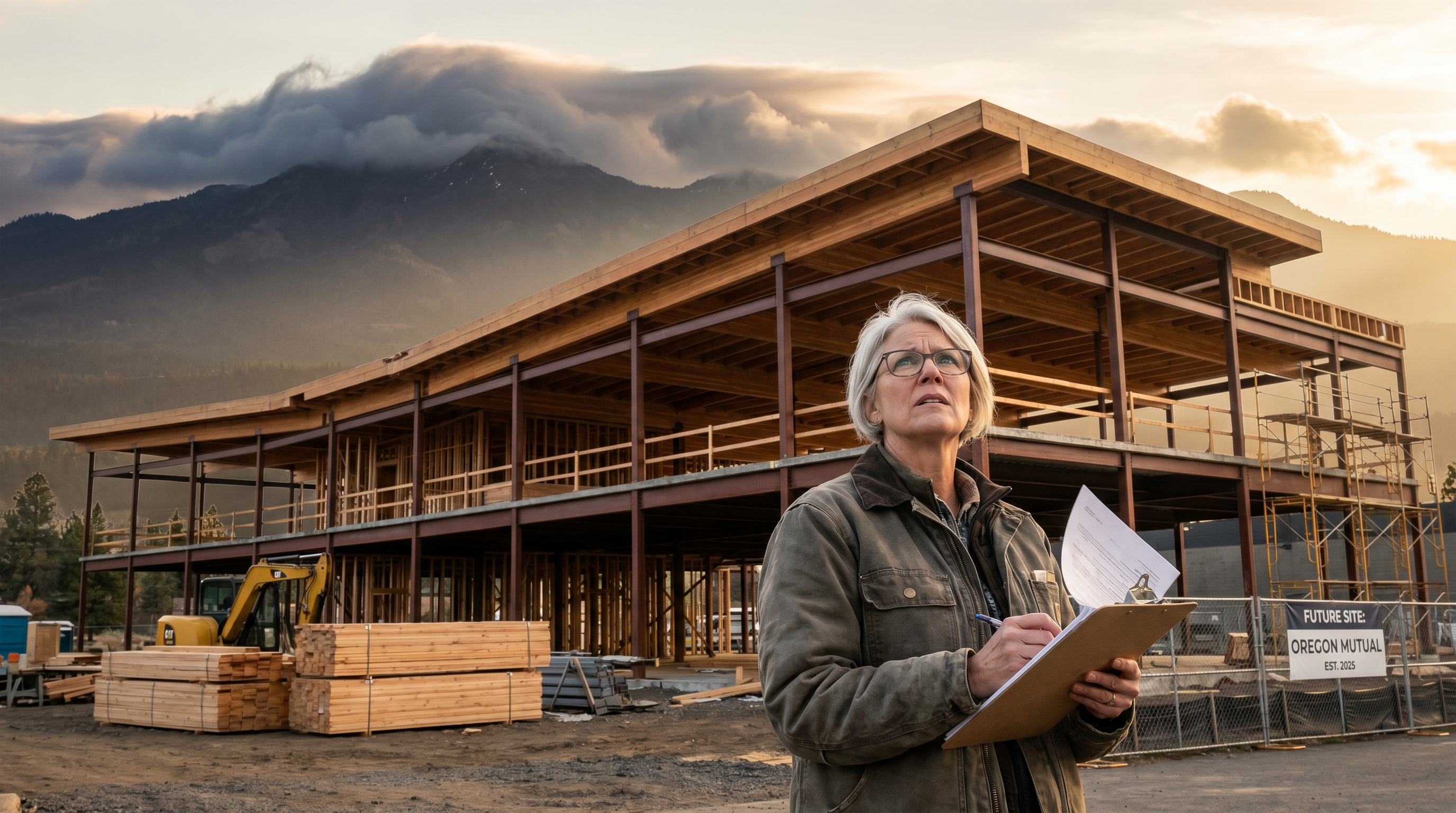

When an Oregon business owner buys commercial property insurance, they typically set their coverage limit based on what their building cost to build — or what they paid for it. That number goes into the policy, the premium is calculated, and the policy renews year after year with the same limit. It's a system that worked reasonably well in a stable construction cost environment. It doesn't work in the environment we've been living in since 2020.
Commercial construction costs in Oregon have increased 40–60% since 2019, driven by lumber price spikes, supply chain disruptions, labor shortages, and persistent materials inflation. A commercial building that cost $800,000 to build in 2018 may cost $1.2 million or more to rebuild today. If your commercial property insurance limit hasn't kept pace, you are underinsured — and you may not find out until you file a claim.
The Underinsurance Problem: How the Coinsurance Penalty Works
Most commercial property policies contain a coinsurance clause that requires you to insure your building to at least 80% (sometimes 90% or 100%) of its current replacement cost value. If your coverage falls below that threshold, the insurer applies a coinsurance penalty to every claim — not just total losses.
Here's how the penalty works in practice: Suppose your building has a current replacement cost of $1,000,000. Your policy requires 80% coinsurance, so you should carry at least $800,000 in coverage. But your policy limit is $600,000 — set five years ago when construction costs were lower. You are only insured to 75% of the required amount.
When you file a $200,000 claim for a partial loss — a fire in one section of the building — the insurer applies the coinsurance formula: ($600,000 ÷ $800,000) × $200,000 = $150,000. You receive $150,000, not $200,000. You pay the $50,000 shortfall out of pocket, even though you had insurance and paid your premiums faithfully.
This is not a technicality that only applies to catastrophic total losses. The coinsurance penalty applies to every claim — a burst pipe, a roof collapse, a fire in one room. Underinsurance affects every claim you file until you correct your coverage limits.
Is Your Commercial Property Underinsured?
Get a free replacement cost review from Prineville Insurance — before inflation creates a gap in your coverage.
What Inflation Has Done to Oregon Construction Costs
The construction cost inflation of the past five years has been unlike anything the insurance industry has seen in decades. Key cost drivers include:
- Lumber: Peaked at nearly 400% above pre-pandemic levels in 2021. Currently 30–50% above 2019 levels despite partial retreat from the peak.
- Structural steel: Up 25–40% from 2019 levels, driven by global demand and domestic production constraints.
- Copper: Up 35–45% from 2019 levels, affecting electrical systems, plumbing, and HVAC.
- Concrete and masonry: Up 20–30% from 2019 levels, driven by energy costs and aggregate supply constraints.
- Labor: Oregon construction labor costs have increased 15–25% since 2019 due to workforce shortages, driven partly by housing costs in Central Oregon pricing workers out of the local market.
For a typical commercial building in Central Oregon, these cost increases translate to a 40–60% increase in total replacement cost. A building insured for $500,000 in 2019 may require $700,000–$800,000 to rebuild today. If your policy limit hasn't been updated, you're carrying a coverage gap of $200,000–$300,000 on a single building.
Building Ordinance: The Hidden Cost Multiplier
Inflation isn't the only factor driving up rebuild costs. Oregon's building codes have been updated significantly over the past decade, and building ordinance coverage is often overlooked until a loss occurs.
When a building is damaged and must be rebuilt, Oregon law typically requires the rebuilt structure to comply with current building codes — not the codes in effect when the building was originally constructed. This can add 10–30% to total rebuild costs for older buildings, covering requirements such as:
- Updated electrical systems and panels
- ADA accessibility upgrades
- Seismic retrofitting requirements
- Energy efficiency standards (Oregon's updated energy code)
- Fire suppression system requirements
Standard commercial property policies cover rebuilding to the same specifications as the original building — they do not cover the extra cost of code upgrades unless you have a building ordinance endorsement. For older commercial buildings in Prineville, Bend, Redmond, and across Central Oregon, this gap can be substantial.
Eight Coverage Options to Address Inflation-Driven Underinsurance
Replacement Cost Value (RCV)
Pays to rebuild your property using materials of like kind and quality at current construction costs — not the depreciated value of what was destroyed. Essential in an inflationary environment where today's rebuild cost far exceeds the original construction cost.
Extended Replacement Cost
Pays up to 25–50% above your policy limit if rebuilding costs exceed your coverage. Provides a critical buffer against construction cost inflation between your last coverage review and a loss event.
Agreed Value Coverage
Suspends the coinsurance clause by agreeing upfront on the building's replacement cost. Eliminates the risk of a coinsurance penalty reducing your claim payout if your coverage falls below the required percentage.
Inflation Guard Endorsement
Automatically increases your coverage limit by a percentage each year to keep pace with construction cost inflation. Typically 4–8% per year — may need to be supplemented with manual limit increases in high-inflation periods.
Business Income / Extra Expense
Covers lost revenue and extra operating expenses while your property is being rebuilt after a covered loss. Inflation affects rebuild timelines — longer rebuilds mean longer income interruption. Review your period of restoration limits annually.
Building Ordinance Coverage
Covers the increased cost of rebuilding to current building codes after a loss. Oregon's building codes have been updated significantly since many commercial buildings were constructed — code upgrades can add 10–30% to rebuild costs.
Equipment Breakdown
Covers the cost of repairing or replacing mechanical and electrical equipment after a breakdown. HVAC, electrical panels, and commercial kitchen equipment have seen significant price increases — coverage limits need to reflect current replacement costs.
Annual Coverage Review
Not a coverage type, but the most important action you can take. An annual review with your agent ensures your property limits reflect current construction costs, recent improvements, and any changes in your business operations.
Schedule Your Annual Commercial Property Review
Prineville Insurance helps Central Oregon businesses update their property limits to reflect current construction costs — before a claim reveals the gap.
The Annual Insurance Review: Your Best Defense Against Underinsurance
The most effective tool against inflation-driven underinsurance is simple: review your commercial property limits at every policy renewal. Here's what a thorough annual review should include:
- Replacement cost estimate: Use your agent's replacement cost estimator or commission a professional appraisal to establish a current replacement cost for your building.
- Improvement inventory: Document any improvements or additions made to the building since the last review — renovations, equipment additions, HVAC upgrades, and tenant improvements all increase replacement cost.
- Business income limit review: Inflation affects rebuild timelines, which affects how long your business income coverage needs to last. Review your period of restoration and monthly limit of indemnity.
- Contents and equipment: Review your business personal property limits to ensure equipment, inventory, and fixtures are covered at current replacement costs.
- Coinsurance compliance check: Confirm that your coverage limit meets the coinsurance requirement in your policy — typically 80% of replacement cost.
Related to commercial property, businesses that own significant equipment should also review their inland marine and equipment floater coverage limits, as equipment replacement costs have also increased substantially since 2019.
Frequently Asked Questions
Get a Free Commercial Property Insurance Review
Prineville Insurance helps Central Oregon businesses update their property coverage to reflect today's construction costs. Don't let inflation create a gap that only shows up at claim time.


