



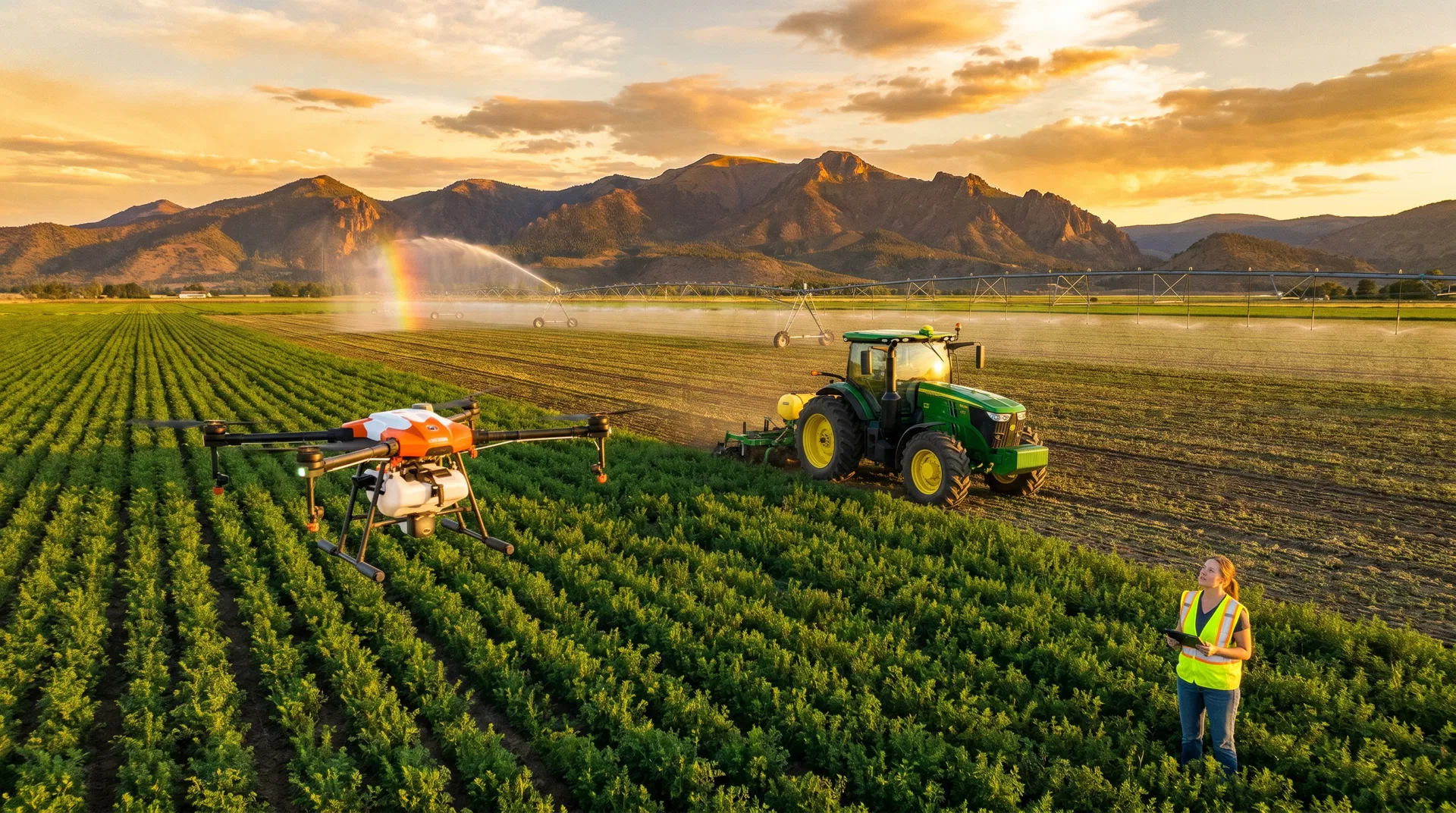

The modern ranch is starting to look like a tech company — with drones in the sky, sensors in the soil, software in the office, and expensive equipment in the field. Across Central Oregon's farms, ranches, nurseries, vineyards, and irrigation districts, precision agriculture technology is no longer the future. It is the present. A single operation might run GPS-guided autonomous tractors, an agricultural drone for crop scouting and spraying, a smart center-pivot irrigation system controlled by a smartphone app, and farm management software that tracks every input, yield, and soil sample across thousands of acres.
The problem is that most farm insurance policies were written for a world that no longer exists. Standard farm policies were designed to cover tractors with human operators, irrigation systems with manual controls, and data that lived in a filing cabinet. When that $85,000 agricultural spray drone crashes into a neighbor's greenhouse, or when ransomware locks your automated irrigation controller during a critical irrigation window, or when your autonomous tractor's GPS guidance system fails and the machine drives through a fence — you may discover that your standard farm policy has significant gaps.
This guide covers the specific insurance risks of farm technology in Central Oregon, where the combination of high-value precision agriculture equipment, remote operations, wildfire exposure, and limited contractor availability creates a unique risk profile that demands specialized coverage.
The Coverage Gap Nobody Talks About
The fundamental problem with insuring farm technology is that most farm policies were designed around a simple model: the farmer owns equipment, the equipment is on the farm, and if it breaks or burns, the policy pays to repair or replace it. Farm technology breaks that model in several important ways.
First, farm technology creates third-party liability exposures that standard farm liability policies may not cover. A drone flying over a neighbor's property, an autonomous tractor operating near a public road, or a smart irrigation system that malfunctions and floods an adjacent field — all of these create liability claims that may fall outside the scope of a standard farm liability policy.
Second, farm technology creates cyber and data exposures that standard farm policies explicitly exclude. If a cyberattack compromises your farm management software and corrupts three years of yield maps and soil sampling data, or if ransomware locks your automated irrigation controller during a critical growing period, standard farm policies will not respond. The losses can be substantial — not just the cost of recovering the data, but the agronomic value of the data itself and the crop losses caused by the operational disruption.
Third, farm technology creates equipment breakdown exposures that standard farm property policies don't cover. Standard farm property policies cover fire, theft, vandalism, and weather damage — but not mechanical or electrical breakdown. When the electronic controller on your center-pivot irrigation system fails, or when the GPS guidance computer on your autonomous tractor malfunctions, standard farm property coverage won't pay for the repair. You need equipment breakdown coverage.
Understanding these three gap areas — liability, cyber, and equipment breakdown — is the foundation for building a farm technology insurance program that actually protects your operation. Talk to a farm and ranch insurance specialist at Prineville Insurance to review your current coverage against these exposures.
Is Your Farm Tech Covered?
Most standard farm policies have significant gaps for drones, autonomous equipment, and precision agriculture technology. Get a free farm tech insurance review from Prineville Insurance — Central Oregon's farm and ranch insurance specialists since 1935.
Drone Insurance: What FAA Certification Doesn't Cover
Agricultural drone use in Central Oregon has grown rapidly. Farms and ranches use drones for crop scouting, irrigation monitoring, livestock surveys, topographic mapping, and increasingly for aerial application of pesticides, herbicides, and fertilizers. The Deschutes and Crook County agricultural communities have been early adopters — and early discoverers of the insurance gaps.
The FAA does not require commercial drone operators to carry insurance. But that doesn't mean you don't need it. Here's what you're exposed to without proper drone insurance:
- Third-party bodily injury: If your drone injures a farmworker, a neighboring landowner, or a bystander, your standard farm liability policy may not cover the claim. Most farm liability policies were not written to cover unmanned aerial vehicles.
- Third-party property damage: If your drone crashes into a neighbor's greenhouse, equipment, or crops, the property damage claim may fall outside your farm liability policy's coverage for "farm operations."
- Hull damage: Agricultural spray drones can cost $15,000–$50,000 or more. Standard farm equipment floaters may cover the drone as scheduled equipment, but confirm this with your agent — some policies exclude aircraft of any kind.
- Chemical liability: If your spray drone applies pesticides or herbicides that drift onto a neighboring property and damage crops, chemical drift liability coverage is essential. Many carriers require FAA Part 137 certification before issuing chemical liability coverage for aerial application operations.
For Central Oregon farms using drones commercially, a standalone drone liability policy with at least $1 million per occurrence in coverage is the minimum. Larger operations, or those spraying chemicals, should consider $5 million or more. Landowners and agricultural cooperatives increasingly require proof of drone insurance before allowing operations on their property.
If you hire a drone service operator to work on your farm — aerial mapping, spraying, livestock surveys — you also need hired and non-owned coverage that responds if the hired operator's drone causes damage while working for you.
Autonomous Tractors: The Liability Question Nobody Has Answered Yet
John Deere's autonomous tractor technology is now available in 18 states, with a nationwide rollout planned. Central Oregon farmers are already testing autonomous guidance systems, and fully autonomous field operations are coming to Crook, Deschutes, and Jefferson counties within the next few years.
The insurance industry has not fully caught up. When an autonomous tractor — operating without a human operator in the cab — causes a bodily injury or property damage, the liability question is genuinely unsettled:
- Product liability: If the autonomous system itself was defective, the manufacturer (John Deere, CNH Industrial, or others) may bear product liability. But pursuing a product liability claim against a major manufacturer is expensive and uncertain.
- Farm premises liability: If the farmer deployed the autonomous tractor and it caused harm, the farmer's farm liability policy may respond — but only if the policy's definition of "farm operations" and "operator" covers unmanned equipment. Many older farm policies do not.
- Commercial auto: If the autonomous tractor operates on a public road, commercial auto liability may apply. Farm policies typically exclude vehicles operated on public roads from farm liability coverage.
The practical advice for Central Oregon farmers deploying autonomous equipment: review your farm liability policy's definitions carefully, discuss autonomous equipment endorsements with your agent, and consider whether your current liability limits are adequate for the exposure. A commercial umbrella policy provides an important additional layer of protection for high-value autonomous equipment operations.
For the physical damage coverage on autonomous tractors, a farm equipment floater or inland marine policy is the right tool — schedule the tractor at its full replacement value, including the autonomous guidance hardware and software, which can add $10,000–$30,000 to the value of a conventional tractor.
Smart Irrigation Systems: Three Coverage Gaps
Center-pivot irrigation systems are the backbone of Central Oregon agriculture. Modern pivots are no longer simple mechanical systems — they are networked, sensor-equipped, GPS-guided machines controlled by smartphone apps and farm management software. A modern center-pivot system with variable-rate irrigation capability, soil moisture sensors, and remote monitoring can represent a $150,000–$500,000 investment.
Three coverage gaps are particularly important for smart irrigation systems:
Gap 1: Equipment breakdown. Standard farm property policies cover fire, theft, and weather damage to your pivot — but not mechanical or electrical breakdown of the pivot's electronic control systems. When the variable-rate controller fails, or when a power surge damages the pivot's GPS guidance hardware, standard farm property coverage won't pay. Equipment breakdown coverage fills this gap.
Gap 2: Cyber and remote access vulnerability. Smart irrigation systems connected to the internet are vulnerable to cyberattacks. In 2021, a hacker accessed a Florida water treatment facility's control system through remote access software. Farm irrigation systems face similar risks. If a cyberattack manipulates your irrigation controller and causes overwatering that damages your crops or floods a neighboring property, standard farm policies will not cover the loss. A precision agriculture cyber endorsement is essential for networked irrigation systems.
Gap 3: Third-party water damage liability. If your smart irrigation system malfunctions and discharges water onto a neighboring property, causing crop damage or property damage, the liability claim falls under your farm liability policy — but only if the policy covers "water damage caused by irrigation system malfunction." Some farm liability policies have specific exclusions for gradual water damage or irrigation-related losses. Review your policy carefully, and consider the specialized irrigation and water systems insurance coverage available through Prineville Insurance.
8 Coverage Types Every High-Tech Farm Needs
Agricultural Drone Hull & Liability
Covers physical damage to your drone (hull coverage) and third-party liability if your drone injures someone or damages property. FAA Part 107/137 operations require separate drone liability — not covered by standard farm policies.
Farm Equipment Floater / Inland Marine
Covers GPS guidance systems, autonomous tractors, precision planting equipment, variable-rate applicators, yield monitors, and other high-value farm technology against theft, vandalism, and accidental damage — on and off the farm.
Precision Agriculture Cyber Insurance
Covers ransomware attacks, data breaches, and system failures affecting farm management software, automated irrigation controllers, GPS systems, and livestock monitoring technology. Combines equipment breakdown and cyber coverage.
Equipment Breakdown
Covers sudden mechanical or electrical breakdown of farm technology — irrigation pump controllers, automated feeding systems, climate control systems, and other equipment not covered by standard property policies for mechanical failure.
Farm Liability Extension for Autonomous Equipment
Extends your farm liability policy to cover bodily injury and property damage claims arising from autonomous or remotely operated farm equipment. Review your policy's 'operator' definition — many exclude unmanned equipment.
Data Loss & Software Coverage
Covers the cost of recovering or recreating lost farm data — yield maps, soil sampling records, prescription maps, and farm management records — following a cyberattack, hardware failure, or accidental deletion.
Smart Irrigation System Coverage
Covers physical damage to automated irrigation infrastructure (sensors, controllers, pivot electronics) and liability for irrigation system malfunctions that cause water damage to neighboring properties or crops.
Hired & Non-Owned Drone Coverage
Covers liability when you hire a drone service operator to work on your farm — crop spraying, aerial mapping, livestock surveys. If the hired operator's drone causes damage, your hired/non-owned coverage responds.
Request a Farm Technology Insurance Review
Prineville Insurance works with carriers that specialize in precision agriculture, drone liability, and smart farm cyber coverage. We'll review your current farm policy against your technology exposures and identify the gaps before a claim does.
Request a Farm Tech Coverage Review →Precision Agriculture Cyber Insurance: The Coverage Most Oregon Farmers Don't Have
Farm management software, GPS guidance systems, automated irrigation controllers, livestock monitoring platforms, and variable-rate application systems all create cyber exposures that standard farm policies explicitly exclude. The agricultural sector has become an increasingly attractive target for cybercriminals — not because farms are soft targets, but because the consequences of disrupting farm operations during critical windows (planting, irrigation, harvest) are severe enough to make ransom payments likely.
HSB (Hartford Steam Boiler) and Munich Re offer precision agriculture cyber endorsements that combine equipment breakdown and cyber coverage specifically for farm technology. These endorsements typically cover:
- Ransomware attacks on farm management software
- Cyberattacks on automated irrigation and climate control systems
- Data breaches involving farm financial records, employee data, or customer information
- System failures caused by computer attacks
- Costs of recovering or recreating lost farm data (yield maps, soil sampling records, prescription maps)
- Business interruption losses caused by cyber events affecting farm operations
For Central Oregon farms with significant precision agriculture technology investments, a precision agriculture cyber endorsement is no longer optional. The cost of a ransomware attack during a critical irrigation window — measured in crop losses, emergency response costs, and data recovery expenses — can easily exceed $50,000–$100,000. The annual premium for a precision agriculture cyber endorsement is typically $500–$2,000 depending on the scope of your technology exposure.
Cyber liability insurance for farm operations is also worth considering if your farm stores customer data, processes credit card payments at a farm stand, or maintains employee records — exposures that go beyond precision agriculture into general business cyber risk.
GPS Equipment and Inland Marine: The Right Tool for High-Value Farm Tech
Standard farm property policies cover equipment at a scheduled value or blanket value — but they were designed for tractors and combines, not for the sophisticated electronics that modern precision agriculture requires. GPS guidance systems, variable-rate controllers, yield monitors, soil sampling equipment, and drone hardware are better covered under a farm equipment floater or inland marine policy, which provides:
- Coverage on a replacement cost basis (not actual cash value, which depreciates electronics rapidly)
- Coverage for equipment away from the farm — at repair shops, during transport, at custom application operations
- Coverage for theft, which is a significant risk for portable GPS equipment and drone hardware
- No coinsurance requirements that can trap farmers with inadequate blanket limits
When scheduling farm technology on an inland marine policy, include the full replacement value of the hardware and the software — GPS guidance systems often include proprietary software licenses that cost $5,000–$15,000 to replace separately from the hardware. Also schedule drone batteries, charging equipment, and spare parts, which can represent 20–30% of the total drone system value.
Workers' Compensation and Farm Technology: The Seasonal Employee Trap
Farm technology doesn't eliminate the need for workers — it changes the nature of farm work. Drone operators, precision agriculture technicians, irrigation system technicians, and data analysts are increasingly common on Central Oregon farms. These workers may be classified differently than traditional farm laborers, with implications for workers' compensation coverage.
Oregon's workers' compensation system requires coverage for most farm employees, including seasonal workers. But the classification of precision agriculture workers — are they farm laborers, equipment operators, or technology workers? — affects the premium rate and the adequacy of coverage. Misclassification can result in premium audits, retroactive premium adjustments, and coverage disputes if a claim occurs.
If you hire independent contractors to operate drones, maintain precision agriculture equipment, or manage farm technology systems, review the independent contractor insurance risks carefully. Oregon's worker classification rules are strict, and misclassifying employees as contractors creates significant workers' compensation and liability exposure.
Central Oregon-Specific Considerations
Farm technology insurance in Central Oregon has several region-specific considerations that farms in other parts of Oregon don't face:
Wildfire exposure: Drones, GPS equipment, and farm management hardware stored in farm buildings face wildfire risk that is higher in Central Oregon than almost anywhere else in the state. Ensure that your farm equipment floater covers wildfire damage and that your scheduled values reflect current replacement costs — not the purchase prices from three to five years ago, before construction and electronics costs increased significantly. Review your wildfire insurance coverage alongside your farm tech coverage.
Remote operations: Many Central Oregon farms operate equipment remotely across large acreages. Autonomous tractors, remote-controlled irrigation systems, and drone operations in remote areas create liability exposures that are harder to manage than operations near populated areas. If something goes wrong in a remote location, emergency response times are longer and the potential for undetected damage is greater.
Irrigation district coordination: Central Oregon's irrigation districts — Deschutes Irrigation District, North Unit Irrigation District, Central Oregon Irrigation District — are increasingly integrating smart technology into their distribution systems. If your farm's smart irrigation system interfaces with district infrastructure, review the liability allocation between your operation and the district carefully.
Contractor availability: If a cyberattack or equipment breakdown disables your precision agriculture systems, finding qualified technicians to repair or restore them in Central Oregon can take days or weeks. Business interruption coverage for farm technology downtime — particularly during critical planting or harvest windows — is worth discussing with your agent. See also our guide to farm and ranch insurance programs available through Prineville Insurance.
Building Your Farm Technology Insurance Program
A complete farm technology insurance program for a Central Oregon operation typically includes these components working together:
- Farm liability policy with autonomous equipment endorsement and drone liability extension (or separate drone liability policy)
- Farm equipment floater / inland marine policy covering GPS systems, drones, precision agriculture hardware at replacement cost
- Equipment breakdown coverage for electronic controllers, irrigation systems, and farm technology infrastructure
- Precision agriculture cyber endorsement covering ransomware, data breaches, and system failures affecting farm technology
- Workers' compensation with correct classification for precision agriculture workers
- Commercial umbrella providing excess liability coverage over all underlying policies
The total cost of a comprehensive farm technology insurance program varies widely based on the scale of your operation and the value of your technology investments. For a mid-sized Central Oregon farm with $200,000–$500,000 in precision agriculture equipment, drone operations, and smart irrigation systems, expect to budget $3,000–$8,000 annually for the technology-specific coverage components, in addition to your base farm and ranch insurance program.
Frequently Asked Questions
Protect Your Farm Technology Investment
Prineville Insurance has been serving Central Oregon farms and ranches since 1935. We understand precision agriculture, drone operations, and smart irrigation systems — and we work with carriers that specialize in farm technology coverage. Call us or request a free review today.


