



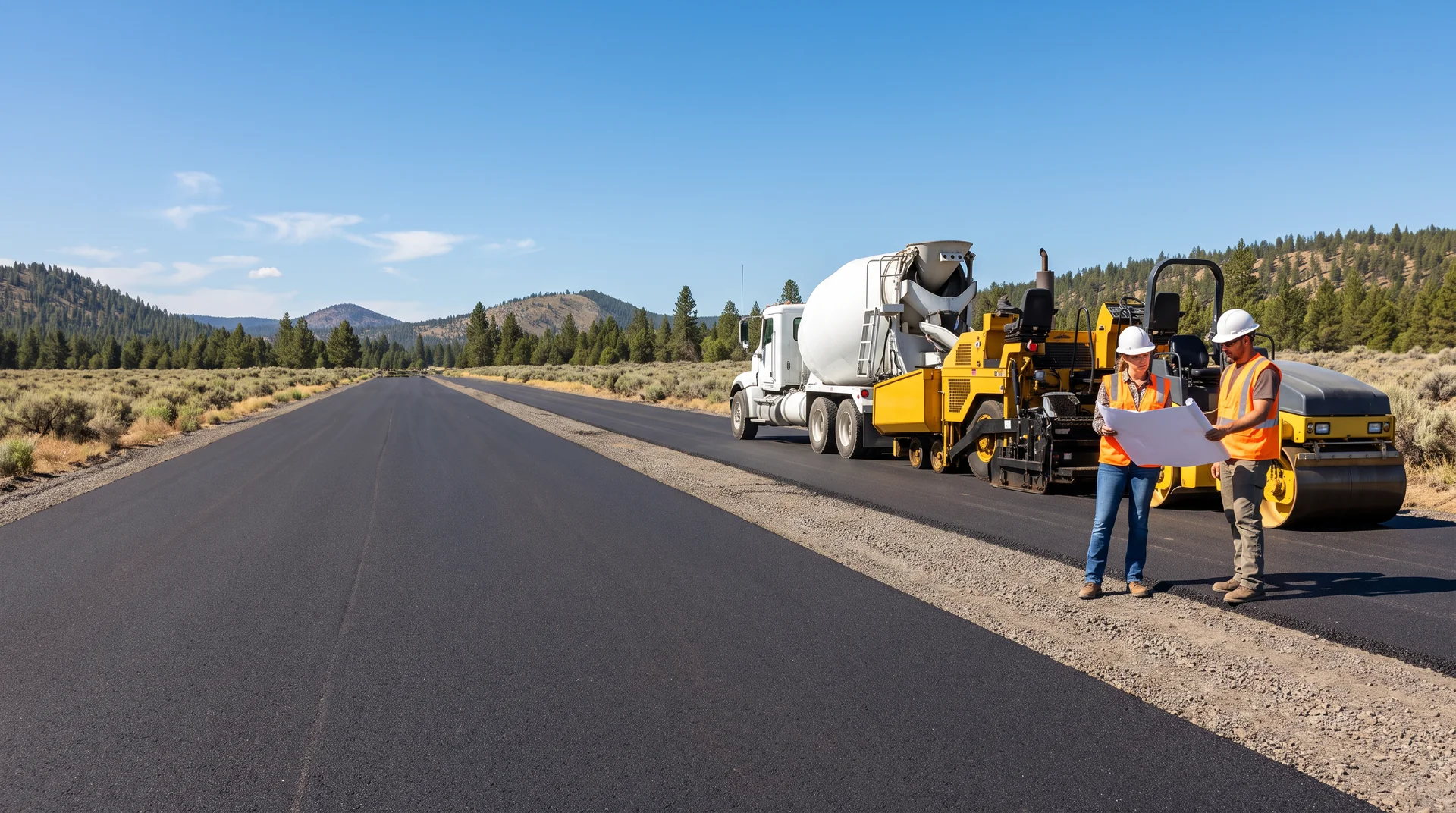

A ready-mix truck headed to a pour, an asphalt paver moving through an active lane closure, a roller crossing a fresh lift, and a service pickup carrying tools can all be part of one Oregon project—but not necessarily one simple insurance question. Start with the site's commercial auto insurance page, then build a conversation around your actual vehicles, drivers, work zones, equipment, contracts, and operating territory.
This article is educational information, not insurance, transportation, safety, legal, licensing, tax, environmental, contract, regulatory, underwriting, or claim advice. It cannot determine whether an Oregon credential, permit, filing, endorsement, certificate, policy, limit, exclusion, contract clause, driver qualification, or safety practice applies to a particular business or loss. Current laws, project documents, agency requirements, carrier rules, policy terms, declarations, endorsements, and actual facts control.
Heavy Paving Operations Are More Than a Vehicle Schedule
A paving contractor may own mixer trucks, dump trucks, water trucks, transfer equipment, tractors, rollers, pavers, trailers, lowboys, fuel/service units, pickups, portable plants, tools, parts inventory, and leased or rented equipment. Some businesses haul their own material; some operate for hire; some use owner-operators or subcontractors; some do only private work while others bid municipal, county, state, or public-works projects. Those differences can change the questions an insurance professional needs to ask.
Separate the vehicle from what it does. A truck that moves from the yard to a private jobsite can present different facts than a truck traveling long distances between quarries, plants, public roads, supplier yards, and projects. A lowboy moving a roller or paver involves different equipment and loading facts than a mixer carrying liquid concrete. Oregon's dump-truck and aggregate-hauling guide and the site's tools, equipment, and inventory in company vehicles article can help organize a more detailed inventory of those operations.
| Project fact to identify | Why it can change the discussion | Useful records to bring |
|---|---|---|
| Truck, trailer, and equipment schedule | A mixer, dump truck, paver, roller, lowboy, water truck, support pickup, rented machine, and borrowed trailer are not interchangeable assets. | VINs, plates, serial numbers, photos, stated values, lease/rental agreements, lienholder details, and replacement-cost information. |
| How and where the fleet operates | For-hire hauling, own-account operations, interstate movement, weight, route, mileage, off-road travel, private roads, active lanes, and public-right-of-way work can each prompt different questions. | Routes, job list, travel radius, dispatch information, material/haul description, ODOT records, permits, and current registrations. |
| People around moving equipment | Drivers, operators, laborers, flaggers, visitors, owner-operators, and subcontractors can be exposed to traffic, backing, loading, unloading, heat, dust, or work-zone hazards. | Driver and operator list, payroll, subcontractor agreements, training outlines, safety plan, vehicle inspection process, and incident history. |
| Contracts and owner requirements | A prime contract, subcontract, equipment lease, public-owner specification, vendor agreement, or certificate request may call for specific documents or terms. | Unsigned and signed agreements, bid specifications, certificate/additional-insured wording, insurance requirements, indemnity language, and deadline calendar. |
| Revenue when a unit is down | A key mixer, paver, truck, plant component, or shop repair can affect project sequencing, rental decisions, payroll, and delivery commitments. | Maintenance records, critical equipment list, backup/rental plan, customer schedule, revenue records, and current policy documents. |
Oregon Truck Credentials and Insurance Filings Are Not a Generic Checklist
Oregon Department of Transportation's Commerce and Compliance Division explains that an Oregon operating account may be required in circumstances such as operating trucks over specified combined weights or hauling for hire, and it directs carriers to current registration, credential, tax, insurance, records, and permit resources.[2] The facts that matter include the actual vehicle, combined weight, carrier status, operating area, route, and current regulations. Do not borrow a compliance answer from another contractor, jobsite, or truck configuration.
ODOT separately publishes commercial-vehicle licensing, interstate/IFTA, over-dimension, insurance, and renewal resources.[3] Its insurance page also distinguishes among certain interstate and intrastate carrier filings and describes circumstances in which public-liability, property-damage, or cargo proof may be filed with the agency.[5] Those agency filings are not the same as a complete review of every truck, trailer, jobsite, employee, piece of equipment, contract, property, or claim scenario. Confirm transportation requirements with ODOT and discuss the insurance program with the professionals serving the operation.
Jobsite Exposure Can Move From the Road to the Work Zone in Seconds
A paving project may involve public traffic, delivery windows, staged lanes, backing movements, hot material, confined site access, temporary striping, plant traffic, pedestrian activity, loaders, rollers, and equipment moving around crews. Federal OSHA identifies struck-by and caught-between hazards among common highway infrastructure work-zone risks, while Oregon OSHA offers construction resources covering topics such as high-visibility apparel, motor-vehicle safety, heavy equipment, flagging, and concrete/masonry work.[6] [7]
ODOT's Traffic Control Plans Design Manual is an ODOT technical design resource for temporary traffic-control plans and cautions that other agencies may have different policies.[4] It is helpful context for understanding why a project can have carefully specified work-zone, staging, marking, sign, and traffic-management requirements. It is not a substitute for a project-specific traffic-control plan, agency direction, contract reading, or safety evaluation. The same care that goes into a work-zone plan should go into describing operations accurately for insurance purposes.
Put the Fleet, Equipment, and Project Documents in One Conversation
Prineville Insurance can help organize a policy-specific review around the vehicles, trailers, equipment, drivers, jobsite practices, contracts, certificates, property, and current insurance documents behind your actual Oregon operation. Bring the facts early, before a bid, lease, project award, equipment delivery, or certificate deadline turns a question into an assumption.
Equipment, Material, and Property Need Their Own Questions
A scheduled truck does not answer every question about a paver, roller, trailer, generator, hopper, saw, compressor, spare part, temporary storage yard, shop, or batch/plant equipment. Ownership, lease terms, rental agreements, location, transport method, valuation, maintenance, access controls, and who has care, custody, or control can all matter. The site's contractor insurance page and construction insurance resource can help a contractor organize the broader property-and-operations discussion.
Transportation of a machine or material can also be a separate fact pattern. FMCSA explains that its cargo-securement rules apply to cargo-carrying commercial motor vehicles in interstate commerce and distinguishes certain bulk commodities carried in integral tanks, hoppers, boxes, or similar vehicle structures from those rules.[8] The result for a particular vehicle, load, route, and trip should be confirmed with the relevant transportation and safety authorities—not guessed from a general description of asphalt, aggregate, concrete, pipe, machinery, or a trailer.
Contracts, Certificates, and Bonds Should Be Read Before the Deadline
Paving and concrete work can be governed by a private owner agreement, general-contractor subcontract, rental contract, material supply agreement, public-owner specification, or subcontractor agreement. Each may request a certificate, additional-insured language, waiver, particular limit, auto requirement, indemnity provision, completed-operations wording, or bond. Ask for the complete contract and insurance-requirements section early; a certificate alone may not show every term that needs attention.
Oregon CCB says a certificate demonstrating valid public liability and property-damage insurance is required for its licensing process and that surety bonds are required based on the contractor's endorsement.[1] That helps explain why a contractor may have separate licensing and bond documentation. It does not mean a CCB bond is a payment guarantee for every issue, that a certificate changes the policy, or that any particular project requirement is met. Use the site's surety bonds page, commercial property insurance page, and umbrella insurance resource to prepare thoughtful questions, then compare those questions with the actual contract and policy.
Review Drivers, Crews, and Subcontractors as the Season Changes
Spring startup, peak paving season, a new quarry or material supplier, a larger public bid, a newly acquired mixer, an added lowboy, a hired driver, a subcontracted trucking unit, or a different project radius can all change the operating picture. Keep vehicle and equipment lists current. Match drivers and operators to the actual units they use. Preserve training, inspection, maintenance, and project records. Discuss payroll, subcontractor roles, and changes in work with appropriate advisers rather than assuming last year's description still fits.
For a public project, review the bid package and current owner requirements at the same time as the insurance documents. The site's Oregon public-works contractor insurance guide provides additional questions about bonds, certificates, additional-insured requests, jobsite vehicles, and subcontractors. For employee exposure, the workers' compensation insurance page is a helpful starting point. Neither page replaces project-specific legal, safety, regulatory, or policy review.
Frequently Asked Questions
Does a ready-mix, asphalt, or paving truck fit under a standard business auto policy?
Do not assume it does. A mixer truck, paver-support truck, lowboy, dump truck, service pickup, trailer, or vehicle carrying specialized equipment can each present different vehicle, value, radius, driver, jobsite, hauling, and contractual facts. The declarations, scheduled vehicles, policy definitions, endorsements, carrier requirements, and loss facts control. Bring the actual fleet and operations to a policy-specific review.
Does an Oregon contractor license or CCB bond insure a paving truck or jobsite loss?
No single document answers every insurance question. Oregon CCB license, bond, and liability-insurance documentation serve licensing purposes; truck, equipment, cargo, worker, property, contract, environmental, and jobsite issues may require separate review. A certificate, bond, or license is not a guarantee of coverage, compliance, workmanship, payment, or a claim result.
Do Oregon motor-carrier insurance filings apply to every concrete or paving truck?
Eligibility and filing requirements depend on the carrier, vehicle weight, for-hire status, operations, routes, authority, and current law. ODOT publishes different material for intrastate and interstate carrier operations. Confirm the actual facts with ODOT and qualified transportation professionals rather than relying on a blog or another operator's answer.
Are tools, spare parts, asphalt equipment, and pavers automatically covered wherever they are?
Do not assume they are. Ownership, lease or rental terms, the equipment schedule, location, transport method, storage, security, value, and the policy's definitions and exclusions can matter. Itemize the equipment and review the actual policy before a project starts, an item is moved, or a rental agreement is signed.
What should a paving or ready-mix contractor bring to an insurance review?
Bring current declarations, vehicle and driver lists, VINs, vehicle values, equipment schedules, lease and rental agreements, contracts, certificates, job locations, haul routes, project scope, payroll and subcontractor information, loss history, safety procedures, maintenance and inspection records, and questions about deductibles and contractual requirements. The goal is to discuss the actual operation, not to make assumptions from a generic checklist.
References
- Oregon Construction Contractors Board — CCB License
- Oregon Department of Transportation — Motor Carrier Requirements to Operate in Oregon
- Oregon Department of Transportation — Commercial Vehicle Licensing Services
- Oregon Department of Transportation — Traffic Control Plans Design Manual
- Oregon Department of Transportation — Insurance Requirements
- Oregon OSHA — Construction
- Occupational Safety and Health Administration — Highway Work Zones and Signs, Signals, and Barricades
- Federal Motor Carrier Safety Administration — Cargo Securement Rules


