




A pickup, cargo van, box truck, trailer, or service vehicle may be the most mobile part of an Oregon business. It can also hold expensive tools, replacement parts, retail stock, sample products, client property, generators, ladders, mobile equipment, and records needed for the next job. A thoughtful commercial auto insurance review should look beyond the vehicle itself and ask exactly what travels with it.
This is educational information, not legal, regulatory, accounting, security, or insurance advice. A vehicle schedule, photo, receipt, certificate, or blog post does not create coverage, prove that an item is covered, set a value, eliminate a deductible, satisfy a filing requirement, or guarantee a claim outcome. Policy forms, endorsements, item classification, ownership, attachment, storage, location, cause of loss, limits, sublimits, exclusions, valuation terms, and the facts of a claim determine what may apply. The goal is to help Oregon businesses organize better questions before a theft, collision, wildfire evacuation, water loss, or job-site disruption.
The Vehicle May Be Insured—But What About the Business Property Inside It?
Oregon’s Division of Financial Regulation (DFR) explains that commercial auto policies typically have higher liability limits than personal policies and may address rented and other nonowned vehicles, including an employee’s car driven for company business.[1] The regulator advises business owners to consider higher insurance for permanently attached items such as a generator or toolbox. That is an important starting point, not a universal coverage rule for every item on a work truck, van, trailer, or passenger vehicle.
The questions become more specific once the door opens. Is the generator permanently mounted or simply transported? Are the tools owned by the business, a worker, a subcontractor, or a customer? Is the business carrying materials it will install, goods it has sold, stock it owns, rented equipment, or property belonging to someone else? Is the item used only at a job site, stored overnight in the vehicle, or hauled across Oregon for a fee? These facts can direct the conversation toward commercial auto, physical damage, contractors equipment or inland marine, business personal property, cargo, installation, customer-property, or another policy feature. No one label answers every question.
Start With a Vehicle-by-Vehicle Loadout
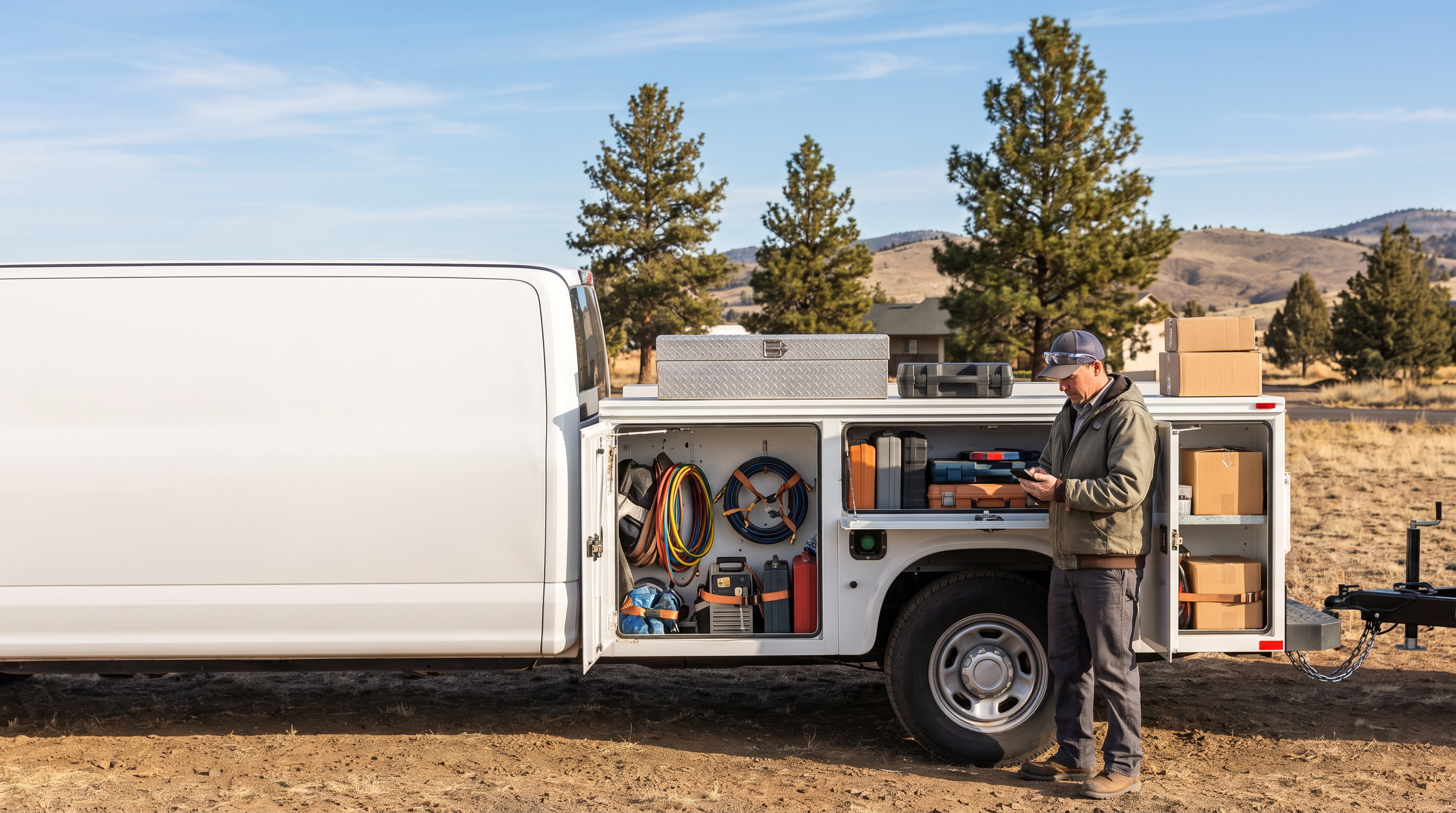
Build a current list for each vehicle—not only a master company tool list. For a Prineville HVAC van, that might include tool cases, recovery equipment, parts bins, ladders, secured test devices, and a generator. A Bend landscaper’s truck may carry mowers, trimmers, trailers, fuel equipment, and customer materials. A Redmond retailer’s delivery van might contain inventory, packaging, point-of-sale equipment, and returns. A farm-service crew traveling to Madras, Sisters, or La Pine may carry pumps, diagnostic tools, hoses, remote-site supplies, and trailer-mounted equipment.
Photograph the exterior, cab, open storage compartments, hitch area, racks, and the normal loadout. Keep make, model, serial, purchase, rental, lease, maintenance, and ownership records where practical. Retain an indication of whether an item is bolted down, stored in a locked compartment, loaded temporarily, owned by the company, personally owned by a worker, or entrusted by a customer. DFR’s general commercial insurance guidance can help frame the wider business-risk discussion, but the actual policy controls each coverage question.
| What travels in the vehicle? | Questions to document | Coverage conversation to start |
|---|---|---|
| Permanently attached equipment | How and where is it affixed? Is it removable? Is it listed, valued, leased, or financed? | Ask how the current commercial auto and physical-damage provisions treat attached equipment and what documentation the insurer wants. |
| Loose tools and job equipment | Who owns each item? What is its serial number, purchase record, usual storage location, and normal travel pattern? | Ask whether a contractors-equipment, inland-marine, business-property, or other policy feature may be relevant; do not assume the auto policy responds. |
| Stock, supplies, and materials | Are the items sold, installed, delivered, returned, or held overnight? Is the property your business’s or another party’s? | Ask how property in transit, business inventory, installation materials, theft, and valuation are addressed under the actual program. |
| Customer property | What is in your care, custody, control, repair, transport, or temporary storage? What contract or work order applies? | Ask about the customer-property and contractual-liability questions before accepting or transporting it. |
| Rented, borrowed, or employee-owned vehicles | Who owns the vehicle? Who drives it? What does the agreement say? How is it used for business? | Ask about hired/non-owned auto and the effect of leases, rental agreements, personal vehicles, and employee work use. |
| Mobile equipment and trailers | Is the unit a vehicle, a trailer, or equipment? Does it operate on public roads, at a job site, or both? | Ask each insurer to identify the policy and terms intended for towing, road use, stored equipment, and job-site operation. |
Six Questions That Prevent a “Basic Auto Policy” Assumption
First, separate liability from property. Commercial auto liability is generally a conversation about the business’s responsibility for an accident involving a covered auto; it is not automatically a complete inventory solution for what is carried in or on the vehicle. Physical-damage choices can raise different questions about damage to a scheduled auto. Either feature may be important, but neither should be treated as a blanket answer for every wrench, laptop, compressor, sample kit, trailer, pallet, or customer-owned item.
Second, identify the item’s relationship to the vehicle. Oregon DFR’s permanently attached generator/toolbox example is a prompt to ask how attachment is defined under your policy.[1] A loose tool case stored in a van, a piece of mobile equipment used at a job site, and a trailer-mounted unit may each need a different conversation. The Oregon Department of Administrative Services notes, in its own state risk-management language, that mobile equipment is not treated as an automobile for its automobile-liability clause.[5] Private commercial policies can differ, so use the distinction to ask a clearer question rather than applying that public-agency clause to your own policy.
Third, identify ownership. A business’s tools are different from a worker’s personal tools, a rented lift, a subcontractor’s equipment, or customer property picked up for repair. Fourth, identify purpose: are you transporting the property to perform your own work, delivering your own goods, hauling someone else’s goods for compensation, or simply storing it overnight? Fifth, identify location and security: does the vehicle park at a fenced yard, a garage, a motel, a job site, a rural driveway, or an unattended public lot? Sixth, identify the contract and any customer requirement before the work begins. These questions can be coordinated with your general liability, property, contract, and operations review.
Why Cargo Rules and Business Property Questions Should Not Be Mixed Together
“Cargo” is often used casually for anything in the back of a truck, but insurance and regulatory contexts can be more specific. ODOT says cargo insurance may be required for certain intrastate motor carriers applying for Intrastate 1A Permit Authority and describes filings for loads hauled for hire that are subject to loss or damage during transportation.[3] FMCSA likewise explains that federal insurance filing obligations vary based on entity type, operating authority, cargo type, and vehicle type.[4] These sources are useful because they show that motor-carrier obligations are specialized—not because they establish a coverage answer for every Oregon service vehicle.
A contractor transporting its own tools, a mobile salon carrying supplies, an independent repair shop collecting a client’s equipment, and a freight carrier hauling another party’s load may all have different questions. For-hire or interstate operations should confirm their requirements directly with the applicable regulator, carrier, broker, and legal/compliance advisers. Other businesses should not buy, reject, or rely on a coverage feature simply because it sounds like “cargo.” Describe the operation precisely, then ask which policy, endorsement, limit, deductible, valuation basis, and exclusions are relevant.
Get the Vehicle, Loadout, and Business Operation on the Same Page
Prineville Insurance can help you organize a policy-specific conversation around vehicles, drivers, attachments, loose equipment, inventory, customer property, trailers, rented units, and changing business operations.
Central Oregon Scenarios Worth Reviewing Before the Next Job
Contractors and trade businesses often expand one vehicle at a time. An owner buys a pickup, adds a ladder rack, purchases a generator, begins carrying an employee’s tools, takes on larger projects, then starts using a trailer or renting specialty equipment. A service company may add delivery work, install a storage system, or send a technician farther from its Prineville, Bend, or Redmond base. A farm or ranch operation may move equipment along rural routes or to remote water, haying, or livestock locations. Each operational change is a good reason to review the vehicle schedule, driver list, equipment records, contracts, and applicable insurance—not evidence that coverage automatically changes with the business.
If a vehicle is used to meet a contract requirement, secure a certificate of insurance, or transport materials to a customer’s site, make the discussion earlier rather than later. Your business may also need to compare the expectations in a contract with the insurance actually in force. See our guide for Oregon businesses working with subcontractors, freelancers, and 1099 workers for additional pre-work documentation and certificate questions. For agricultural or remote-property operations, our Oregon farm irrigation and remote property guide offers related questions about equipment, records, and rural operations.
Theft, weather, fire, and collision prevention should be operational rather than insurance-only decisions. DFR identifies anti-theft devices and secure parking as factors that may affect a commercial auto premium; whether a particular feature changes your price or coverage depends on the insurer and program.[1] Consider locked storage where appropriate, current keys/access management, driver training, written equipment check-out procedures, routine vehicle inspections, secure overnight parking, accurate records, and a plan for what the crew should take during a wildfire evacuation. Do not rely on a security measure as proof that a loss will be covered; it is one part of a broader prevention and documentation practice.
Keep the Driver, Vehicle, and Equipment Records Current
DFR recommends that a business make sure its own name is listed as principal insured when it owns or leases the vehicle, and it advises reviewing driving records and driver training for employees who operate company cars.[1] That makes driver and ownership records as important as an equipment list. Notify your insurance professional about a new entity name, leased or newly acquired vehicle, employee driver, change in vehicle use, service territory, trailer, delivery practice, hazardous-material exposure, or new business line. Ask what needs to be updated before—not after—the first trip.
Vehicle exposures can also overlap with other business risks. A technician may have customer data on a laptop in the van, a job-site crew may have payroll or scheduling information on a tablet, or a vehicle theft may interrupt operations. A cyber liability discussion can be appropriate when devices or business information travel with the crew. Employees using vehicles and equipment also raise separate workplace-safety and workers’ compensation questions. Those policies address different risks, and a claim under one should never be assumed to answer a question under another.
What to Do If a Vehicle, Tool, or Load Is Damaged or Stolen
Prioritize people and emergency directions. Seek medical or emergency help where needed and follow law-enforcement or fire-evacuation instructions. Once it is safe, preserve relevant photos, identify the vehicle and property involved, protect remaining property from further damage only as appropriate, retain receipts for emergency measures, keep repair or replacement documentation, and notify the insurer or agent promptly. Avoid discarding damaged property before the insurer has had an opportunity to provide instructions or inspect it. A current vehicle-loadout record can help you describe the loss, but it does not decide liability, coverage, value, or payment.
Keep the claim conversation separate from a future operations review. After the immediate issue is stabilized, note the unanswered questions: Was the item permanently attached? Who owned it? Was it scheduled? Was it being transported for the business or for another party? Did an employee use a personal vehicle? Was a trailer involved? The answers may inform an update to a future policy, but each current claim is governed by its own facts and policy terms. For broader recovery steps, visit the site’s Oregon insurance claim process guide.
Frequently Asked Questions
Does commercial auto insurance cover the tools and equipment inside my company vehicle?
It depends. Commercial auto coverage, physical-damage coverage, attached-equipment provisions, contractors equipment or inland-marine coverage, business personal-property coverage, endorsements, limits, deductibles, exclusions, the equipment’s ownership, and the facts of the loss can all matter. Oregon DFR specifically suggests discussing higher insurance for permanently attached items such as a generator or toolbox. That does not establish how a policy treats loose tools, stock, materials, mobile equipment, customer property, or theft from a vehicle. Review the actual policy with an insurance professional.
What does permanently attached equipment mean for insurance purposes?
The exact definition belongs in the policy and may vary by insurer. Oregon DFR uses a generator or toolbox as examples of items that can be permanently attached to a business vehicle. Whether an item is actually attached, removable, separately scheduled, owned or leased, or treated as vehicle equipment is a policy-specific question. Take photos and retain invoices, then ask about the applicable policy language before a loss.
Is cargo insurance the same as coverage for my company’s own tools or inventory?
Not necessarily. Oregon ODOT’s motor-carrier guidance discusses cargo filings for certain for-hire carriers and hauled loads. Those regulatory filing rules are specialized and should not be treated as a coverage answer for a contractor carrying its own tools, a retailer moving its own stock, or a service technician transporting parts. Ask what property is being transported, who owns it, why it is being transported, and which policy or endorsement is intended to respond.
What should I document before a vehicle theft, crash, or wildfire evacuation?
Create a current vehicle-by-vehicle record with exterior and interior photos, VIN and plate information kept securely, tool and equipment photos, make/model/serial details where relevant, purchase records, lease or rental agreements, and a clear note about ownership. Update the list after major purchases, vehicle changes, or a move to a new storage location. Documentation can help organize a claim and policy review, but it does not guarantee coverage, a valuation, or payment.
What if an employee uses a personal vehicle for company work?
Oregon DFR notes that commercial auto policies may address rented and other nonowned vehicles, including employees’ cars used for company business. Whether coverage applies and how a business should structure its program depends on the policy, employee use, reimbursement arrangements, vehicle ownership, employment relationship, and insurer requirements. Raise the question before a new delivery, sales, service, or travel practice begins.
The Practical Next Step: Review the Load, Not Just the Vehicle
Before the next renewal, purchase, contract, long-distance trip, or expansion in services, make a vehicle-by-vehicle inventory. Bring photos, purchase records, serials where relevant, leases, vehicle schedules, driver information, certificates, and a description of how the property is actually used. A coordinated review can help identify questions across commercial auto, business property, tools and equipment, general liability, cyber, employees, and contracts. If your growing operation also requires bonds, review the related Oregon surety bonds resource so bonding and insurance questions are organized separately.
The strongest starting point is accuracy: describe the vehicles, people, property, routes, storage, contracts, and services your business uses today. Then use that record to hold a policy-specific conversation with the insurers you work with. That approach is more reliable than assuming a “basic” auto policy automatically travels as far as your tools, equipment, inventory, and business do.
References
- Oregon Division of Financial Regulation — Commercial Auto Insurance
- Oregon Division of Financial Regulation — Property Insurance for Businesses
- Oregon Department of Transportation, Commerce and Compliance Division — Insurance Requirements
- Federal Motor Carrier Safety Administration — Insurance Filing Requirements
- Oregon Department of Administrative Services, Risk Management — Automobile Liability Insurance


