
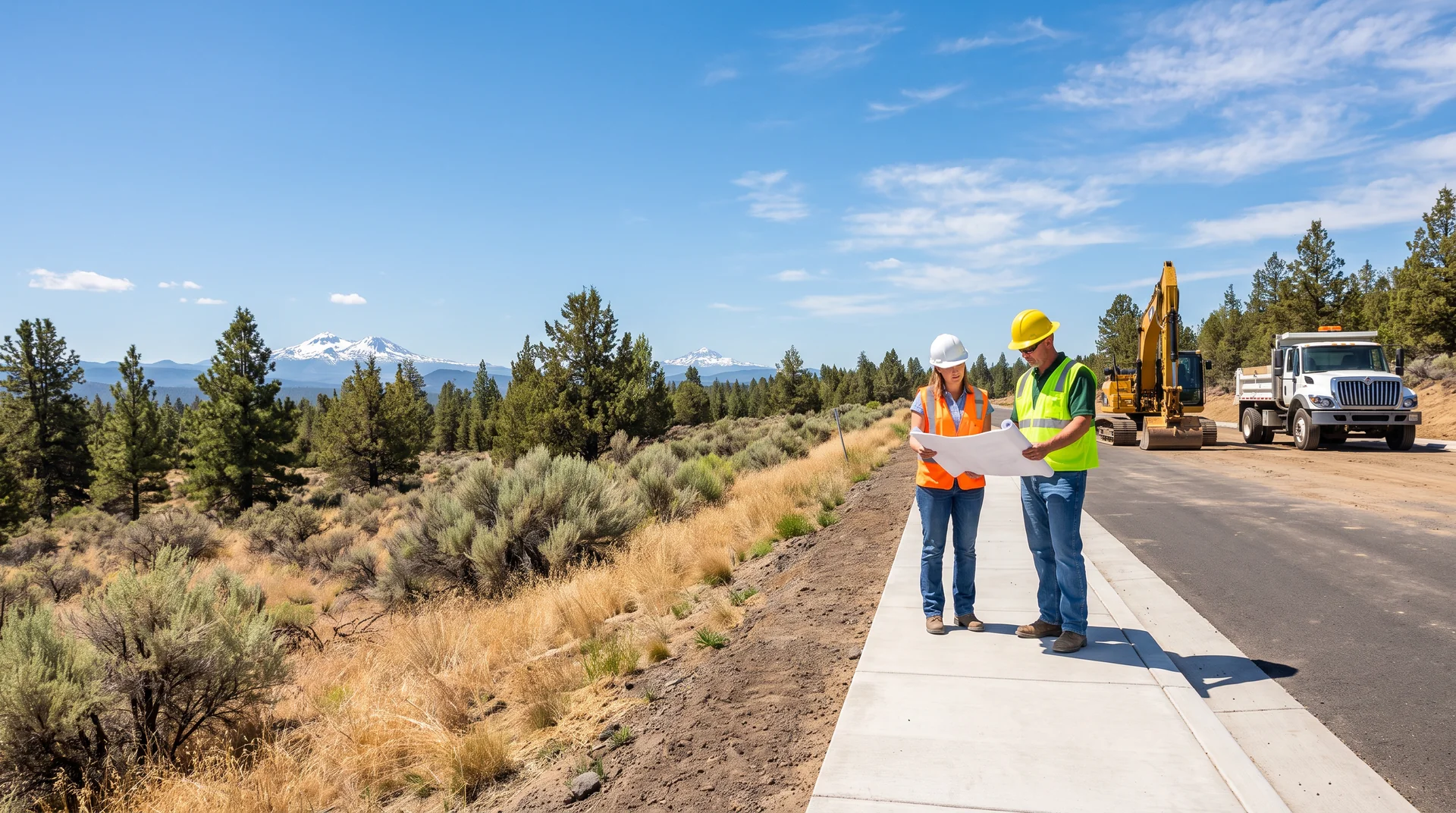

A public works opportunity can be a road, sidewalk, utility, school, park, water, municipal-building, or public-facility project—and it can ask far more than whether a bid price is competitive. Begin with the operation-specific questions on the site's contractor insurance page, then line up the actual solicitation, contract, scope, entity, workers, subcontractors, vehicles, equipment, bonds, certificates, and endorsements before work begins.
This article is educational information, not insurance, legal, bonding, public-procurement, prevailing-wage, labor, licensing, safety, transportation, contract, underwriting, or claim advice. It cannot decide whether a project is public works, which bond, certificate, endorsement, limit, policy, filing, approval, exemption, vehicle authority, or contract term applies. The current bid package, public-agency instructions, statutes and rules, policy documents, carrier requirements, surety terms, entities, and facts control.
Start With the Project Documents, Not a Generic Insurance List
Oregon's procurement guidance explains that public works can encompass construction and related work funded directly or indirectly by a public agency for a public benefit, with the statutory definition, project facts, and exemptions all relevant.[1] That means a paving contractor in Prineville, a utility subcontractor in Redmond, a bridge crew serving rural Central Oregon, and a builder renovating a public facility may each face different requirements—even if all describe their work as “construction.”
Before asking for a certificate, collect the full solicitation, addenda, contract, insurance exhibit, bond form, project schedule, scope, site-access requirements, agency correspondence, and any federal-funding language. Then compare those materials with the actual policy forms and endorsements. The goal is not to promise that a program “meets the bid.” It is to identify questions early enough to resolve them with the public agency, insurer, bond producer, surety, broker, and qualified advisers.
| Project change or request | Questions to organize | Documents to bring to review |
|---|---|---|
| A public agency issues a solicitation | Is the scope public works? Which bond, certificate, coverage, endorsement, wage, safety, vehicle, and subcontract provisions appear in the actual bid package? | Solicitation, addenda, bid form, insurance exhibit, bond form, scope, plans, agency contact, anticipated start date, and funding information. |
| The contract requests a certificate or additional insured | What exact legal entity, certificate holder, policy dates, limits, operations, primary/non-contributory wording, waiver request, and additional-insured endorsement wording does the contract require? | Executed or draft contract, certificate request, endorsement wording, named-insured details, policy declarations, endorsements, agent contact, and job number. |
| A crew adds trucks, trailers, rented equipment, or employee vehicles | Who owns, leases, rents, drives, parks, maintains, and dispatches each vehicle or item? Is it used for hauling, towing, jobsite travel, or for-hire work? | Vehicle and driver schedule, registrations, leases, rental agreements, equipment lists, garaging, routes, cargo or towing details, and subcontract terms. |
| A subcontractor is hired | What is each tier's actual scope, legal entity, bond status, payroll or worker roles, certificates, endorsements, equipment, vehicles, site access, and flow-down obligation? | Subcontract, scope sheet, CCB and public-works bond records where applicable, certificate/endorsement requests, safety plan, payment terms, and contact list. |
| The job is delayed, expanded, or altered | Do the project duration, values, locations, equipment, payroll, subcontractor tiers, traffic control, storage, or required documents change? | Change orders, revised schedule, site plan, updated values, certificates, bonds, agency notices, equipment records, and revised contracts. |
Know Which Bond Is Being Discussed
“Bond” is often used as a catch-all term, but public works participants may encounter more than one instrument. Oregon's public-works bond law describes a $30,000 public works bond filed with the Construction Contractors Board before starting covered work by a contractor or subcontractor, subject to the statute's exceptions and elections.[3] Oregon DAS also states that covered public-works contract documents require the contractor and every subcontractor to have the applicable public works bond filed before work begins unless exempt.[1]
That is not the same as a performance or payment bond on a public-improvement contract. ORS 279C.380 describes performance and payment bonds equal to the full contract price for a successful bidder, subject to statutory exceptions and the agency's applicable process.[2] Nor is either automatically the same as a contractor license bond. Your surety bonds resource and construction insurance resource are useful starting points, but the specific solicitation and bond form are the documents that define the request.
Certificates, Additional Insured Requests, and Endorsements
A certificate of insurance is evidence of active coverage information, not a policy rewrite. Oregon DAS Risk Management's current guide says a certificate cannot change coverage or add contract terms, and that requested endorsements must be attached to count.[4] Its State risk-management template highlights the importance of matching the legal named insured, certificate holder, coverage types, limits, policy dates, job or contract reference, and attached endorsements to the actual contract.
Additional-insured, waiver-of-subrogation, primary/non-contributory, cancellation-notice, completed-operations, and project-specific requests deserve exact review. Do not assume a phrase in a bid form automatically appears in a policy, that every carrier offers every request, or that a certificate alone proves an endorsement. Bring the executed or proposed contract, exact wording, entity names, and required time period to your agent before promising a document to the agency or prime contractor. The site's commercial general liability and commercial umbrella insurance resources can help frame the policy-and-limit discussion.
Review the Contract and the Operation Together
Prineville Insurance can help organize a policy-specific discussion around the bid documents, entity, bond requests, certificates, endorsements, jobsite operations, vehicles, equipment, subcontractors, workers, property, and continuity exposures involved in an Oregon public works opportunity.
Jobsite Vehicles, Road Work, and Equipment
Public works can put a contractor's pickups, vans, dump trucks, trailers, rented machinery, employee-driven vehicles, and permanently attached tools in a different operational setting from a typical private job. Oregon DFR explains that standard liability does not address automobile or truck claims, and its commercial-auto guidance asks businesses to consider ownership or lease status, drivers, use, rented and nonowned vehicles, and attached items.[6][7] This is why the project schedule, route, vehicle list, tow or hauling details, driver information, and contract language all belong in the review.
ODOT's Commerce and Compliance Division lists operating-authority triggers including trucks over 26,000 pounds and smaller trucks hauling for hire, while also identifying exemptions and operation-specific rules.[8] A construction business should not assume that a public project changes—or eliminates—those rules. Ask the appropriate ODOT contact and qualified transportation advisers about the actual equipment, weights, hauling, registration, authority, and route. Use the site's commercial auto insurance and commercial property insurance resources to prepare a vehicle, equipment, and tools schedule for a policy-specific review.
Subcontractors: Verify the Paperwork, Scope, and Flow-Down
Public works risks are not limited to a prime contractor. The Oregon DAS manual says the applicable public works bond requirements must appear in the subcontract chain, and ORS 279C.836 requires a contractor to verify a subcontractor's relevant public works bond status before allowing it to start work, subject to the statute's choices and exemptions.[1][3] That is an operations and documentation issue as well as a legal and labor question.
Create a practical subcontractor file: the signed agreement, legal entity name, detailed scope, public works bond status where applicable, required certificates, endorsements, limits, dates, equipment, vehicles, worker roles, safety responsibilities, traffic control, site access, and change-order process. The site's Oregon subcontractor, freelancer, and 1099-worker guide and workers' compensation resource can help identify questions, but neither classifies a worker or establishes a contract requirement for a particular project.
Safety, Property, and Project Continuity
Oregon OSHA construction rules establish minimum safety and health requirements for employees doing construction work and address topics such as motor vehicles and mechanized equipment, traffic exposure, excavation, fall protection, material handling, and more.[9] Safe operations do not guarantee coverage, and insurance does not certify safety compliance. Still, a current safety plan, training records, traffic-control approach, jobsite maps, incident procedures, equipment controls, and subcontractor coordination can make a policy and contract review more accurate.
Review where materials, tools, mobile equipment, jobsite trailers, plans, and records are stored; who is responsible under the contract; and how an interruption could affect labor, rented equipment, deadlines, and future work. When the project includes course-of-construction or builder's-risk questions, bring values, interests, storage details, project phase, contract language, and lender or agency requirements to the discussion. The site's builder's risk insurance resource can help prepare the right questions without implying a particular policy responds to a particular loss.
Frequently Asked Questions
Is an Oregon public works bond the same as a performance or payment bond?
No. They are different instruments with different statutory and contract purposes. Oregon's public works bond statute addresses a bond that contractors and subcontractors generally file with the Construction Contractors Board before covered public works work, subject to its exemptions and elections. A public-improvement contract may also require separate performance and payment bonds. Read the current bid package and governing requirements with the public agency, surety professional, and qualified advisers rather than treating one bond as a substitute for another.
Does a certificate of insurance make a contractor an additional insured?
Not by itself. Oregon DAS Risk Management explains that a certificate shows active insurance information but does not change the policy or add contract terms; the requested endorsement must be attached to count. Whether an additional-insured request is available, valid, or responsive depends on the policy, endorsement, contract wording, named insured, project, carrier, and facts.
Does general liability automatically address a jobsite truck or employee vehicle?
Do not assume so. Oregon DFR notes that standard liability insurance does not cover automobile or truck claims. Ownership, leasing, driver, vehicle use, commercial-auto policy wording, hired/nonowned status, attached equipment, endorsements, contract requirements, and incident facts all matter.
Must every subcontractor have the same insurance or bond arrangement as the prime contractor?
Not necessarily, but public works contracts and statutory requirements can create project-specific subcontractor obligations. The Oregon DAS Procurement Manual says applicable public works bond provisions must be carried into subcontracts, and ORS 279C.836 addresses verification before a subcontractor starts work. Match every tier's actual scope, entity, agreement, certificates, bond status, workers, vehicles, and equipment to the current project documents.
What should an Oregon contractor bring to a public works insurance review?
Bring the solicitation, bid form, draft and final contract, scope, addenda, bond and insurance requirements, entity information, certificate requests, endorsement wording, subcontract forms, vehicle and driver schedules, payroll or worker-role information, equipment and property schedules, project locations, safety plan, prior-loss details, and the current policies and endorsements. A policy-specific review can then focus on the actual work instead of a generic checklist.
References
- Oregon Department of Administrative Services — Oregon Procurement Manual: Public Works
- Oregon Legislature — ORS 279C.380: Performance Bond; Payment Bond
- Oregon Legislature source — ORS 279C.836: Public Works Bond
- Oregon DAS Risk Management — A Guide to Controlling Risk: Certificate of Insurance
- Oregon Construction Contractors Board — Contractor License, Liability Insurance, and Workers' Compensation
- Oregon Division of Financial Regulation — Liability Insurance
- Oregon Division of Financial Regulation — Commercial Auto Insurance
- Oregon Department of Transportation — Motor Carrier Requirements to Operate in Oregon
- Oregon OSHA — Construction