



Here is the single most expensive misconception in Central Oregon agricultural insurance: farm families assume their vehicles are covered because they have a farm policy or a personal auto policy. They are not — at least not in the way most people think. And when the claim comes, the gap between what they thought was covered and what the policy actually pays can run into the hundreds of thousands of dollars.
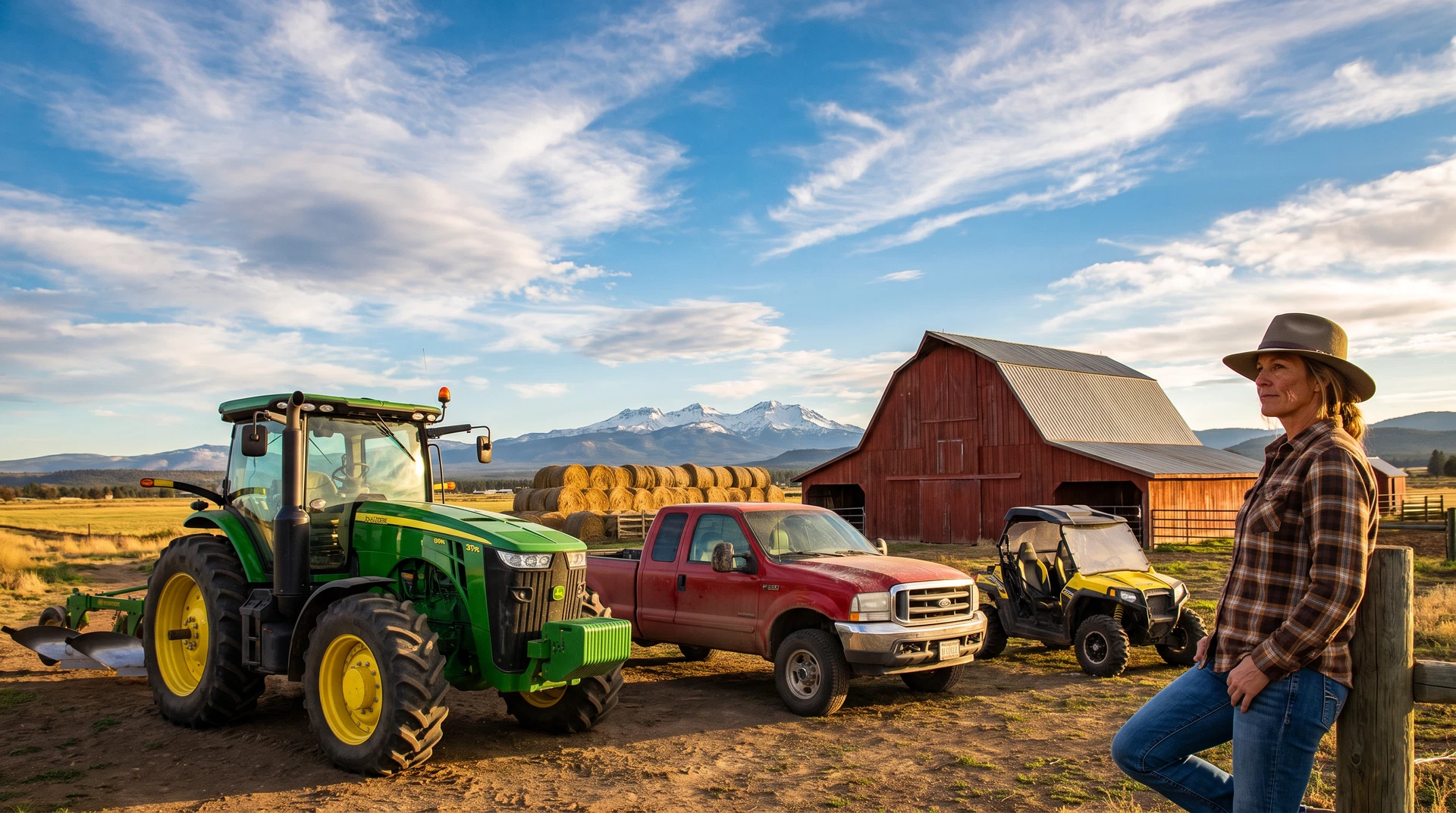
A new John Deere 8R tractor costs $400,000–$500,000. A Case IH Magnum runs $350,000–$450,000. A quality side-by-side UTV — a Polaris Ranger or Can-Am Defender — runs $25,000–$55,000. A well-equipped ranch truck is $60,000–$90,000. The combined value of the vehicles on a working Central Oregon farm or ranch can easily exceed $1 million. And yet most farm families have never had a structured conversation with their agent about exactly which policy covers which vehicle, under what circumstances, and for how much.
This guide covers every category of farm vehicle — tractors, ATVs, UTVs, side-by-sides, and ranch trucks — and explains exactly what each type of policy covers, where the gaps are, and what the right coverage looks like for Central Oregon, Eastern Oregon, and Eastern Washington farm and ranch operations.
Is Your Farm Equipment Insured at Its Current Value?
Equipment values have surged since 2020. Many farm policies were written years ago and have never been updated. A free policy review takes 20 minutes and could close a six-figure gap.
The Three Policy Types — and Why the Wrong One Means No Coverage
Before diving into individual vehicle types, it is essential to understand the three policy categories that govern farm vehicle coverage — because using the wrong one is the root cause of most farm vehicle claim disputes.
| Policy Type | Designed For | Public Road Use | Business Use | Biggest Gap |
|---|---|---|---|---|
| Personal Auto | Private transportation | Yes | Excluded | Any farm or business use voids coverage |
| Farm Auto | Farm vehicles, occasional road use | Occasional only | Farm use only | Regular road use or for-hire hauling not covered |
| Commercial Auto | Regular business road use | Yes — primary use | Yes | Higher cost; off-road vehicles often ineligible |
| Equipment Floater | Tractors, combines, off-road equipment | Not applicable | Yes | Does not include liability coverage |
The practical test is straightforward: how often is the vehicle driven on public roads for farm business purposes? If the answer is "regularly," you need commercial auto. If the answer is "occasionally, to move between fields or to the feed store," farm auto may be appropriate. If the vehicle never leaves the property, an equipment floater or farm property schedule is the right tool. And if the vehicle is used for personal transportation and farm work, you likely need two separate policies — or a carefully structured endorsement.
Tractors: The $500,000 Mistake Nobody Talks About
Modern farm tractors are the most underinsured asset on most Central Oregon farms. The reason is simple: equipment values have surged dramatically since 2020, driven by supply chain disruptions, parts shortages, and strong agricultural commodity prices. A John Deere 8R series tractor that was worth $280,000 in 2019 is worth $420,000–$500,000 today. A Case IH Magnum that was insured for $200,000 five years ago may need $350,000 to replace. But the farm policy — written at the old value and never updated — still shows the old number.
This is the underinsurance trap described in the harvest season insurance checklist: when a total loss occurs, the insurer pays the scheduled value, not the replacement cost. If your tractor is scheduled at $280,000 and costs $480,000 to replace, you absorb the $200,000 difference. That is not a coverage dispute — it is a policy that was never updated.
The second tractor gap is equipment breakdown coverage. Standard farm property policies cover tractors damaged by external perils: fire, theft, hail, lightning, windstorm. What they do not cover is mechanical or electrical failure — the internal breakdown that stops a tractor from working even when it looks perfectly intact. A tractor motor that seizes during harvest. A hydraulic system failure. A GPS guidance system that shorts out. An engine block crack from a freeze. None of these are covered under a standard farm property policy. Equipment breakdown coverage is a separate endorsement that specifically addresses sudden, internal failures — and it is one of the most consistently overlooked gaps in agricultural insurance.
The third gap is liability when a tractor crosses a public road. Most farm policies include some liability coverage for farm equipment operated on public roads — but the limits are often far too low for a piece of equipment weighing 20,000–40,000 pounds. If a tractor is involved in a serious accident on a county road or state highway, the liability exposure can easily exceed $1 million. Review your farm liability limits specifically in the context of your heaviest equipment.
ATVs, UTVs, and Side-by-Sides: The Coverage That Disappears When You Leave the Farm
All-terrain vehicles (ATVs) and utility task vehicles (UTVs) — including side-by-sides like the Polaris Ranger, Can-Am Defender, John Deere Gator, and Kawasaki Mule — have become essential tools on Central Oregon farms and ranches. They are used for everything from checking fence lines and moving irrigation pipe to hauling feed and transporting workers across large properties. And they are expensive: a well-equipped side-by-side UTV runs $25,000–$55,000, and some specialty models exceed $70,000.
Here is the coverage rule that catches most farm families off guard: ATVs and UTVs are covered under a farm policy only when they are specifically scheduled on the policy AND used for agricultural purposes on the insured premises. The moment the vehicle leaves the farm for recreational use, trail riding, or use at any location other than the insured property, the farm policy coverage typically does not apply. And if the vehicle is licensed for road use, it may need a commercial auto or recreational vehicle policy rather than a farm policy.
The practical implications for Central Oregon farm families:
- Every ATV and UTV must be individually scheduled on your farm policy with its current value. A blanket "farm equipment" schedule that does not list each vehicle by make, model, and VIN may not cover a specific vehicle at all.
- Recreational use off the farm is not covered under a standard farm policy. If you take your side-by-side to the Ochoco National Forest, the Maury Mountains, or any off-farm location, you need a separate recreational vehicle policy or endorsement.
- Road-licensed UTVs that are driven on public roads need commercial auto or recreational vehicle coverage, not just a farm policy listing.
- Liability for ATV/UTV accidents — including injuries to passengers, guests, or workers — may not be covered under your farm liability policy if the vehicle is not properly scheduled and the use is not strictly agricultural.
The solution is a structured review of every ATV and UTV on the property: current value, primary use (agricultural vs. recreational), whether it is licensed for road use, and whether it is individually listed on the farm policy. This is exactly the kind of review included in the harvest season insurance checklist — and it takes less than an hour to complete.
Ranch Trucks: The Vehicle That Falls Between Every Policy
The ranch truck is the most policy-mismatched vehicle in agricultural insurance. It is used for personal transportation, farm work, hauling livestock to auction, delivering produce to market, picking up supplies, and pulling trailers — sometimes all in the same week. And because it crosses between personal use, farm use, and commercial use, it often ends up on the wrong policy, or on multiple policies that each have gaps.
The three scenarios that create claim problems:
Scenario 1: Ranch truck on a personal auto policy
The truck is used to haul cattle to the Madras Livestock Auction every month and deliver hay to neighboring ranches. An accident occurs during a delivery run. The personal auto policy's business use exclusion voids the coverage. The claim is denied.
Scenario 2: Ranch truck on a farm auto policy, but used commercially
The truck is covered under a farm auto policy but is used twice a week to deliver produce to Bend restaurants. Farm auto covers vehicles used "primarily on the farm and occasionally on public roads for farm purposes." Regular commercial deliveries exceed this definition. The claim is disputed.
Scenario 3: Ranch truck on commercial auto — correctly structured
The truck is covered under a commercial auto policy with appropriate liability limits. The same accident occurs. The claim is paid. The farm family continues operating.
The practical test for ranch truck coverage: how often does the truck operate on public roads for farm business purposes? If the answer is more than occasionally — more than a few times per month — commercial auto is the appropriate coverage. For farm families with multiple trucks used in different ways, each vehicle's actual use pattern needs to be reviewed individually.
This is the same gap described in our Farm & Cattle Insurance Complete Guide — farm vehicles that cross the line between farm use and regular commercial use without the owner realizing it. The solution is a vehicle-by-vehicle use analysis, not a blanket assumption that "farm vehicles are covered."
Equipment Breakdown: The Coverage Gap That Hits at the Worst Possible Moment
Equipment breakdown coverage — sometimes called boiler and machinery coverage — is the single most consistently overlooked gap in agricultural insurance. And it hits at the worst possible moment: mid-harvest, during peak irrigation season, when the combine goes down on a Saturday afternoon with 400 acres still standing.
Standard farm property policies cover equipment damaged by external perils. What they do not cover is mechanical or electrical failure — the internal breakdown that stops equipment from working even when it looks perfectly intact. This includes:
- Tractor engine seizure or mechanical failure
- Combine or harvester mechanical breakdown
- Irrigation pump motor burnout
- GPS guidance system electrical failure
- Grain dryer electrical system failure
- Hydraulic system failure on any piece of equipment
- Air conditioning or cab pressurization system failure
- Transmission failure on a tractor or combine
Modern farm equipment is far more dependent on sophisticated electronics than it was a decade ago. GPS-guided tractors, automated irrigation controllers, precision planting systems, and computerized combines all represent significant capital investment and significant operational dependency. When any of these fail due to an internal mechanical or electrical cause, the standard farm policy will not respond.
Equipment breakdown coverage can include: the cost of repair or replacement, lost income during downtime, spoilage of stored crops due to system failure, and expedited expenses for temporary rental equipment. For a farm that depends on a single combine or a single tractor to complete harvest on time, the downtime cost alone can exceed the cost of the equipment breakdown endorsement many times over. This is one of the first endorsements we add when reviewing a farm and ranch policy.
The Underinsurance Problem: Why Your Policy Values Are Probably Wrong
Equipment values have surged dramatically since 2020. Supply chain disruptions, parts shortages, strong agricultural commodity prices, and inflation have pushed the replacement cost of farm equipment to levels that most farm policies — written years ago and never updated — do not reflect. This is not a coverage dispute; it is a math problem.
| Equipment | 2019 Value | 2026 Replacement Cost | Potential Gap |
|---|---|---|---|
| John Deere 8R Tractor | $280,000 | $420,000–$500,000 | $140,000–$220,000 |
| Case IH Magnum Tractor | $200,000 | $320,000–$420,000 | $120,000–$220,000 |
| John Deere S Series Combine | $380,000 | $550,000–$650,000 | $170,000–$270,000 |
| Polaris Ranger XP 1000 | $16,000 | $24,000–$32,000 | $8,000–$16,000 |
| Ranch Pickup Truck (3/4 ton) | $45,000 | $65,000–$85,000 | $20,000–$40,000 |
The solution is an annual equipment valuation review — a structured update of every scheduled piece of equipment to its current replacement cost. This is not complicated, but it requires actually doing it. An agent who does not proactively ask about equipment values at renewal is not serving their agricultural clients well. At Prineville Insurance, we include equipment valuation as a standard part of every farm and ranch policy renewal review.
Wildfire and Farm Equipment: A Central Oregon-Specific Risk
Central Oregon and Eastern Oregon face some of the highest wildfire risk in the Pacific Northwest, and farm equipment is directly in the path of that risk. Tractors, combines, and other equipment left in fields during a wildfire event can be destroyed in minutes. Hay stored in open-sided sheds, grain in bins, and fuel tanks on equipment are all accelerants that can turn a manageable fire into a total loss.
The coverage question for wildfire and farm equipment is straightforward: fire is a covered peril under most farm property policies, so equipment destroyed by wildfire is generally covered — at the scheduled value. This brings us back to the underinsurance problem. If your combine is scheduled at $380,000 and costs $600,000 to replace, wildfire does not change the math. You still absorb the gap.
The second wildfire issue is equipment used to fight fire. Many Central Oregon ranchers use their tractors and equipment to create firebreaks, disc lines, and defensible space during fire events. If equipment is damaged while being used for fire suppression activities, the coverage question becomes complex — some policies cover this use, others do not. This is a conversation worth having with your agent before fire season, not after. For more on wildfire coverage in Central Oregon, see our wildfire insurance resources.
Questions About Your Farm Vehicle Coverage?
Prineville Insurance has been serving Central Oregon farm and ranch families since 1935. We can review your current coverage, identify gaps, and structure the right combination of farm auto, commercial auto, equipment floater, and equipment breakdown coverage for your specific operation.
The Farm Vehicle Insurance Checklist: 10 Questions to Ask Your Agent
Use this checklist as a starting point for your next farm policy review. If you cannot answer "yes" to all 10 questions, you have gaps worth addressing.
| # | Question | Why It Matters |
|---|---|---|
| 1 | Is every tractor, combine, and piece of major equipment individually scheduled at its current replacement cost? | Blanket schedules and outdated values leave you absorbing the gap at claim time. |
| 2 | Does your farm policy include equipment breakdown coverage? | Standard policies cover external perils only — not mechanical or electrical failure. |
| 3 | Is every ATV and UTV individually listed on your farm policy? | Unlisted vehicles are typically not covered, even if you have a farm policy. |
| 4 | Are your ATVs and UTVs used recreationally off the farm? If so, do you have recreational vehicle coverage? | Farm policy coverage ends at the farm boundary for non-agricultural use. |
| 5 | Are any UTVs licensed for road use? If so, are they covered under commercial auto? | Road-licensed UTVs may need commercial auto, not just a farm policy listing. |
| 6 | Which of your trucks are covered under personal auto, farm auto, and commercial auto? | The wrong policy type means no coverage when a claim occurs. |
| 7 | Do any of your trucks regularly operate on public roads for farm business purposes? | Regular commercial use requires commercial auto, not farm auto. |
| 8 | Are your farm liability limits adequate for your heaviest equipment operating on public roads? | A 30,000-pound tractor involved in a highway accident can generate $1M+ in liability. |
| 9 | Have you reviewed your equipment values in the past 12 months? | Equipment values have surged since 2020 — old scheduled values create underinsurance gaps. |
| 10 | Do you have coverage for equipment used to fight wildfire or create firebreaks? | Some policies cover this use; others do not. Know before fire season. |
Related Resources from Prineville Insurance
- → Farm & Ranch Insurance — Coverage Overview
- → Farm & Cattle Insurance in Oregon, Washington & Idaho: The Complete Guide
- → Harvest Season Insurance Checklist for Central Oregon Farms
- → Horse Property Insurance: What Your Homeowners Policy Doesn't Cover
- → Crook County Agritourism Insurance: Barn Weddings, Farm Stays & U-Pick
- → Wildfire Insurance Resources for Central Oregon
- → Commercial Insurance — Including Commercial Auto
Frequently Asked Questions
Does my personal auto policy cover my farm truck?+
Is my ATV or UTV covered under my farm policy?+
Does my farm policy cover equipment breakdown on my tractor?+
What is the difference between farm auto and commercial auto?+
How much does it cost to insure a John Deere tractor?+
What happens if my ranch truck crosses onto a public road and causes an accident?+
Get A Farm Vehicle Insurance Review
Prineville Insurance has served Central Oregon farm and ranch families since 1935. We offer free farm policy reviews — a structured conversation about every vehicle on your property, what it's worth today, and whether your current coverage actually protects it.