



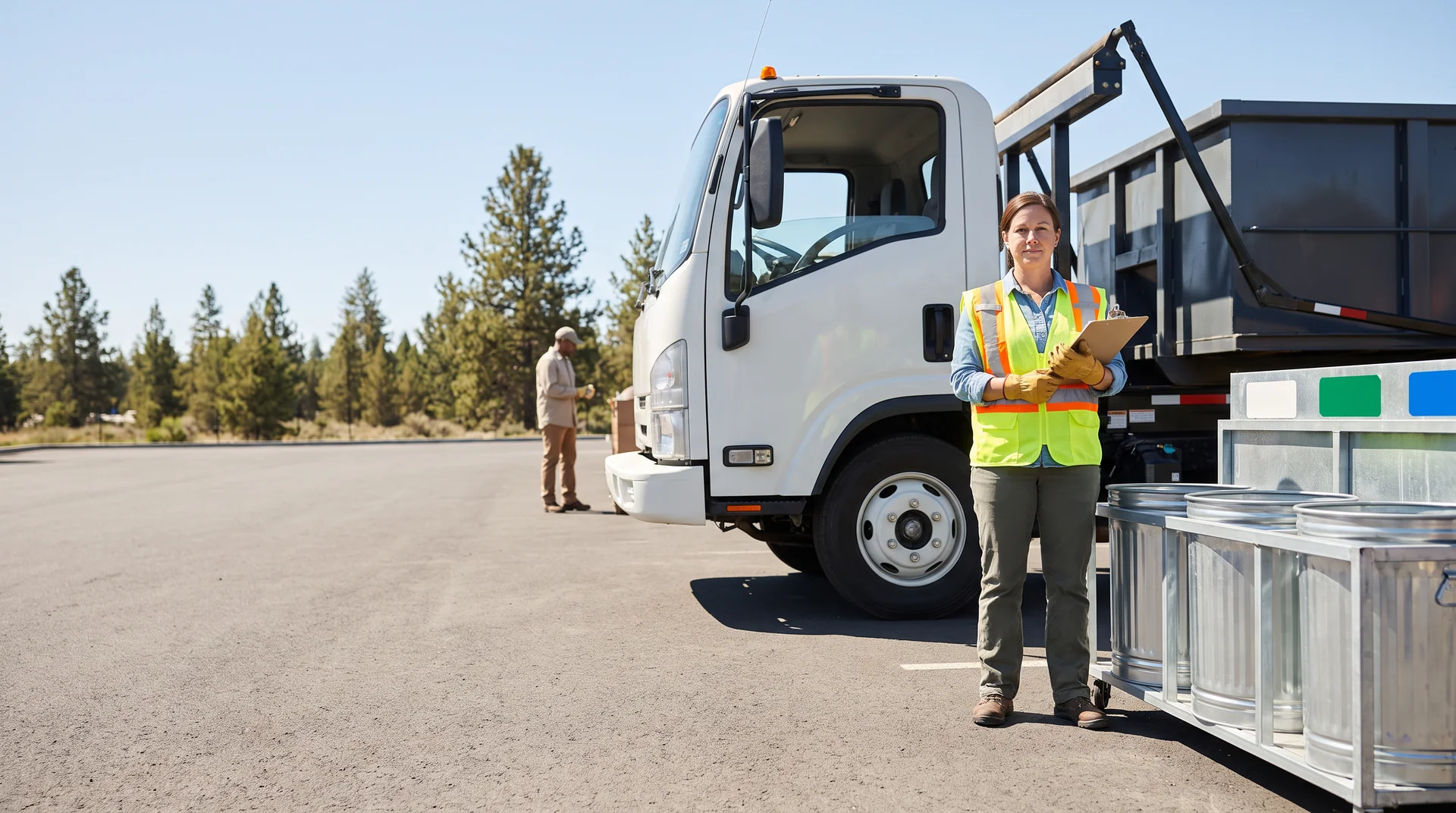

An Oregon waste, recycling, dumpster, or junk-removal operation may look straightforward from the curb: arrive, load, haul, sort, and leave the site clean. In Prineville, Bend, Redmond, Madras, Sisters, La Pine, and across Central Oregon, the real operation usually combines roads, driveways, customer homes and businesses, crews, trailers, containers, heavy items, recycling facilities, disposal sites, equipment, customer instructions, and material that is not always easy to identify. A strong commercial insurance review starts with the actual work—not simply the words “junk removal.”
This article is educational information, not insurance, legal, environmental, waste-management, transport, safety, employment, permitting, tax, or claim advice. It does not determine whether a material is hazardous, whether a route or vehicle requires a particular authority, who owns an item, who is legally responsible, whether a job is safe, or whether a loss is covered. The policy, declarations, endorsements, limits, deductibles, exclusions, contracts, customer instructions, regulations, receiving-facility rules, facts of the event, and qualified professional guidance control.
Map the Actual Work Before Choosing Coverage Labels
Two businesses can both advertise “cleanouts” while doing very different work. One may haul household furniture in a pickup and trailer. Another may place roll-off containers at construction sites, transport demolition debris, move appliances, enter hoarded homes, sort donated goods, handle commercial accounts, stage material in a yard, or coordinate with recycling processors. Those differences can change the property, vehicle, public-liability, employee, disposal, and continuity questions that should be discussed.
Build a one-page operating map before renewal: service area, vehicle and trailer list, normal load types, customer locations, dumpster ownership, storage yard, crew roles, subcontractors, after-hours work, recycling partners, receiving facilities, contracts, recurring commercial accounts, and the materials the company refuses to accept. Pair that map with the current commercial auto insurance and policy declarations. The goal is not to guess coverage; it is to ensure the operations description is specific enough for a policy-specific review.
| Operating area | Questions to organize | Useful records |
|---|---|---|
| Trucks, trailers, and dumpsters | Who owns, leases, drives, loads, maintains, parks, and dispatches each unit? Which items are permanently attached and which are loose tools or equipment? | Vehicle list, VINs, trailer and dumpster schedule, photos, maintenance and inspection records, driver list, garaging locations, and equipment invoices. |
| Customer property and job-site work | What does the written work order say is to be removed, retained, donated, delivered, recycled, or photographed? Who authorizes changes on site? | Signed estimate, scope of work, photos before/during/after, change orders, item list, load tickets, customer communications, and incident notes. |
| Material stream and disposal | Which loads can include appliances, electronics, tires, oil, batteries, suspicious containers, or other special materials? Which facilities accept them? | Intake questions, refusal procedure, destination list, weight tickets, processor receipts, load photos, employee instructions, and facility agreements. |
| Crew and public safety | Where do employees work near traffic, stairs, loading areas, pets, sharp objects, unstable debris, lift gates, compactors, and customer access? | Training and tailgate records, equipment checks, incident reports, job hazard notes, driver records, PPE plan, and supervisor contacts. |
| Work yard, technology, and continuity | What happens if a truck, dispatch system, yard, container inventory, equipment, or office is damaged, stolen, or inaccessible? | Property schedule, equipment values, backups, vendor contacts, alternate dispatch plan, payroll records, job calendar, and financial statements. |
Trucks, Dumpsters, Trailers, and Attached Equipment Need Their Own Conversation
Oregon’s Division of Financial Regulation notes that commercial auto policies typically have higher liability limits and may address rented or nonowned vehicles, including employee vehicles used for company business.[1] The agency highlights ownership or lease status, drivers, and primary use as key facts. It also points out that permanently attached items—such as a generator or toolbox—deserve an intentional coverage discussion. For a hauling operation, that may extend to a dump body, lift mechanism, winch, rack, container system, mounted tool, trailer connection, GPS device, or other equipment, depending on the policy and setup.
Do not treat the truck policy as a substitute for every other exposure. Oregon DFR separately explains that commercial general liability is not the policy for claims arising from operating an automobile or truck.[6] Likewise, a standard vehicle description may not tell the whole story about a rented truck, employee-owned vehicle, customer driveway, trailer, detached tool, or non-owned container. A coordinated general liability insurance and commercial-auto review is often more useful than looking at either in isolation.
Hauling for Hire and Vehicle Weight Can Create More Than an Insurance Question
Insurance and operating authority are different decisions. ODOT says a business may need to establish an Oregon motor-carrier account when operating trucks with a combined weight over 26,000 pounds, or when operating trucks 26,000 pounds or less for hire, subject to exemptions and the actual facts.[2] Interstate work can introduce additional requirements. This does not mean every junk-removal crew has the same status. It means the company should verify its own vehicles, loaded weights, compensation model, route, account setup, records, and any interstate work with ODOT and qualified transport professionals.
Bring that same fleet information to an umbrella liability insurance conversation when the business has substantial assets, frequent public-road exposure, customer-site work, large commercial accounts, or contract requirements. Availability, underlying-policy requirements, limits, exclusions, and fit differ by carrier and operation; an umbrella is not automatic and is not a promise that every loss will be covered.
Make the Work Order, Load Record, and Policy Tell the Same Story
Prineville Insurance can help an Oregon waste, recycling, or junk-removal business organize a policy-specific review of its trucks, trailers, dumpsters, crew activity, customer property procedures, work yard, and continuity plan.
Customer Property Is More Than What Fits in the Truck
A clear customer instruction can be one of the most valuable controls in this type of business. A box may be marked for removal but contain a family heirloom. A commercial client may expect recyclable equipment to be delivered to a processor, not discarded. A landlord, tenant, property manager, estate representative, contractor, or business owner may give different instructions about the same item. The most important control is operational: define the scope, identify any excluded or retained property, document change requests, photograph unusual or high-value items where appropriate, and preserve load and destination records.
Those records support both customer communication and an insurance review. They do not establish ownership or coverage on their own. A policy-specific review should address property in the company’s care, custody, or control; property taken from a job site; property left in a truck or container; subcontractor activity; storage; transport; theft; and disposal or donation arrangements. For operations that regularly move tools or equipment, the site’s guide to tools, equipment, and inventory in company vehicles provides a related starting point, though a waste-hauling operation needs its own facts reviewed.
Screen the Waste Stream Before a Crew Loads It
Waste classification and disposal rules are not simply an after-the-fact landfill question. Oregon DEQ lists discarded vehicles, large appliances, used oil, tires, lead-acid batteries, and computers, monitors, and televisions among materials that are illegal to dispose of at solid-waste disposal sites.[3] DEQ also notes that self-haulers can be held liable for disposing of those materials at a solid-waste disposal site. An operator should use that information to build an intake and routing process—not to make a snap judgment at a customer’s curb.
Ask crews to pause and escalate when they encounter suspicious liquids, leaking containers, unlabeled chemicals, pressurized cylinders, asbestos concerns, medical waste, batteries, e-waste, tires, fuel, paint, solvents, or materials outside the approved work order. Oregon Metro’s business hazardous-waste resource explains that hazardous waste should go through a designated hazardous-waste management or recycling facility and describes a regional very-small-quantity-generator program with specific eligibility thresholds.[4] Those thresholds are not a universal rule for every Oregon business or item. Verify current receiving-facility requirements, local rules, transport obligations, and specialist guidance before accepting, consolidating, or moving unfamiliar material.
Crew Safety, Employee Injuries, and Pollution Questions Should Not Be Blended Together
A two-person removal crew may face lifting, falling-object, sharp-object, traffic, heat, cold, stairs, uneven ground, pets, confined spaces, shifting loads, equipment, and customer-site hazards in one day. Oregon DFR says commercial general liability excludes employees, while workers’ compensation addresses employee work-related injuries and illnesses.[6] That is why a workers’ compensation insurance discussion should be paired with the real crew structure, job tasks, payroll, supervision, training, and subcontractor arrangements—not treated as an afterthought to a vehicle policy.
Oregon OSHA states that HAZWOPER protects employees who may be exposed to hazardous substances during cleanup work, at hazardous-waste facilities, or in emergency response, and that the work determines the procedures required.[5] This is not a reason to label every cleanout job hazardous-waste work. It is a reason to use written stop-work and escalation procedures when the job changes. A separate pollution liability insurance review may also be appropriate for some operations, but coverage is policy-specific and must not be assumed from the service description alone.
Protect the Yard, Dispatch System, Records, and Ability to Keep Routing
A work yard can accumulate equipment, detached dumpsters, trailers, tools, spare parts, recycling containers, fuel-related equipment, business records, computers, and customer access information. A property schedule should identify what is owned, leased, borrowed, stored, or used off premises. That creates a stronger commercial property insurance review and makes it easier to spot gaps in records after theft, fire, weather, vandalism, or other loss.
Oregon DFR says business interruption/continuation insurance can address certain fixed costs and profits based on financial records when a covered event causes an extended shutdown.[7] A dispatch outage, truck repair, inaccessible yard, equipment failure, or canceled route does not automatically satisfy that trigger. Still, create an alternate dispatch plan, a current vehicle-and-container schedule, customer-contact backup, vendor list, load history, payroll record, and repair contacts. If customer information, card data, routing systems, or dispatch applications are essential to operations, include a cyber liability insurance conversation in the broader risk review.
What to Bring to a Waste, Recycling, or Junk-Removal Insurance Review
Bring the current policies and declarations; complete vehicle, trailer, and dumpster schedule; driver list; equipment list; work yard information; recurring contracts; certificates customers require; sample work orders; customer-property and change-order procedures; employee and subcontractor details; disposal and recycling partners; load tickets; incident and loss history; safety records; fleet maintenance information; financial statements; and continuity plan. For comparison, the site’s Oregon livestock hauling insurance guide shows why a vehicle and trailer operation must be described around its actual cargo, route, equipment, and responsibility—although the insurance and regulatory questions are distinct for each industry.
The objective is to make the business’s actual operation understandable before the next contract, truck purchase, fleet change, busy season, customer dispute, disposal question, or loss. Clear records cannot guarantee coverage or compliance. They can help the business ask more accurate questions of its agent, carriers, safety advisers, lawyer, accountant, broker, receiving facilities, and regulators.
Frequently Asked Questions
Does a general liability policy automatically cover a junk-removal truck, roll-off dumpster, or trailer?
Do not assume it does. Oregon DFR explains that standard commercial general liability and auto insurance address different exposures. The answer can depend on the vehicle, ownership, driver, use, attached equipment, trailer, accident facts, policy form, limits, deductibles, exclusions, endorsements, and other insurance. Review the actual operation and policies together rather than relying on a business description alone.
Is customer property covered while a crew is moving it, sorting it, or loading it for disposal?
Not automatically. A customer may describe an item as junk and later say it was supposed to be kept, recycled, donated, or delivered elsewhere. Ownership, custody, contract language, inventory, photos, receipts, property type, handling method, policy wording, exclusions, and facts of the event can all matter. Use clear written work orders and ask for a policy-specific explanation of property in your care, custody, or control.
Can a waste or junk-removal business put everything collected into a landfill dumpster?
No. Oregon DEQ identifies certain materials that are illegal to dispose of in solid-waste disposal sites, including used oil, tires, lead-acid batteries, large appliances, and certain electronics. The correct destination depends on the material, condition, amount, receiving facility, local rules, transport requirements, and current guidance. Confirm the plan with the appropriate disposal, recycling, environmental, and transport authorities before accepting or moving a load.
Does HAZWOPER apply to every Oregon junk-removal or recycling crew?
No blanket answer applies. Oregon OSHA explains that HAZWOPER protects employees who may be exposed to hazardous substances during cleanup work, at hazardous-waste facilities, or during emergency response, and that the work performed determines the applicable procedures. A company that encounters suspicious containers, releases, cleanup work, or hazardous materials should obtain qualified safety and regulatory guidance rather than self-classifying the work from a general checklist.
Will business interruption insurance pay if a truck, dump trailer, or work yard is unavailable?
Not necessarily. Oregon DFR describes business interruption coverage as a response to certain fixed costs and profits when a covered event causes an extended shutdown. A vehicle repair, equipment problem, dispatch outage, supply delay, or weather event does not automatically trigger coverage. Review the covered cause of loss, waiting period, period of restoration, limits, exclusions, financial records, fleet setup, and continuity plan under the actual policy.
References
- Oregon Division of Financial Regulation — Commercial Auto Insurance
- Oregon Department of Transportation — Motor Carrier Requirements to Operate in Oregon
- Oregon Department of Environmental Quality — Landfill Ban in Oregon
- Oregon Metro — Business Hazardous Waste Disposal
- Oregon OSHA — Hazardous Waste Operations
- Oregon Division of Financial Regulation — Liability Insurance
- Oregon Division of Financial Regulation — Business Interruption Insurance


