



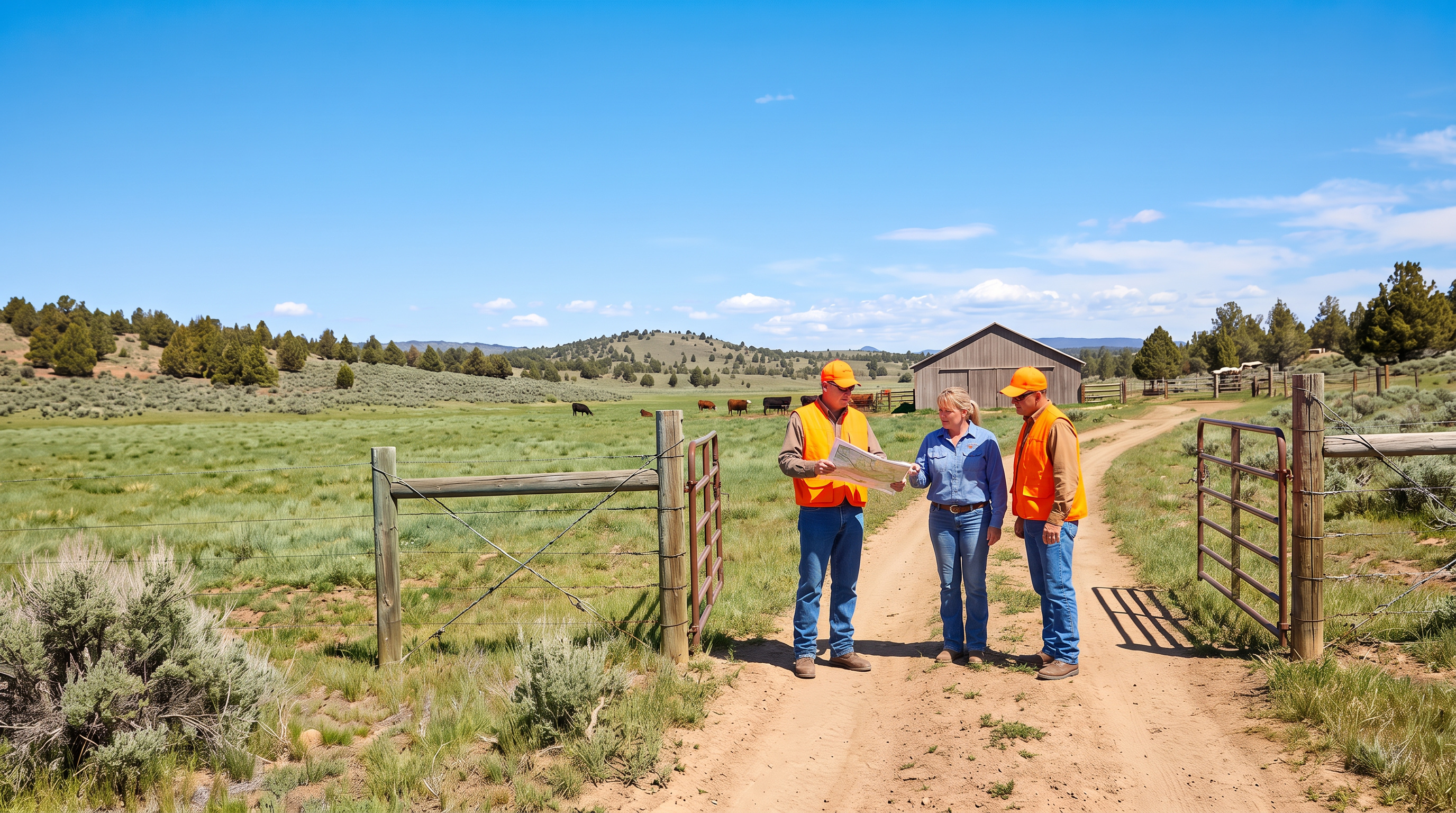

Letting a neighbor hunt, leasing access to a hunting club, and hosting guided hunts are not interchangeable insurance decisions. Once visitors enter your Oregon ranch, the activity, payment, vehicles, agreements, and people involved deserve a fresh ranch insurance review—even when livestock and hay remain your primary business.
The short answer: tell your agent before adding hunting leases or recreational access. Oregon’s recreational-use protections are conditional, a paid hunt raises different questions from free permission, and a waiver or certificate does not create coverage. Match the actual operation to accepted policy terms rather than assuming an existing farm policy covers every visitor.[1] [6]
A cattle ranch near Prineville or Powell Butte may welcome deer hunters. A property outside Madras may allow bird hunting, hiking, or camping. A ranch in Eastern Oregon may work with a hunting club or access program. Each arrangement changes who enters, how they travel, and what services you provide.
This article is insurance education, not legal advice, a hunting-permission determination, or a promise of immunity or claim payment. Examples are hypothetical. Actual statutes, agreements, activities, policy forms, endorsements, insurer acceptance, and loss facts control.
1. Start With What You Are Actually Allowing
Describe the arrangement in plain language. Is it occasional free permission, an annual paid hunting lease, a club membership, public access through an agency agreement, or guided recreation? Identify the allowed activities, property boundaries, dates, maximum group size, non-hunting guests, and whether participants may invite others.
Include services that make the visit more than access: lodging, meals, animal handling, equipment rental, transportation, instruction, or paid supervision. Those details can turn a simple premises discussion into a broader business review. Our farm and ranch coverage overview helps organize the underlying operation; it is not proof that a new recreational activity is included.
ODFW’s Access and Habitat Program distinguishes open-access and by-permission properties. Hunt by Reservation has its own permit and property rules, including non-hunting guests and a prohibition on commercial guiding or profit activities through that permit. These examples show why the particular permission matters; they are not default terms for an independent paid lease.[2] [3]
2. Oregon Recreational-Use Law Is Not Blanket Immunity
Oregon includes hunting among recreational purposes. However, ORS 105.682 must be read with ORS 105.688. Permission, the principal purpose for entering, statutory restrictions, and the facts of a claim matter. Do not reduce these provisions to “hunters cannot sue the landowner.” Potential protection from liability is also different from insurance-funded defense under an accepted policy.[1]
Charging for permission is a central issue. The statute defines a charge as an admission price or fee requested or expected in return for allowing entry, subject to specific exclusions. Oregon does not provide a general paid-hunting exemption. Calling the payment a lease, membership, or donation does not settle its legal treatment.
Amounts received from a public body in return for public access are treated differently under the definition. That distinction does not mean private hunting revenue, guided services, lodging, or a bundled package receives the same treatment. Mixed charged and uncharged activities or areas can involve statutory notice conditions; a sign does not restore protection for the charged hunting activity itself.[1]
Have qualified Oregon counsel review your actual permission, payments, land control, and agreements. Your agent’s role is to review the insurance exposure—not certify statutory immunity. A general liability discussion should remain necessary even when a legal defense might be available.
3. Disclose Paid Recreation Before Relying on Farm Liability
A farm policy may describe agricultural operations differently from a paid recreational business. Ask whether the insurer accepts the precise hunting arrangement and whether business, recreational, firearms, participant, animal, or other restrictions affect it. Do not assume every farm form has the same exclusion, or that a larger liability limit fixes an excluded operation.
Separate injury to a visitor from damage to the ranch’s own property. A premises liability discussion does not establish coverage for a burned hay stack, damaged gate, injured livestock, lost lease revenue, or an environmental claim. Visitor-caused losses can require different policy sections, deductibles, and conditions.
Tell your agent when access becomes another source of revenue or includes several services. Our Northwest diversified farm-business article explains why adding a nontraditional operation deserves a fresh coverage conversation rather than a label change alone.
4. A Club Policy, Certificate, and Additional-Insured Endorsement Are Different
A hunting club or group may carry its own liability insurance. Ask who is named insured, whether members and guests qualify, and whether claims between participants are addressed. A hunting liability policy should not be described as accident or medical insurance for every injured hunter.[4] [5]
Confirm whether the landowner and the correct ownership entity are additional insureds under an actual endorsement. A policy protecting a club does not automatically protect every ranch owner, tenant, manager, or separately owned parcel. Check the covered locations, activities, dates, limits, defense provisions, and exclusions.
Specialist programs illustrate the need to read eligibility carefully. One association program distinguishes ordinary leases from commercial guiding and other activities it does not accept. That is an example—not a universal rule or an assertion that Prineville Insurance offers that program.[5]
Oregon DFR explains that a certificate does not amend, extend, or change the policy. Being a certificate holder is not the same as being an additional insured. Review the policy and endorsement against the agreement before relying on requested certificate wording.[6]
Bring the Access Agreement Before Opening the Gate.
Prineville Insurance can help organize the questions about permitted recreation, payments, guides, vehicles, guests, and additional-insured requests. Include the current farm policy, proposed lease, property map, and any club or guide insurance documents.
5. Guided Hunts, Transportation, and Lodging Need Their Own Review
A land-access lease and paid guiding are separate questions. Oregon’s Marine Board administers outfitter-guide registration. Actual leading, instruction, supervision, packing, transportation, and where services occur can matter. The statute includes a specific exclusion for an individual providing compensated services exclusively on property that individual owns or controls; do not assume every ranch entity or arrangement qualifies.[8] [9]
Check the applicable registration and insurance obligations with the Marine Board and qualified counsel. A registration exception is not an exemption from every liability exposure or a determination that a farm policy covers the activity. Likewise, a guide’s required insurance does not establish that the ranch is insured.
If your operation supplies guides, lodging, meals, equipment, or other services, describe each part during an outdoor recreation business insurance review. Identify hired guides, independent operators, employees, and volunteers without assuming their legal status from the contract label.
Driving hunters to a trailhead, lending an ATV, and letting visitors bring their own vehicles create different exposures. Review ranch-owned vehicles, hired or borrowed transport, passenger use, trailers, drivers, and road access. Commercial auto insurance is not a substitute for reviewing every recreational vehicle or participant activity. Off-road access deserves separate questions even when a vehicle never uses a public highway.
The Oregon ATV and off-road recreation insurance guide adds context for rentals, participant injuries, and organized activities. Allowing a hunting group to use an access road is not automatically the same operation as running an ATV park, but each actual activity needs to be disclosed.
6. Waivers, Safety Rules, and Maps Help—But Do Not Replace Insurance
Oregon’s recreational-activity release law took effect April 7, 2026. It permits certain releases under stated conditions and exceptions; it does not guarantee that every waiver is enforceable. Free-access immunity under ORS 105 and a contractual release are distinct legal questions.[7]
Have counsel review clear risk disclosures, the relevant participants, the services supplied, and statutory exceptions. Vehicle transportation to an activity is not necessarily treated like participating in vehicle-based recreation. A downloaded waiver should not be relied on to eliminate every claim, and no release creates policy coverage.
Use a property-specific access plan. Identify boundaries, approved routes, buildings, livestock areas, wells and ponds, neighboring land, locked gates, and places visitors must not enter. Set limits on guests, overnight stays, fires, vehicle access, and equipment use. Clarify communication, emergency location information, check-in/out, and who may suspend access. These are planning suggestions, not a certification of compliance or a substitute for competent safety instruction.
Keep visitors separate from active livestock handling and agricultural work where appropriate. Never imply hunting permission also authorizes entry to barns, neighboring private land, tree-stand use, or access to ranch machinery. ODFW’s property-specific examples reinforce the importance of boundaries and permission.[2] [3]
7. Review Excess Limits and the Whole Working-Ranch Business
An excess or commercial umbrella discussion starts with the accepted underlying coverage. An umbrella does not necessarily remove a hunting, guiding, vehicle, or business exclusion. Confirm covered operations, required underlying policies and limits, who is insured, and how defense and aggregate limits work.
Review renewals before the next hunting season and disclose changes promptly: more groups, overnight guests, added acreage, a different guide, new transportation, or a shift from free access to paid leases. Keep club and guide policy dates aligned with the agreed access period without assuming a certificate guarantees continuing coverage.
Hunting access belongs in the wider review of your working ranch as a business. Livestock, property, equipment, vehicles, workers, recreation, and contractual obligations can involve different forms. Treat the review as connected questions rather than one policy name that promises everything.
Before You Grant the Next Visitor Access
Bring a map showing the actual parcels and access roads, the ownership and operating entity names, current policies and endorsements, proposed lease or permission terms, payment details, permitted activities, group and guest limits, and services you or others provide. Include club/guide certificates and endorsements, vehicle arrangements, and representative safety or waiver documents.
Ask three practical questions: does the insurer accept the described activity; which people and entities are insured; and what remains outside the agreed coverage? Have Oregon counsel handle legal permission, releases, land-use and immunity questions. If an incident occurs, prioritize emergency assistance, preserve facts and records, and notify the agent or insurer under the policy’s requirements rather than deciding coverage from the lease alone.
Frequently Asked Questions
Does Oregon recreational-use law automatically protect my ranch from hunting claims?
No. Hunting is a listed recreational purpose, but permission, the principal purpose for entry, charges, statutory conditions, and the facts of the claim matter. ORS 105.682 and 105.688 must be considered together. A possible legal defense is not an insurance policy or a guarantee against a lawsuit. Ask qualified Oregon counsel about your actual access arrangement.
Does charging for a hunting lease change the liability discussion?
Yes. A fee requested or expected in exchange for permission to enter raises the statutory charge issue. Oregon does not provide a general paid-hunting exemption from that restriction. Public-body payments for public access are treated differently under the definition, but that does not automatically establish protection for a particular agreement. Have the actual transaction and insurance reviewed before opening access.
Will ordinary farm liability insurance cover a paid hunting operation?
Do not assume it will. Tell your agent whether the arrangement is free permission, a paid lease, a club, guided hunting, lodging, transportation, or another business operation. Ask about insurer acceptance and any business, recreation, firearms, vehicle, or other relevant restrictions. A farm classification or a substantial liability limit does not prove the activity is covered.
Does a hunter’s certificate make the ranch an additional insured?
No. A certificate is informational and does not amend, extend, or change coverage. Being listed as certificate holder is different from being an additional insured. Review the actual endorsement, correct landowner and entity names, covered activities, locations, dates, limits, and exclusions. A club’s policy may not accept commercial guiding or other services included in your arrangement.
Can a waiver replace liability insurance for recreational visitors?
No. Oregon’s 2026 recreational-release law permits certain releases under stated conditions and exceptions; it does not guarantee that every waiver will be enforceable. Free-access immunity and a contractual release are separate legal questions. Counsel should review the agreement, including vehicle transportation and other services. Neither document creates insurance coverage.
Does every paid ranch hunting arrangement require outfitter-guide registration?
Not necessarily. Oregon regulates paid guiding separately from bare land permission. The law includes a specific exclusion for an individual providing compensated services exclusively on property that individual owns or controls; do not assume every entity or arrangement qualifies. Actual guiding, transportation, land control, and where the services occur matter. Check the Marine Board and qualified counsel, and review insurance regardless of registration status.
References
Sources reviewed November 19, 2026. Statutory protections and specialist insurance examples have conditions and exceptions; no cited program establishes product availability through Prineville Insurance. Obtain qualified Oregon legal advice for your actual agreement and rely on the accepted policy and endorsements for coverage.
- Oregon Legislature — ORS 105.672–105.696: Recreational Use of Land
- ODFW — Hunting on Private Lands: Access and Habitat Program
- ODFW — Hunt by Reservation Program and Property Rules
- National Agricultural Law Center — Practical Considerations for Hunting Leases
- National Deer Association — Hunting Liability Insurance and Program Restrictions
- Oregon DFR — Certificates Do Not Amend, Extend or Change Coverage
- Oregon Laws 2026, Chapter 132 — Recreational-Activity Releases
- Oregon State Marine Board — Outfitter Guide Registration and Insurance
- Oregon Legislature — ORS Chapter 704: Outfitters and Guides


