

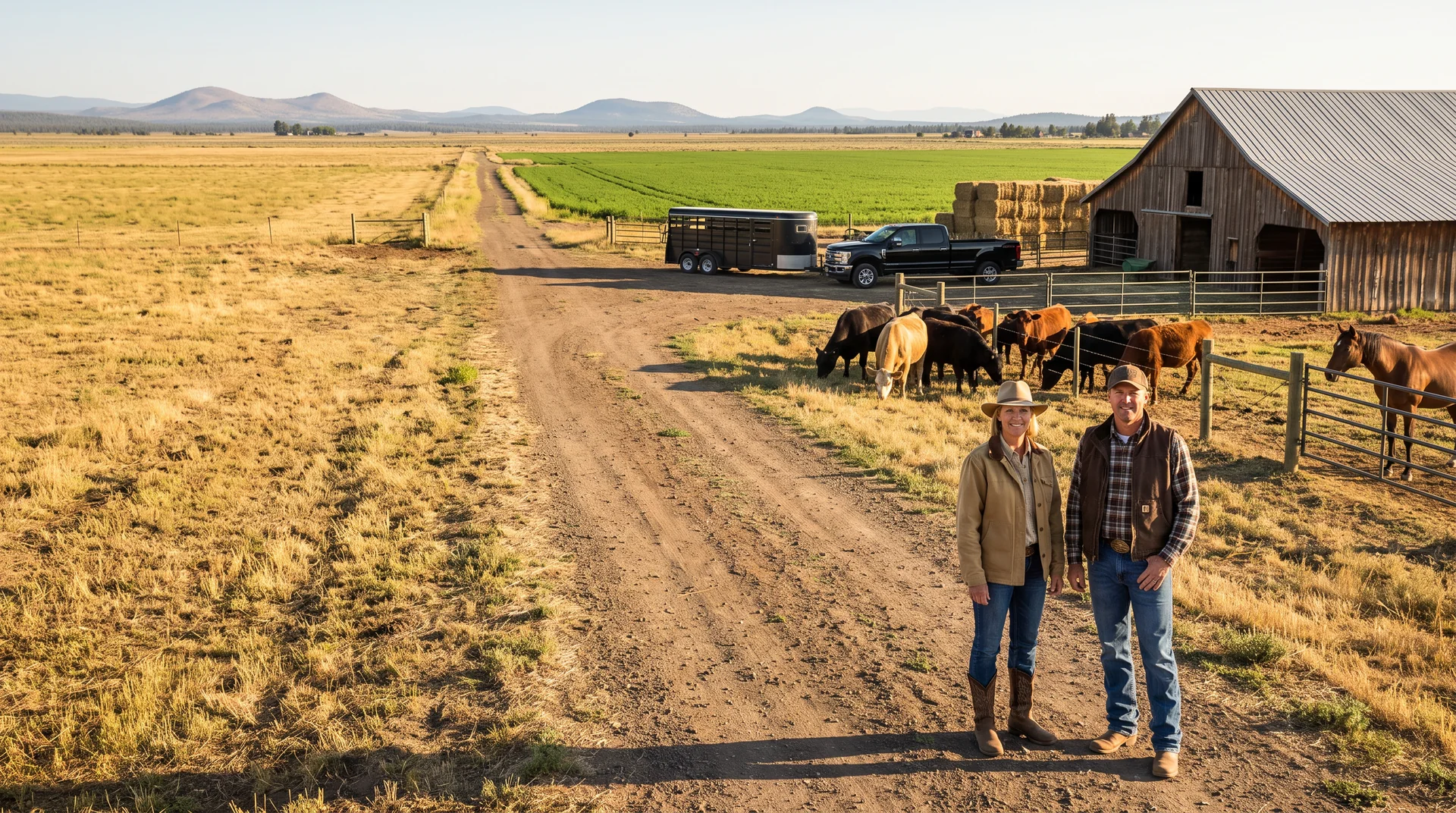

A working ranch can be a cattle enterprise, horse operation, hay or crop producer, equipment yard, trucking operation, employer, landlord, and family business all at once. In Central Oregon and across the West, one gate may lead to leased pasture, branded livestock, a shop, remote outbuildings, water systems, ranch pickups, stock trailers, customer work, seasonal labor, and a changing mix of revenue. Start with Prineville Insurance's farm and ranch insurance resources, then build the insurance review around every real activity—not a one-line description on an application.
This article is educational information, not insurance, legal, livestock-health, veterinary, employment, safety, environmental, tax, contract, land-use, crop-program, underwriting, or claim advice. It does not determine whether a ranch needs a particular policy, limit, endorsement, permit, safety procedure, entity structure, program, or coverage. The actual policy, declarations, endorsements, application, carrier requirements, contracts, applicable rules, and facts of a loss control.
A Ranch Is a Business System, Not Just Land and Livestock
Oregon State University's Small Farms Program describes risk management as an ongoing process: identify exposures, assess them, use controls, reduce financial loss, and monitor the business and policies as things change.[1] That framework fits a working ranch because a change that looks small operationally can materially change the insurance conversation: buying a breeding bull, adding a horse program, planting a new crop, leasing another field, taking in custom hay, hiring a hand, transporting cattle, building a shop, installing irrigation, or opening the gate to customers or visitors.
Begin with an honest activity inventory. Identify what the entity owns, leases, borrows, transports, stores, sells, produces, boards, repairs, and invites onto the property. Include the named insured, landowners, family members, managers, employees, contractors, customers, tenants, and anyone who uses ranch equipment or vehicles. This is not a coverage promise; it is the information an agent and carrier may need to assess the actual operation.
| Ranch business activity | Insurance questions to organize | Helpful records |
|---|---|---|
| Cattle, horses, breeding stock, and other livestock | Which animals are owned, cared for, boarded, hauled, leased, or used in the business? Are values, transit, mortality, care-custody-control, contracts, and animal-health records part of the review? | Current inventory, purchase records, veterinary and movement records, IDs/brands, sale or board contracts, photos, and values. |
| Hay, crops, forage, and farm products | Which crops, fields, contracts, stored inputs, irrigation systems, and revenue streams are part of the enterprise? Which risks are handled by commercial policies versus separate crop or federal risk-management options? | Acreage and crop records, contracts, receipts, storage inventory, irrigation details, sales records, and crop-insurance documentation if applicable. |
| Buildings, shops, corrals, fences, and remote improvements | How are barns, homes used in the business, shops, feed storage, tack rooms, gates, fences, tanks, pumps, solar or backup systems, and outdoor property listed and valued? | Photos, receipts, serial numbers, repair history, replacement estimates, lender requirements, maps, and current property schedules. |
| Pickups, stock trailers, ranch trucks, and machinery | Who owns, leases, drives, maintains, transports, or uses each unit? Is the use personal, ranch-only, hired, or commercial? What do the policies and contracts say about trailers, drivers, cargo, and hired or borrowed units? | Titles, leases, VINs, maintenance logs, driver rules, route information, equipment lists, and transport agreements. |
| Employees, family labor, contractors, and custom work | Who hires, directs, trains, pays, and supervises each person? What work is being done and whose equipment is used? Which written scopes, certificates, and policy requirements apply? | Payroll or invoices, written scopes, certificates, employee/contractor agreements, training records, and incident-reporting process. |
Cattle, Horses, Crops, and the Limits of a Single Label
“Ranch insurance” is useful shorthand, but it should not replace an inventory of the livestock and revenue at stake. A cow-calf ranch, registered-bull program, backgrounding yard, boarding barn, breeding operation, hay producer, direct-market beef business, crop field, and guest ranch can present different property, liability, animal, contract, income, and transportation questions. Use the site's livestock insurance and crop insurance resources to map the conversation, then provide a current record of every enterprise.
Federal livestock risk-management plans are also separate from a commercial ranch policy. USDA Risk Management Agency describes Livestock Risk Protection as addressing price declines and Livestock Gross Margin as addressing qualifying gross-margin risk; availability and rules vary.[5] Those plans are not a substitute for reviewing ranch property, liability, vehicles, employees, contracts, animal values, or the terms of a particular commercial policy. A crop-insurance professional can explain current program options, deadlines, commodities, counties, and eligibility.
Property Values: Beyond the Main Barn
Oregon DFR identifies buildings, equipment, machinery, inventory, documents, fences, signs, and outdoor property as examples of business property that a business may need to consider.[3] On a ranch, the list can extend far beyond a barn: shop tools, fuel systems, handling equipment, corrals, panels, chutes, water tanks, stock tanks, gates, irrigation pumps, pivots, feed, hay, tack, computer systems, fencing, cameras, generators, remote cabins, and machinery may each require a policy-specific valuation discussion.
Keep an asset inventory that includes location, owner, use, serial number, photo, receipt, maintenance record, lender interest, and replacement-cost estimate when available. Ask whether the form uses actual cash value or replacement-cost concepts, how limits apply to outdoor property and remote structures, and whether scheduling or other documentation is needed. The commercial property insurance page is a helpful starting point, but it cannot determine how a carrier will value a specific ranch asset or loss.
Give the Insurance Review the Whole Ranch Picture
Prineville Insurance can help organize a policy-specific conversation around cattle, horses, crop activity, ranch property, equipment, vehicles, employees, contractors, land agreements, wildfire planning, limits, deductibles, exclusions, and endorsements.
Premises Liability, Contracts, and Liability Layers
Oregon DFR explains that commercial general liability may address certain third-party bodily injury and damage-to-others-property allegations, while it does not replace auto coverage or workers' compensation for employee injuries.[2] That distinction matters on a ranch that has delivery drivers, livestock buyers, veterinarians, farriers, equipment vendors, contractors, custom operators, lessees, customers, event guests, or other visitors. The circumstances of a visitor, the work being done, control of the property, contracts, policy wording, exclusions, limits, and loss facts all matter.
Treat every contract as a separate document to read—not as a simple certificate request. Leases, grazing agreements, board agreements, custom-work contracts, hauling contracts, crop agreements, lender requirements, event agreements, and vendor terms may require specific entity names, limits, additional-insured wording, waiver language, or insurance documentation. Use commercial general liability and commercial umbrella insurance discussions to organize questions about underlying limits and higher liability layers, but do not assume a certificate or umbrella solves every contractual requirement.
Ranch Trucks, Stock Trailers, Hauling, and Equipment on the Road
A ranch pickup and stock trailer can shift from personal errands to ranch work, livestock transport, custom hauling, equipment delivery, or interstate travel. Oregon DFR notes that commercial-auto questions can depend on ownership or lease status, drivers, and the vehicle's primary use. Review the entire fleet—including leased, borrowed, employee-owned, and trailer units—against actual use, routes, drivers, garaging, maintenance, contracts, and cargo or livestock facts. The site's commercial auto insurance resource and Oregon livestock hauling guide can help assemble the right questions.
Do not stop with a truck list. Bring titles, lease documents, VINs, vehicle photos, maintenance records, driver authorizations, trailer records, transport agreements, and any customer or hauler contract. That does not establish coverage; it helps the insurance review match the actual road and hauling exposure.
Employees, Family Members, Seasonal Labor, and Contractors
A ranch can involve owners, family members, employees, seasonal hands, interns, independent contractors, custom operators, and vendor crews. A job title or 1099 label does not, by itself, decide employment, workers' compensation, safety, legal, or insurance treatment. Oregon OSHA maintains agricultural resources that include tractors, heat, pesticide, hazard-communication, labor-housing, wildfire-smoke, and safety-meeting materials.[7] Use these resources as prompts for a ranch-specific safety and adviser conversation, not as a substitute for professional compliance advice.
Identify who directs each person's work, pays them, provides equipment, supplies a vehicle, trains or supervises them, and signs the contracts. Then review the real facts with qualified employment, safety, legal, and insurance advisers. Prineville Insurance's workers' compensation resource can help frame the insurance questions, but cannot classify a worker or decide a claim.
Wildfire, Livestock Evacuation, and Continuity Records
Wildfire preparation on a ranch is an operational project as well as an insurance-records project. Oregon's wildfire-preparedness guidance encourages plans for alerts, evacuation, go-kits, large animals, transportation, shelter, medical records, and supplies.[8] For a working ranch, document the cattle and horse evacuation plan, trailer and driver options, alternate pasture or shelter contacts, water and backup-power locations, livestock records, gate and access maps, equipment locations, photos, and emergency contacts. A plan is not a coverage guarantee, underwriting promise, or substitute for emergency instructions.
Oregon DFR describes business-interruption coverage as a potential response to certain fixed costs and lost profits after a covered event causes a shutdown, subject to the policy.[4] Do not assume smoke, drought, disease, road closure, fire restriction, evacuation, or access loss triggers coverage. Ask how the actual policy treats covered causes of loss, waiting periods, limits, seasonal income, dependent operations, exclusions, and the records needed after a loss. The site's Central Oregon wildfire insurance resources can help start the preparedness conversation.
Annual Working-Ranch Insurance Review Checklist
Review the entity and ownership structure; land and grazing agreements; cattle, horses, and other livestock; crop and hay operations; buildings and remote improvements; equipment and tools; ranch trucks and trailers; drivers; employees and contractors; product sales; visitor or customer activity; property values; leases and lender requests; certificates; loss history; wildfire plans; and every new activity planned for the year. Explain changes in plain language and keep the documents that support the description. A more accurate record gives a ranch a stronger starting point for its policy-specific review.
Frequently Asked Questions
Is a working ranch covered by one standard commercial policy?
Do not assume so. A working ranch may have a mix of livestock, horses, crops, leased ground, buildings, ranch vehicles, trailers, machinery, employees, family labor, contractors, farm products, and guest or customer activity. The relevant policy forms, limits, deductibles, exclusions, endorsements, eligibility, valuation, contracts, and facts of a loss all matter. A policy-specific review should reflect the operation actually being run.
Does liability insurance replace workers' compensation or commercial auto coverage on a ranch?
No. Oregon DFR explains that commercial general liability, workers' compensation, and commercial auto address different exposures. A visitor injury, an employee injury, a ranch-truck accident, damage to another person's property, and a livestock-related incident can require separate analysis under the applicable policy and facts. Ask how the relevant policies fit together instead of relying on one label.
Are cattle, horses, crops, and price risk all handled by the same insurance program?
Not necessarily. Ranch-package property or liability coverage, animal-related coverage, crop insurance, and federal livestock price or margin risk-management plans are different products with different rules, triggers, deadlines, availability, and terms. USDA RMA describes livestock price and margin plans as risk-management options; that information does not determine what a commercial policy covers. Review each part of the operation with the appropriate insurance professional.
Will a wildfire closure, drought, disease event, or evacuation automatically trigger business-income coverage?
Not automatically. Oregon DFR describes business-interruption coverage as potentially addressing certain fixed costs and lost profits after a covered shutdown, subject to the policy. A drought, disease issue, smoke condition, fire restriction, closure, evacuation, access problem, or voluntary shutdown needs a review of the actual cause, policy trigger, waiting period, exclusions, limits, records, and loss facts.
What should a ranch prepare before an insurance review?
Bring current declarations and endorsements; entity and ownership information; a clear activity list; leases and contracts; livestock and horse schedules; crop and hay records; vehicle, trailer, and equipment lists; building and improvement values; receipts and serial numbers; employee and contractor roles; payroll or invoices; certificates; photos; safety and incident records; emergency contacts; and recent operational changes. Accurate records make a policy-specific conversation more useful.
References
- Oregon State University Small Farms Program — Business Planning, Risk Management, and Insurance
- Oregon Division of Financial Regulation — Liability Insurance
- Oregon Division of Financial Regulation — Property Insurance
- Oregon Division of Financial Regulation — Business Interruption Insurance
- USDA Risk Management Agency — Livestock Insurance Plans
- Oregon Department of Agriculture — Traveling with Animals
- Oregon OSHA — Agriculture
- Oregon Department of Emergency Management — Before Wildfires: Prepare and Prevent