



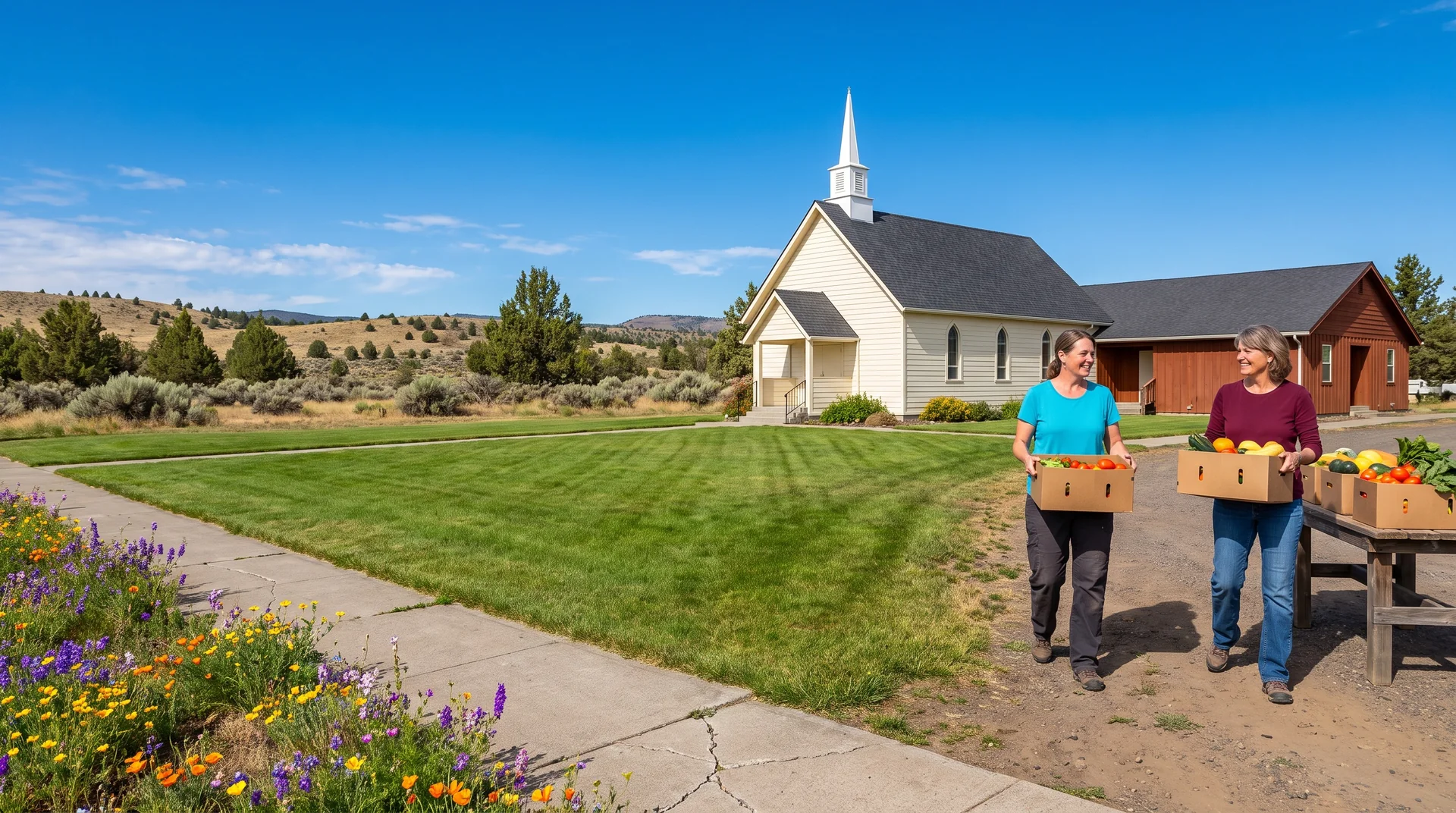

On Sunday, the building is a place of worship. On Tuesday, volunteers distribute groceries. A weekday classroom hosts children, a recovery group meets in the evening, and another nonprofit borrows the fellowship hall. For churches in Prineville, Bend, Redmond, Madras, and across Oregon, a busy community calendar can mean insurance questions that go well beyond the sanctuary. Our religious organization insurance guide is a starting point; the next step is describing every activity actually taking place.
The short answer: a church becoming a community hub should review its property, liability, people, vehicles, and agreements before adding programs or granting outside access. A church policy does not automatically cover every charitable activity. What matters includes who operates the program, who is insured, what the policy covers or excludes, and what endorsements the insurer has accepted.
This article is educational information, not a coverage determination or legal, childcare, food-safety, employment, building-code, or regulatory advice. Policy language and actual facts control. Ask qualified advisers and the responsible Oregon and local agencies about current requirements; coverage availability, eligibility, and terms vary.
Start With Who Runs Each Program
A food pantry operated by church staff is not necessarily the same insurance situation as a separate nonprofit renting a room. A church-sponsored support group differs from an independent group that receives a key and runs its own meetings. A daycare may be a ministry of the church, a separate legal entity, or a tenant with its own employees. Shared branding or a common address does not settle who is insured.
Prepare an activity inventory that records the legal operator, program purpose, schedule, maximum attendance, ages served, paid staff, volunteers, rooms used, and any transportation. Explain who supervises, accepts registrations, collects money, maintains equipment, and responds to incidents. Include free activities and new programs that have not yet generated revenue. Give the insurer this information before opening or signing an agreement, not only at renewal.
Discuss whether general liability addresses the disclosed premises and operations, who qualifies as an insured, and whether participant-related or specialized exclusions apply. Ministry-specific insurance resources distinguish general liability from pastoral counseling, abuse-related liability, leadership liability, and other protections.[3] That distinction is useful for a review, but a product description from one provider does not establish your church's coverage or eligibility.
Food Pantries: Distribution, Refrigeration, and Meal Service
A pantry distributing sealed groceries presents different questions from a kitchen preparing hot meals. Describe donated and purchased products, refrigerated foods, storage locations, repacking, home-prepared donations, and deliveries. A claim could involve alleged foodborne illness, an allergen, a volunteer lifting injury, or a visitor falling in the queue. Ask how the policy treats food distribution and preparation rather than assuming general premises liability answers every scenario.
Oregon's Food Sanitation Rules identify food banks and distribution warehouses within Oregon Department of Agriculture jurisdiction.[8] Prepared-meal service needs its own review with the appropriate public-health authority. OHA's benevolent-meal-site guidance addresses a narrow temporary arrangement involving periodic free meals without a permanent kitchen; it is not a blanket exemption for a recurring church kitchen or permission to accept any home-prepared food.[9] Confirm which agency and requirements apply to the actual program.
Build procedures for accepting donations, checking packaging, monitoring refrigeration, addressing allergens, cleaning, and tracing products if a concern is reported. Brotherhood Mutual's donated-food guidance emphasizes food condition, temperature control, and reviewing donor hold-harmless agreements.[4] Have legal counsel assess any applicable food-donation protections; do not treat charitable status or a release as automatic immunity. Our Oregon food-bank and thrift-store insurance article provides related questions.
Property protection matters too. List refrigeration units, freezers, shelving, food inventory, and the highest stock value on hand. Ask about equipment breakdown, spoilage, utility interruption, and donated property; these can have distinct triggers and limits. A building policy does not necessarily reimburse food lost after every outage.
Daycare, Preschool, and Child Supervision Need Their Own Review
A nursery during worship, childcare during a support-group meeting, a recorded preschool, and full-day weekday daycare are not interchangeable. Describe the children's ages, hours, whether parents remain on site, staffing, playgrounds, pickup procedures, meals, and field trips. Identify the entity responsible for the children and whether it employs staff or contracts with another provider.
Church affiliation alone does not establish an Oregon childcare licensing exemption. Oregon law defines and excludes care arrangements based on how they operate, and the Department of Early Learning and Care distinguishes licensed care, license-exempt care, and certain programs that must be recorded.[6] [7] Confirm the actual program with the Child Care Licensing Division. Permission to operate, any required background checks, and insurance acceptance are separate issues.
Ask about childcare or education-related liability, professional services exclusions, abuse and molestation coverage, participant accident options, and transportation. Review who is insured, any separate limits, defense-cost treatment, reporting provisions, and the insurer's safeguarding requirements. Our Oregon youth-program insurance guide expands on these questions without assuming every church program qualifies for the same arrangement.
Support Groups: Hosting a Meeting Is Not the Same as Providing Treatment
A peer-led grief circle, recovery meeting, pastoral counseling session, and licensed therapist's service can share a room while involving different responsibilities. Make clear whether the church sponsors the group or only supplies space. Identify who leads, their qualifications, whether fees are charged, who keeps records, and whether the program serves minors or vulnerable adults.
Ask whether pastoral counseling or professional liability is needed and whether the proposed policy addresses the particular service. General liability should not be assumed to handle every allegation about advice, emotional injury, supervision, privacy, or professional treatment. If an independent clinician uses the building, review their entity, applicable professional insurance, and agreement separately; a general liability certificate does not establish professional coverage.
Set practical boundaries for room access, confidentiality, participant records, emergency response, and referral to qualified services. Do not promise that every group is confidential under every circumstance. Discuss actual procedures with qualified legal and program advisers, particularly where reporting responsibilities or safety concerns arise.
Bring the Calendar, the Agreements, and the Full Picture
Prineville Insurance can help organize an insurance review around what your church actually does. Bring current policies, program descriptions, operator names, room-use agreements, and planned changes before the next pantry opening, daycare enrollment, or outside-group booking.
Shared Building Use: Agreements, Certificates, and Endorsements
Whether an outside group pays rent or uses the hall for free, use a written agreement reviewed by legal counsel. Address permitted activities, rooms, attendance, hours, keys, setup, cleanup, damage, food, alcohol, child supervision, emergency procedures, and insurance responsibilities. A recurring tenant may need a different arrangement from a one-evening event. AGFinancial highlights the premises exposure involved when churches share facilities and recommends local legal review of its sample agreement.[2]
A certificate holder is not automatically an additional insured. Oregon DFR explains that a certificate provides information only and does not amend, extend, or change a policy.[1] If the agreement requests additional-insured protection, confirm that the policy or endorsement actually grants the applicable status. Check the church's correct legal name, covered activities, dates, limits, and exclusions. Primary/noncontributory wording and cancellation notice are separate contract and policy questions.
Have the insurance and legal advisers compare the agreement with what the insurance can actually provide. Do not promise broad indemnity or coverage merely to obtain a booking. An outside group's policy does not replace the church's own premises responsibility, and an umbrella does not automatically fill exclusions. For weddings, private parties, and other bookings, our religious organization event-use guide offers related planning questions.
Volunteers, Employees, and Safeguarding Are Separate Subjects
Volunteers may unload deliveries, supervise children, unlock rooms, maintain buildings, or drive participants. Ask how the policy defines insured volunteers and authorized duties. Also discuss volunteer accident options and injury arrangements; liability insurance and medical or accident benefits are not the same protection. Do not assume a volunteer's own injury is covered simply because the church has liability insurance.
Paid daycare staff, custodians, administrators, and other employees need a worker-status review. Oregon WCD explains that almost all employers with subject workers need workers' compensation, with exemptions depending on the actual facts.[5] A church or nonprofit label does not settle the question. Our workers' compensation resource can help start the discussion; verify the duties and arrangements with the insurer and appropriate agency.
Use written safeguarding procedures, appropriate screening and training, supervision rules, controlled access, and a clear incident process. Oregon identifies clergy and specified childcare and child-services roles among mandatory reporters. An individual's applicable reporting duty is personal and is not replaced by an internal report to a pastor or committee.[10] [11] Not every volunteer automatically has the same legal status, and clergy-related privilege questions require fact-specific legal guidance. Insurance reporting procedures should not delay an applicable report to authorities.
The church board should document approvals, assign responsibility, and review complaints and contracts. Our nonprofit directors, officers, and volunteer-liability guide explains related governance exposures. Leadership coverage, employment practices, and abuse-related liability require separate analysis; none should be inferred from the general liability limit.
Recheck the Building, Vehicles, and Ability to Keep Serving
A classroom, commercial-style kitchen, or busy distribution area may change the use of an older building. Check proposed changes with local building, fire, and other responsible officials before conversion. Review exits, occupancy, accessibility, alarms, cooking equipment, parking, and public access with qualified professionals. A permit or inspection is not an insurance endorsement.
Our commercial property insurance resource helps frame building values, improvements, equipment, and property belonging to others. List tenant-owned furniture, donated inventory, kitchen systems, and supplies. Ask about valuation, ordinance or law, flood, earthquake, wildfire, equipment breakdown, and deductibles rather than assuming all causes of loss receive the same treatment.
If a covered loss closes the fellowship hall, the church may need temporary pantry storage, rented classrooms, or a different meeting space. Review business income and extra expense provisions, eligible income, covered-loss triggers, waiting periods, restoration periods, and limits. Donations, grants, fees, and rental receipts may not receive identical treatment. A cancelled meeting, power outage, smoke advisory, or road closure does not automatically trigger payment. Our business income insurance guide develops these questions.
Food deliveries and participant transportation also deserve disclosure. Record church-owned vans, rented vehicles, volunteers' personal cars, drivers, passenger ages, routes, and loading arrangements. Our commercial auto insurance resource provides a starting point. Ask about hired and non-owned auto liability, vehicle damage, and goods in transit separately; do not assume one provision protects every driver, passenger, or vehicle.
Finally, pantry registrations, childcare contacts, counseling records, and online donations can involve sensitive information. Limit access, establish retention and disposal practices, and verify payment changes through trusted contacts. A cyber liability insurance review can address data incidents, ransomware, and related response expenses; crime and payment-fraud coverage may be a separate discussion.
Before Adding the Next Community Program
Collect declarations and endorsements, legal entity names, the program calendar, room-use agreements, building values, inventory and equipment lists, payroll and volunteer duties, safeguarding procedures, vehicles, and loss history. Add the proposed childcare or food-service arrangement and any agency correspondence. Photos and a simple floor plan can help explain where deliveries, children, meetings, and worship overlap.
Review changes before advertising, accepting registrations, handing over keys, or signing a contract. Overnight shelter, warming-center use, or emergency lodging should get its own insurance and local safety review rather than being treated as an ordinary meeting. The goal is not a separate policy for every act of service. It is an accurate insurance conversation that supports the congregation's mission without guessing about coverage or responsibilities.
Frequently Asked Questions
Does church insurance automatically cover a food pantry or weekday daycare?
Do not assume it does. Disclose each program, its operator, activities, attendance, staff, food handling, child supervision, and location before it starts. The insurer must review the actual policy, covered operations, insured entities, exclusions, and endorsements. Free service, nonprofit status, or church ownership does not establish coverage.
Is a church-run daycare exempt from Oregon childcare licensing?
Church affiliation alone does not establish an exemption. A nursery during worship, a weekday daycare, and a preschool can have different requirements. Oregon distinguishes licensed care, license-exempt care, and certain recorded programs. Confirm the actual arrangement with the Child Care Licensing Division; a licensing decision does not determine insurance coverage.
Does an outside group’s certificate of insurance protect the church?
A certificate provides insurance information; it does not itself change coverage or make the church an additional insured. Review the agreement and applicable policy endorsement, insured names, activities, dates, limits, and exclusions. Additional-insured status and primary coverage wording depend on policy terms. The church still needs its own premises and operations review.
Can a church host a support group without needing counseling-related insurance?
The answer depends on what actually happens. A peer-led meeting, pastoral counseling, and a licensed professional’s treatment service are different operations. Identify who provides services, whether the church sponsors or merely hosts the group, and who supervises and keeps records. Ask about professional or pastoral counseling coverage and exclusions rather than assuming general liability handles every allegation.
Are volunteers’ injuries automatically covered by church liability insurance?
No automatic protection should be assumed. Liability claims, volunteer accident benefits, and workers’ compensation are different subjects. Determine who is a paid employee, an unpaid volunteer, or an independent contractor and review their actual duties. Ask the insurer about available volunteer protections and Oregon’s Workers’ Compensation Division about applicable worker requirements.
Should a church review insurance before offering emergency shelter or overnight use?
Yes. Overnight occupancy, sleeping arrangements, vulnerable guests, cooking, supervision, and security can change the exposure. Review local fire, building, public-health, and other applicable requirements and disclose the proposal to the insurer before operating. A charitable purpose or emergency need does not automatically approve the activity or create coverage.
References
Sources reviewed November 3, 2026. Oregon agency guidance addresses operational requirements, not insurance coverage. Ministry insurance sources illustrate review topics only; they do not imply Prineville Insurance represents those providers or that their programs or terms are available to your organization.
- Oregon Division of Financial Regulation — Modifying insurance certificates
- AGFinancial — Risk Management Resource: Facilities Use Agreement
- Insurance Board — General Church Liability Insurance
- Brotherhood Mutual — Distributing Donated Food Safely
- Oregon Workers’ Compensation Division — Workers’ compensation insurance overview
- Oregon Department of Early Learning and Care — Become a Provider
- Oregon Legislature — ORS Chapter 329A: Child Care
- Oregon Health Authority — Food Sanitation Rules
- Oregon Health Authority — Benevolent Meal Site Information Guide
- Oregon Department of Human Services — Reporting Child Abuse in Oregon
- Oregon Legislature — ORS Chapter 419B: Child Abuse Reporting