



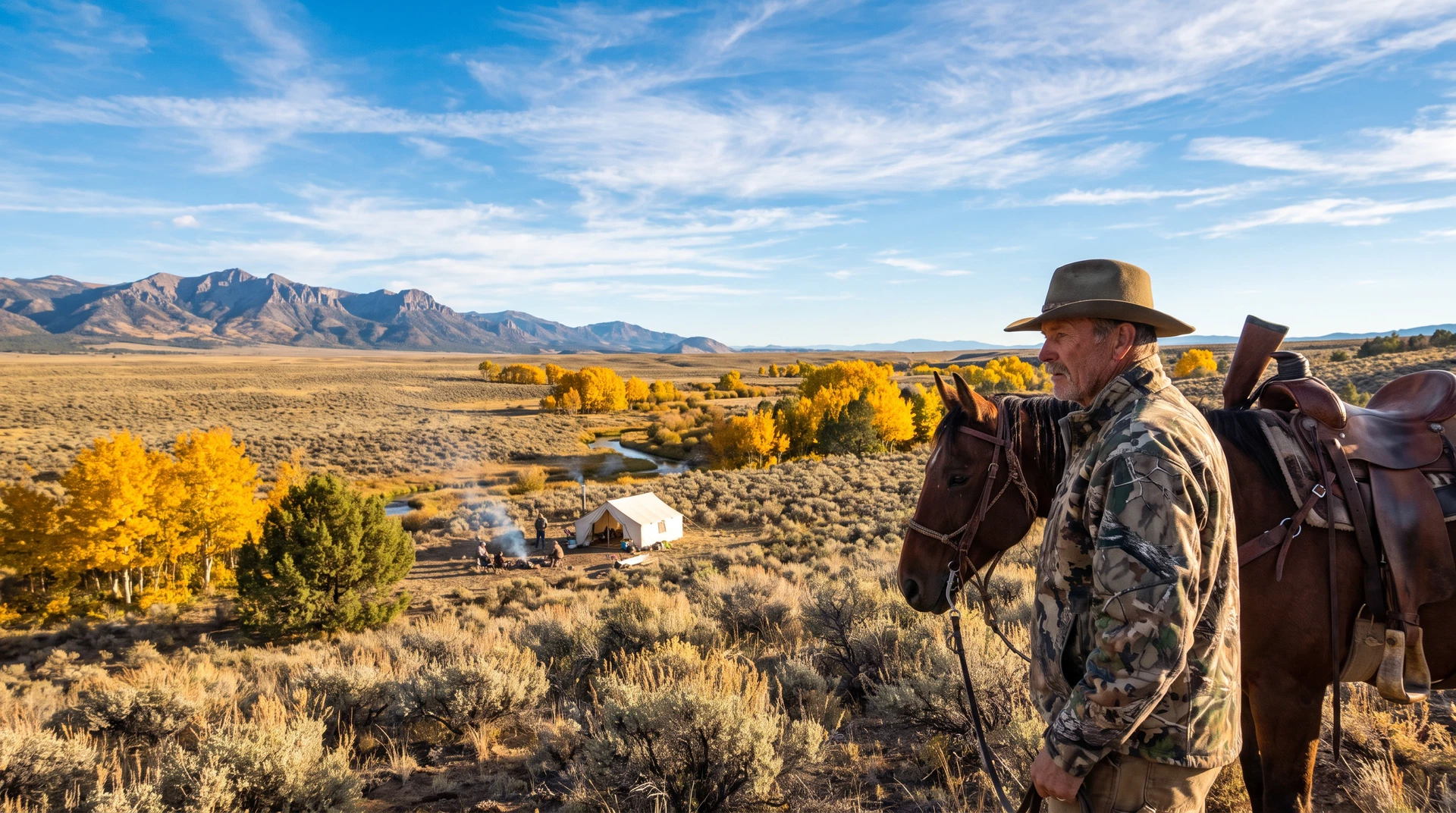

Eastern Oregon is one of the premier hunting destinations in the American West. Every fall, thousands of hunters travel to Harney, Malheur, Grant, Baker, Lake, and Wallowa counties to pursue elk, mule deer, pronghorn, bighorn sheep, upland birds, and waterfowl. Behind every successful hunt is a licensed guide, outfitter, or camp operator — and behind every licensed operation should be a properly structured insurance program.
Oregon law (ORS Chapter 704) requires all licensed outfitters and guides to carry at least $500,000 in general liability insurance. But that legal minimum barely scratches the surface of the real risks involved in running a guiding operation in Eastern Oregon's remote wilderness. A single serious client injury — a horse fall, a firearms accident, an ATV rollover, a wilderness medical emergency — can generate a claim that exceeds $500,000 before the case even reaches a jury.
This guide covers everything Eastern Oregon hunting guides, outfitters, hunting camp operators, lodge owners, pack station operators, and horse outfitters need to know about proper insurance coverage — including what Oregon law requires, what it doesn't cover, and how to build a complete protection package.
Oregon's Legal Requirements for Licensed Outfitters and Guides
Under ORS 704.020, any person who acts as an outfitter and guide in Oregon — meaning they provide guiding services for compensation — must register annually with the Oregon State Marine Board and meet the following insurance requirements:
- General Liability Insurance: Minimum $500,000 combined single limit per occurrence, covering bodily injury and property damage caused by the guide and their employees
- Surety Bond: $5,000 bond required if you accept deposits of more than $100 per person (protects clients if services are not delivered)
- Continuous Coverage: Insurance must remain in force for the entire registration period — a lapse triggers automatic suspension of your guide registration
- First Aid Certification: All guides and employees who directly provide services must be certified in first aid
⚠️ The $500,000 Minimum Is Not Enough
Oregon's $500,000 minimum was set years ago and has not kept pace with claim severity. A serious client injury in a remote wilderness setting — involving evacuation, hospitalization, surgery, and lost wages — can easily exceed $500,000. Most insurance professionals recommend $1 million per occurrence / $2 million aggregate as a practical minimum for hunting operations. The additional premium cost is modest compared to the exposure.
Who Needs Hunting Guide & Outfitter Insurance in Eastern Oregon?
The following operations all require specialized commercial insurance — not personal homeowners or farm policies, which explicitly exclude commercial business activity:
| Operation Type | Oregon Registration Required | Key Insurance Needs |
|---|---|---|
| Licensed Hunting Guide | Yes — Oregon State Marine Board | GL ($1M+), firearms liability, ATV/vehicle coverage |
| Hunting Camp Operator | Yes (if charging for services) | GL, property, liquor liability, commercial auto |
| Hunting Lodge / Guest Ranch | Yes | GL, property, liquor liability, workers' comp, commercial auto |
| Pack Station / Horse Outfitter | Yes | GL, equine liability, horse mortality, commercial auto |
| ATV / UTV Tour Operator | Yes | GL, off-road vehicle liability, equipment coverage |
| Bird Hunting Preserve | May be exempt (private land only) | GL, firearms liability, dog kennel liability |
| Fishing Guide (river/lake) | Yes — Oregon State Marine Board | GL, watercraft liability, USCG license if applicable |
The Core Coverage Package: What Every Eastern Oregon Guide Needs
1. General Liability Insurance
The foundation of any guide or outfitter insurance program. General liability covers bodily injury and property damage claims arising from your guiding operations — a client slips on a rocky trail, a stray shot damages a neighboring property, a horse kicks a guest. The Oregon minimum is $500,000, but $1 million per occurrence / $2 million aggregate is the practical standard.
Your general liability policy should specifically cover:
- Guided hunting activities (firearms, archery)
- ATV and UTV operations on your permitted areas
- Horse and mule pack operations
- Backcountry hiking and camping activities
- Client transportation to and from hunting areas
2. Commercial Auto Insurance
Your personal auto policy does not cover vehicles used for commercial guiding purposes. If you use a pickup truck, SUV, or trailer to transport clients, horses, ATVs, or equipment — and you charge for those services — you need a commercial auto policy. This is one of the most common coverage gaps for Eastern Oregon guides.
Commercial auto coverage should include:
- Vehicles used to transport clients to hunting areas
- Horse trailers and livestock transport
- ATV/UTV trailers
- Non-owned vehicles (if you rent or borrow trucks)
3. Equine Liability Insurance
Pack stations and horse outfitters face a unique liability exposure. Oregon's equine activity statute (ORS 30.687) provides some protection for equine activity sponsors, but it does not eliminate liability in cases of negligence — and courts have found guides negligent for using unsuitable horses, failing to properly instruct riders, or operating in hazardous conditions without adequate precautions.
Equine liability coverage should be specifically endorsed onto your general liability policy or written as a separate equine policy. It covers bodily injury caused by horses, mules, and other equines in your care — including bites, kicks, falls, and runaways.
4. Property Insurance for Camps, Lodges & Equipment
If you operate a hunting camp, lodge, or base camp with physical structures — wall tents, cabins, cook shacks, generator sheds, horse corrals — you need commercial property coverage. Standard homeowners and farm policies do not cover commercial business property.
Property coverage should include:
- Camp structures (tents, cabins, cook facilities)
- Firearms and archery equipment owned by the operation
- ATVs, UTVs, and off-road vehicles
- Saddles, tack, and horse equipment
- Generators, camp stoves, and cooking equipment
- Boats and watercraft (if applicable)
Is Your Guide Operation Properly Insured?
Prineville Insurance works with specialty outdoor recreation carriers to build custom insurance packages for Eastern Oregon guides, outfitters, and hunting camp operators. Get a free coverage review today.
Hunting Camp & Lodge Insurance: The Additional Coverages You Need
If you operate a hunting camp or lodge that provides overnight accommodations, meals, and alcohol service, your insurance needs expand significantly beyond a basic guide liability policy:
Liquor Liability
If your hunting camp or lodge serves alcohol — even informally, as a complimentary amenity — you have liquor liability exposure. Oregon's dram shop law (ORS 471.565) can hold a provider liable for damages caused by an intoxicated guest. Liquor liability coverage must be specifically added to your policy; it is not included in standard general liability.
Workers' Compensation
Oregon requires workers' compensation coverage for any employee — including seasonal guides, camp cooks, wranglers, and cleaning staff. If you use independent contractors, verify their coverage status carefully; Oregon courts have found that many "independent contractors" in guiding operations are actually employees for workers' comp purposes. Contact Prineville Insurance to review your worker classification.
Dog Kennel & Working Dog Liability
Bird hunting operations that use dogs — pointing breeds, flushers, retrievers — have a specific liability exposure if a dog bites a client or damages property. Dog kennel liability coverage protects against these claims and can also cover dogs in your care, custody, and control (including client dogs brought to your operation).
Firearms Liability
Firearms accidents are among the most serious claims in the hunting guide industry. If your operation provides firearms to clients, or if a client's firearm causes injury to another person, your general liability policy must specifically cover firearms-related incidents. Some standard GL policies exclude firearms — verify your policy language carefully.
Federal Land Permits: The Insurance Requirements You Can't Ignore
Much of Eastern Oregon's best hunting country is on federal land — the Malheur National Forest, Ochoco National Forest, Wallowa-Whitman National Forest, and vast BLM holdings in Harney, Lake, and Malheur counties. If you hold a Special Use Permit (SUP) from the U.S. Forest Service or Bureau of Land Management to conduct commercial guiding on federal land, you face additional insurance requirements:
- Minimum coverage: Typically $1 million per occurrence, with the federal agency named as an additional insured
- Certificate of Insurance: Must be submitted annually to the permit-issuing agency
- Commercial auto: Vehicles used on federal land under a SUP must have commercial auto coverage
- Watercraft: River and lake guiding on federal waterways requires watercraft liability coverage
Failure to maintain required insurance can result in immediate suspension of your federal permit — which can shut down your entire operation during peak season.
Pack Stations & Horse Outfitters: A Special Case
Eastern Oregon's backcountry hunting — particularly in the Wallowa Mountains, Eagle Cap Wilderness, and Hells Canyon — relies heavily on pack stations and horse outfitters. These operations face a unique combination of risks:
- Equine mortality: Pack horses and mules are valuable working animals. A horse lost to injury, illness, or accident can represent a $5,000–$25,000 loss. Equine mortality insurance covers the death of a horse from covered causes.
- Major medical: Equine major medical coverage pays for veterinary treatment of serious injuries or illness — colic surgery, for example, can cost $5,000–$15,000.
- Transit coverage: Horses and mules transported in trailers on public roads need commercial auto coverage for the trailer and livestock mortality coverage for the animals in transit.
- Equine liability: As noted above, a horse-related client injury is one of the most common and costly claims in the outfitter industry.
For more on equine insurance, see our comprehensive guide: Horse Property Insurance in Central Oregon, Eastern Oregon & Eastern Washington.
The Coverage Gap Most Eastern Oregon Guides Don't Know About
| Scenario | Personal Homeowners/Farm Policy | Guide/Outfitter Commercial Policy |
|---|---|---|
| Client injured during guided hunt | ❌ Excluded (business activity) | ✅ Covered under GL |
| Client injured by horse/mule | ❌ Excluded (business activity) | ✅ Covered under equine liability |
| Client injured in guide's truck | ❌ Excluded (commercial use) | ✅ Covered under commercial auto |
| Camp cook injured on the job | ❌ No workers' comp | ✅ Covered under workers' comp |
| Firearms accident injures bystander | ❌ Excluded (business activity) | ✅ Covered (if firearms endorsed) |
| ATV rollover injures client | ❌ Excluded (business use) | ✅ Covered under GL + off-road endorsement |
| Lodge fire destroys camp structures | ❌ Excluded (commercial property) | ✅ Covered under commercial property |
Talk to a Commercial Insurance Expert
Prineville Insurance has been serving Eastern Oregon businesses since 1935. We work with specialty outdoor recreation carriers to find the right coverage for guides, outfitters, hunting camps, and pack stations. Call us today for a free coverage review.
Related Insurance for Eastern Oregon Outdoor Operations
Many Eastern Oregon guide and outfitter operations are part of a larger farm, ranch, or agritourism business. If that describes your operation, you may also need:
- Farm & Ranch Insurance: If your guiding operation is based on a working farm or ranch, a farm and ranch policy can cover the agricultural side of the operation while a separate commercial guide policy covers the guiding activities.
- Agritourism Insurance: If you offer farm stays, barn dinners, or other agritourism activities alongside hunting, see our guide on Crook County Agritourism Insurance.
- Surety Bonds: Oregon requires a $5,000 surety bond for guides who accept deposits. See our comprehensive guide on Surety Bonds in Central and Eastern Oregon.
- Commercial Trucking: If you transport clients, horses, or equipment across state lines or on a for-hire basis, you may need commercial trucking coverage beyond a standard commercial auto policy.
Frequently Asked Questions
How much liability insurance does an Oregon hunting guide need?+
Does a hunting guide need a surety bond in Oregon?+
What insurance does a hunting camp or lodge need?+
Is a hunting guide covered by a personal homeowners or farm policy?+
What is equine liability insurance for hunting operations?+
Do I need insurance to guide on BLM or Forest Service land in Eastern Oregon?+
Protect Your Eastern Oregon Guide Operation
Prineville Insurance has served Eastern Oregon businesses since 1935. We work with specialty outdoor recreation carriers to build custom insurance packages for guides, outfitters, hunting camps, and pack stations. Get a free quote today.
Prineville Insurance is an independent insurance agency serving Central Oregon, Eastern Oregon, Eastern Washington, and the Columbia River Basin since 1935. We represent 50+ carriers and can help you find the right commercial, guide, and outfitter coverage for your operation. Call (541) 447-6372 or text us to get started.


