



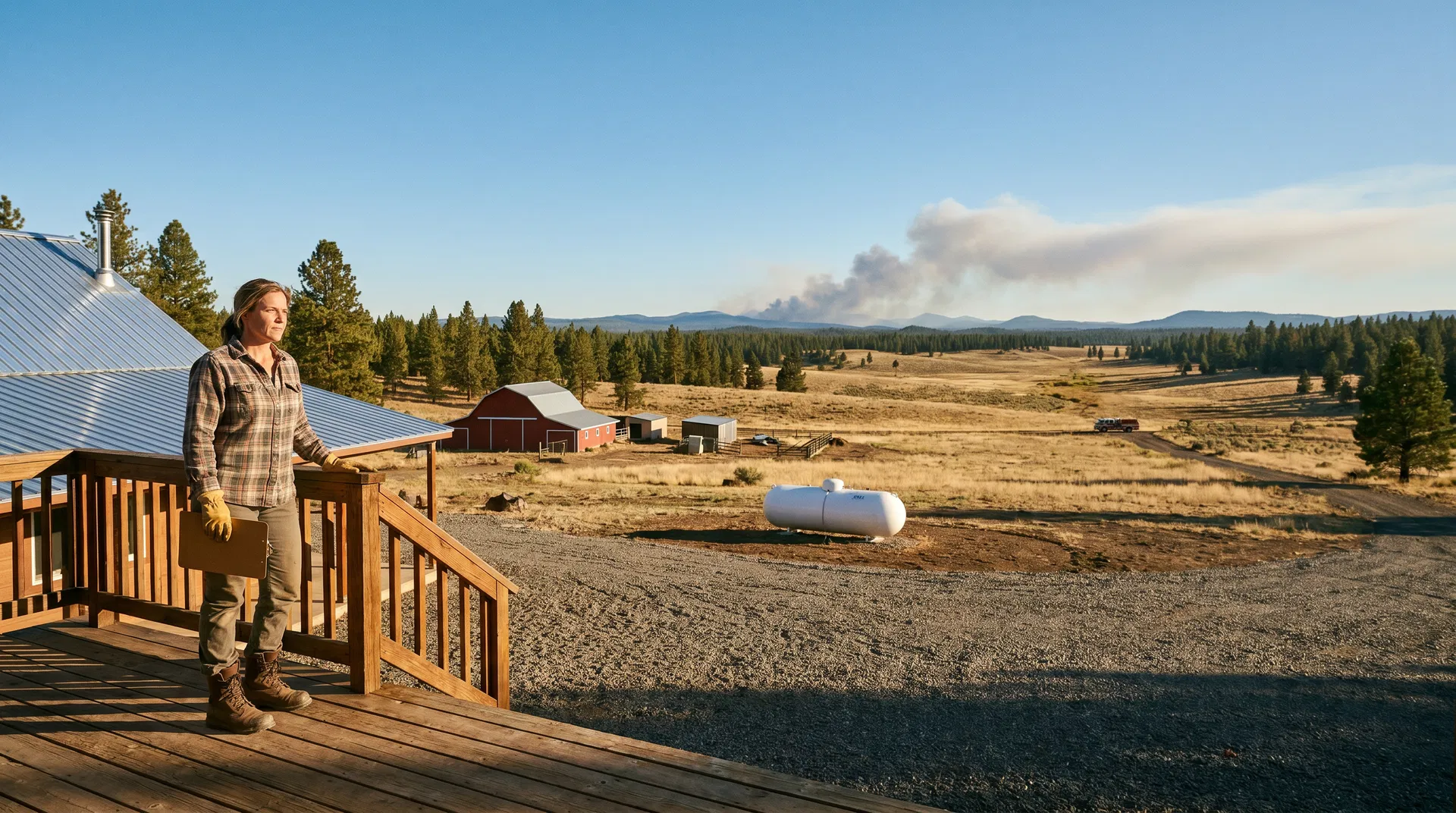

Fire season in Central Oregon does not announce itself politely. One week the Ochoco Mountains are green and the humidity is manageable. The next week a lightning strike in the Maury Mountains or a power line arc near Prineville puts 10,000 acres on the ground before the first air tanker arrives. The difference between a family that recovers quickly and one that spends years fighting with their insurance carrier almost always comes down to preparation done before the fire — not after.
This is not a generic wildfire safety guide. This is a specific, actionable insurance prep checklist for Central Oregon homeowners, ranchers, and farmers. Each item on this list corresponds to a real coverage gap, a real claims dispute, or a real premium discount opportunity. Work through it before June 1 every year.
Is Your Wildfire Coverage Ready for Fire Season?
Most Central Oregon homeowners discover coverage gaps only after a fire. A free wildfire insurance review takes 20 minutes and can prevent years of financial pain.
Get a Free Wildfire Insurance ReviewWhy Central Oregon Is Different
Crook, Jefferson, and Deschutes counties sit in one of the most fire-prone landscapes in the American West. The combination of ponderosa pine forests, high desert grasslands, low summer humidity (often below 10 percent), and east wind events that accelerate through Cascade gaps creates conditions that can push a fire 20 miles in a single afternoon. The 2020 Labor Day fires burned more than one million acres in Oregon in a single week — including significant acreage in Crook and Jefferson counties.
Since 2020, several major insurance carriers have non-renewed policies in Oregon WUI (Wildland-Urban Interface) zones. Premiums for rural properties in Crook County have increased more than 27 percent on average. Some properties that were insurable in 2019 are now declined by standard carriers entirely. The insurance landscape for Central Oregon rural properties has fundamentally changed — and the preparation steps below reflect that new reality.
The 8-Item Wildfire Insurance Prep Checklist
Each item below is a specific action you can complete before fire season. Together, they protect your coverage, document your property, and position you for the fastest possible claims settlement if a fire does reach your property.
1. Defensible Space Photos (Dated)
Walk your entire property and photograph your defensible space zones — Zone 1 (0–30 ft) and Zone 2 (30–100 ft). Date-stamp every photo. Oregon carriers are increasingly offering premium discounts for documented defensible space that meets Oregon State Fire Marshal standards: no dead vegetation within 30 feet, tree crowns spaced 10 feet apart, 10-foot clearance around propane tanks, and 13'6" vertical clearance on driveways for fire truck access. These photos also serve as evidence if a carrier disputes your defensible space compliance after a loss.
2. Roof Condition and Class Rating
Your roof is the single most important factor in whether your home survives a wildfire. Photograph your roof from multiple angles. Note the material and age. Class A fire-rated roofing (metal, tile, Class A asphalt shingles) qualifies for premium discounts with most carriers. Wood shake roofs are a red flag — several carriers will not renew policies on homes with wood shake roofs in WUI zones. If your roof is aging or wood shake, document its condition now and get a replacement estimate before fire season. An undocumented roof claim after a fire is far harder to settle.
3. Outbuilding Values and Contents
Walk every outbuilding on your property — barns, shops, equipment sheds, bunkhouses, hay storage, pump houses — and document the structure and its contents separately. Photograph the exterior and interior. Note the square footage, construction type (wood frame, metal, masonry), and approximate replacement cost. Standard homeowners 'other structures' coverage is typically capped at 10 percent of your dwelling limit — far less than the replacement cost of a modern shop or barn. Ranchers should schedule each outbuilding separately on a farm policy with adequate limits.
4. Updated Replacement Cost Review
Construction costs in Central Oregon have increased 40 to 60 percent since 2019. If your dwelling coverage limit has not been reviewed since 2022, you are almost certainly underinsured. Two-thirds of homeowners who file wildfire claims discover they are underinsured only after the fire — when it is too late. Ask your agent to run a replacement cost estimator on your home before fire season. Confirm whether your policy includes extended replacement cost (25–50% above the stated limit) or guaranteed replacement cost. The difference between these endorsements can be hundreds of thousands of dollars.
5. Evacuation Home Inventory
Walk through every room of your home with your phone and record a video narrating what you see — furniture, electronics, appliances, artwork, firearms, jewelry, tools, and collectibles. Open closets and drawers. Narrate approximate values. Upload the video to cloud storage (Google Drive, iCloud, Dropbox) so it is accessible from anywhere — not just from your home computer. Oregon DFR recommends completing a home inventory before fire season every year. A documented inventory dramatically speeds up claims settlement and prevents disputes over personal property values.
6. Livestock Evacuation Plan
Know your livestock numbers, locations, and trailer requirements before a fire is burning. Identify your evacuation route and a destination (neighbor's property, fairgrounds, or livestock facility) at least 20 miles from your property. Confirm that your livestock mortality coverage is current and that it covers fire, smoke inhalation, and death in transit. Oregon's wildfire.oregon.gov/prepare has a livestock evacuation planning guide. The Central Oregon Emergency Animal Evacuation Facebook group coordinates volunteer trailers during active evacuations — join it now, not during a fire.
7. Farm Equipment Locations and Values
Document every piece of farm equipment: tractors, ATVs, UTVs, center-pivot systems, irrigation pumps, trailers, and implements. Photograph serial numbers and note current market values. Standard homeowners policies exclude farm equipment — it must be scheduled on a farm policy or inland marine floater. Center-pivot irrigation systems are particularly vulnerable: a single pivot can cost $100,000 to $300,000 to replace, and they are often not scheduled at current value. If you store equipment in multiple locations, confirm that your policy covers all locations.
8. Insurance Documents — Digital Copies
Save digital copies of your declarations pages, policy numbers, and carrier contact information to cloud storage and email them to yourself. Know your wildfire deductible before a fire — not after. Many Oregon carriers have added wildfire-specific deductibles (1–5% of dwelling value) that are separate from the standard all-peril deductible. Know your additional living expense (ALE) limit and how long it covers you. After a major wildfire, rental housing in Central Oregon disappears within days — ALE coverage that runs out in 12 months may not be enough for a full rebuild.
Schedule Your Pre-Fire Season Insurance Review
Prineville Insurance specializes in rural and wildfire-exposed properties throughout Crook, Jefferson, and Deschutes counties. We can review your dwelling limits, outbuilding values, livestock coverage, and farm equipment in a single appointment.
Schedule a Wildfire Insurance ReviewThe Coverage Gaps Most People Discover After a Fire
The most painful wildfire insurance conversations happen in the weeks after a fire, when a homeowner or rancher discovers that their policy does not cover what they thought it covered. These are the gaps we see most often in Central Oregon:
Underinsured Dwelling Coverage
Two-thirds of homeowners who file wildfire claims are underinsured — meaning their dwelling coverage limit is lower than the actual cost to rebuild. Construction costs in Central Oregon have increased 40 to 60 percent since 2019, driven by lumber prices, contractor labor shortages, and supply chain disruptions. A home that cost $300,000 to build in 2018 may cost $480,000 to rebuild today. If your policy was last reviewed before 2022, your dwelling limit is almost certainly too low. The solution is an extended replacement cost endorsement (typically 25 to 50 percent above the stated limit) or a guaranteed replacement cost policy.
Outbuilding Undervaluation
Standard homeowners policies cap "other structures" coverage at 10 percent of the dwelling limit. On a $400,000 dwelling policy, that is $40,000 for all outbuildings combined — a figure that will not come close to replacing a modern shop, barn, or equipment shed. Rural properties in Central Oregon routinely have outbuildings worth more than the dwelling itself. Ranchers and rural property owners should schedule each outbuilding separately on a farm and ranch policy with adequate individual limits.
Farm Equipment Exclusions
Standard homeowners policies exclude farm equipment. Tractors, ATVs, UTVs, center-pivot irrigation systems, and farm implements must be scheduled on a farm policy or inland marine floater. Center-pivot irrigation systems are particularly vulnerable — a single pivot can cost $100,000 to $300,000 to replace, and they are often not scheduled at current value. Review every piece of equipment before fire season.
Livestock Exclusions
Standard homeowners policies exclude livestock. Livestock mortality coverage is a separate policy or farm policy endorsement. It covers death from fire, lightning, and windstorm — but may not cover death from smoke inhalation alone unless specifically endorsed. Confirm your livestock coverage before fire season, not during an evacuation.
Additional Living Expense Limits
After a major wildfire, rental housing in Central Oregon disappears within days. ALE (Additional Living Expense) coverage pays for temporary housing, meals, and living costs while your home is being rebuilt. Standard ALE limits of 20 to 30 percent of dwelling coverage sound adequate — until a full rebuild takes 18 to 24 months and rental rates have tripled. Review your ALE limit and confirm the maximum time period covered. Some policies cap ALE at 12 months; others at 24 or 36 months. For a major loss, 12 months is rarely enough.
Wildfire-Specific Deductibles
Many Oregon carriers have added wildfire-specific deductibles that are separate from the standard all-peril deductible. These are often expressed as a percentage of the dwelling value: 1 percent, 2 percent, or 5 percent. On a $500,000 home, a 2 percent wildfire deductible means you pay the first $10,000 of any wildfire claim out of pocket. Know your deductible before fire season. Review your declarations page now.
Home Hardening Discounts Available in Oregon
Oregon carriers are increasingly rewarding home hardening efforts with premium discounts. The Oregon State Fire Marshal has partnered with the Insurance Institute for Business and Home Safety (IBHS) to offer Wildfire Prepared Home certification — a documented assessment of your home's fire resistance that qualifies for premium discounts with participating carriers. Specific improvements that commonly qualify for discounts include Class A fire-rated roofing (metal, tile, or Class A asphalt shingles), ember-resistant vents, multi-pane windows, non-combustible decking, and documented defensible space.
Oregon also offers $250 grants through the State Fire Marshal for defensible space landscaping. A 2026 Oregon bill would require all carriers to factor home hardening efforts into premium calculations — making these investments even more valuable going forward. Document every improvement with dated photographs and receipts, and share them with your insurance agent.
If You Receive a Non-Renewal Notice
Oregon law requires carriers to give 45 days' notice before non-renewing a policy. If you receive a non-renewal notice, do not wait until the policy expires to act. Contact Prineville Insurance immediately. We specialize in placing wildfire insurance for rural and WUI-zone properties that standard carriers have declined or non-renewed. The surplus lines market, specialty farm carriers, and Oregon's FAIR Plan are all options — but each has different coverage terms and pricing, and navigating them requires an agent who knows the Central Oregon market.
Do not let a non-renewal lapse into an uninsured period. Even a 30-day gap in coverage can be catastrophic if a fire occurs during that window.
Related Coverage to Review Before Fire Season
A wildfire insurance review should also include a check of your workers' compensation coverage if you employ farm or ranch workers, your commercial umbrella policy to confirm it extends to all entities on your property, and your rural property coverage for well, septic, and outbuilding gaps. If your property is held in an LLC or trust, confirm that the entity is named on all policies — a transfer to an LLC without updating the policy voids coverage for claims against the entity.
Frequently Asked Questions
Don't Wait Until Fire Season to Find Out You're Underinsured
Prineville Insurance has served Crook County and Central Oregon for decades. We know the WUI zones, the carriers who will write rural properties, and the coverage gaps that cost families the most. A free wildfire insurance review takes 20 minutes and can prevent years of financial pain.
Get a Free Wildfire Insurance Review

