



In July 2026, Arnold Irrigation District shut off water to more than 600 farms, ranches, and properties in Central Oregon — the earliest shutdown in the district's recorded history. Snowpack in the Cascades had been just 30% of normal. Reservoirs were exhausted. Crops were lost. And for most of those 600+ property owners, there was no insurance policy in place to cover a single dollar of the loss.
Water rights in Central Oregon are among the most valuable assets a farm or ranch can own. Senior irrigation rights on the Deschutes River have sold for $1,000 to $3,000 per acre-foot — meaning a 100 acre-foot water right can be worth $100,000 to $300,000 or more. In Eastern Oregon's Malheur, Harney, and Grant basins, values are lower but still significant. Yet despite this enormous financial exposure, most Oregon farmers and ranchers have no insurance specifically addressing water rights risk.
This guide explains what water rights insurance exists, what doesn't, and how to build a coverage package that protects your most valuable agricultural asset — before the next drought hits.
Oregon Water Law: Prior Appropriation and What It Means for Your Risk
Oregon water rights operate under the doctrine of prior appropriation — "first in time, first in right." Water rights established earlier have priority over junior rights during shortages. When the Oregon Water Resources Department (OWRD) issues a curtailment order during drought, junior rights holders are cut off first, regardless of how much they depend on that water.
The Deschutes Basin illustrates this risk dramatically. The Central Oregon Irrigation District (COID) holds senior rights to more than half the volume of the Deschutes River in Bend — rights dating to the early 1900s. During the 2022–2026 drought cycle, junior rights holders in Jefferson County (Madras area) saw their water curtailed while COID continued diversions upstream. Some Jefferson County farmers fallowed a third of their irrigated acreage. Others left farming entirely.
⚠️ The "Use It or Lose It" Rule
Oregon law requires water rights to be put to "beneficial use" at least once every five years. If unused, OWRD can cancel the right. This means some landowners continue irrigating — even at a loss — to protect the value of their water right. This creates a financial catch-22 that no standard insurance policy addresses.
What Insurance Exists for Oregon Water Rights?
There is no single "water rights insurance" policy available in Oregon. However, several coverages can be combined to protect the financial value of your water rights and irrigation-dependent operation:
1. Crop Insurance (Multi-Peril Crop Insurance — MPCI)
The most important coverage for water-dependent farmers is USDA Multi-Peril Crop Insurance (MPCI), administered through the Risk Management Agency (RMA). MPCI covers yield losses from drought — including losses caused by water curtailment — for most crops grown in Oregon and Eastern Washington. Key crops covered in Central and Eastern Oregon include:
- Wheat (winter and spring)
- Potatoes and onions
- Hay and alfalfa (limited coverage)
- Mint and specialty crops (check with your agent)
- Pasture, Rangeland, and Forage (PRF) — covers grass and hay for livestock operations
Critical deadline: Crop insurance must be purchased before the crop year sales closing date — typically February or March for spring crops. You cannot buy crop insurance after a drought is already underway or after planting. Contact Prineville Insurance in the fall or early winter to review your options for the coming season.
2. Irrigation Equipment Breakdown Coverage
Standard farm policies cover physical damage to irrigation equipment from fire, theft, and weather. But the most common and expensive irrigation claim is mechanical breakdown — a pump motor burns out, a pivot gearbox fails, a well pump seizes. These losses are excluded from standard farm property coverage.
Equipment breakdown coverage (also called boiler and machinery coverage) fills this gap. It covers:
- Irrigation pump motors and controls
- Center pivot and linear move systems
- Well pumps and submersible motors
- Pressure tanks and filtration systems
- Business interruption losses while equipment is being repaired
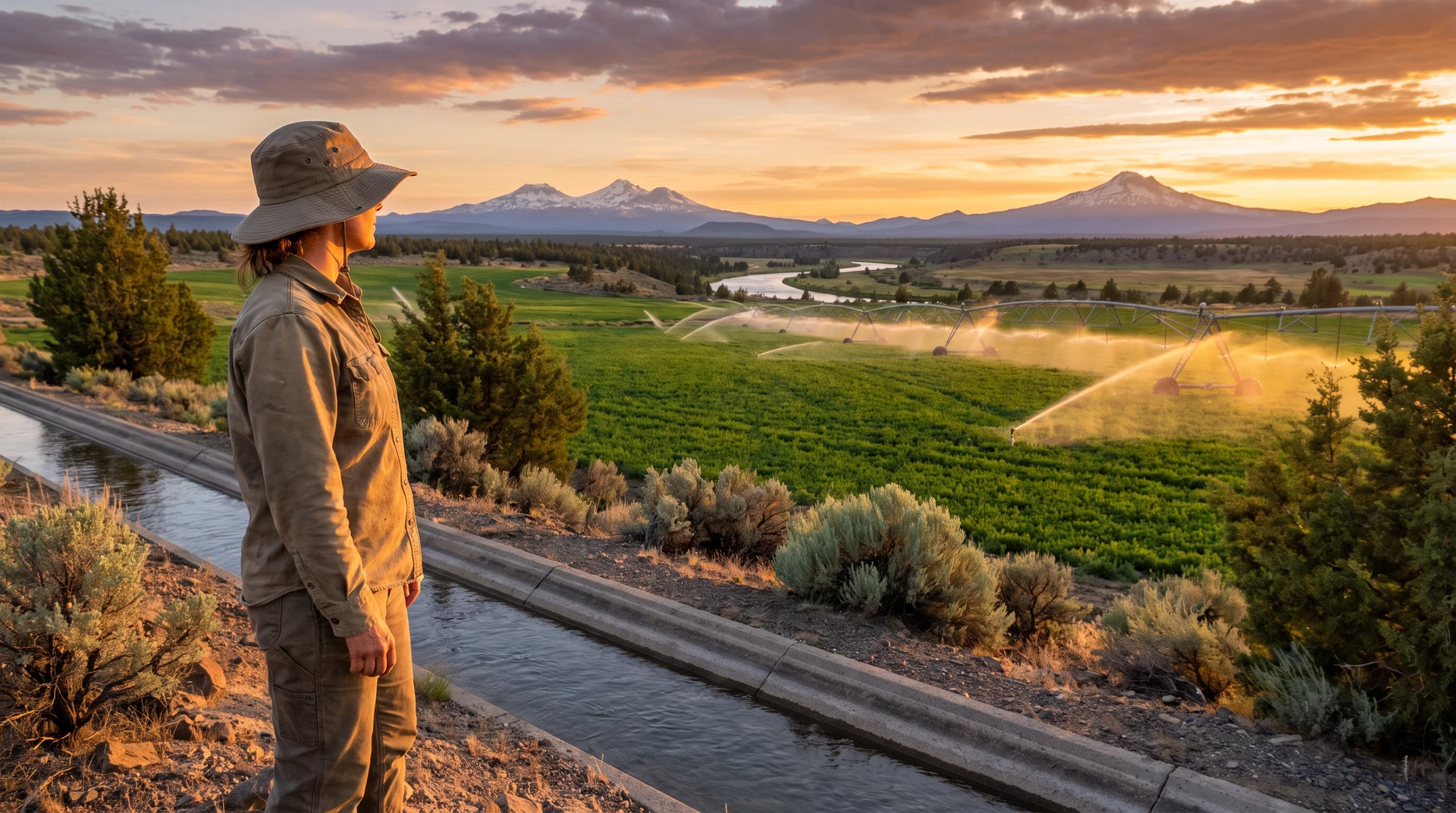
For a Central Oregon farm with a center pivot system, equipment breakdown coverage can be added to a farm and ranch policy for a relatively modest additional premium — and it's one of the most frequently used coverages on irrigated operations.
3. Farm Property Coverage for Irrigation Infrastructure
A properly written farm and ranch policy should include scheduled coverage for:
- Pump houses and well houses
- Mainline and lateral irrigation pipe
- Pivot towers and spans
- Buried drip irrigation systems
- Reservoirs and storage ponds (if man-made)
Many farm policies undervalue or exclude irrigation infrastructure entirely. Review your policy with an agent to confirm your irrigation system is properly scheduled and insured at replacement cost — not actual cash value (ACV). A 20-year-old center pivot that cost $80,000 new may have an ACV of only $20,000, leaving you $60,000 short at claim time.
4. Farm Liability Coverage for Irrigation-Related Incidents
Irrigation operations create liability exposures that standard homeowners policies don't cover:
- Canal and ditch flooding of neighboring properties
- Irrigation runoff causing downstream water quality issues
- Workers injured while operating or maintaining irrigation equipment
- Livestock drowning in irrigation canals or reservoirs
Farm liability coverage through a farm and ranch policy addresses these exposures. Limits should be reviewed annually — especially if your operation has grown or if you have irrigation infrastructure that borders neighboring properties.
5. Title Insurance When Purchasing Water Rights
When buying a farm or ranch with water rights — or purchasing water rights separately — title insurance protects against defects in the water right itself: undisclosed encumbrances, priority date disputes, or errors in the OWRD record. This is particularly important in the Deschutes Basin, where water rights have been bought, sold, transferred, and leased extensively over the past century.
Is Your Irrigation Infrastructure Properly Insured?
Most farm policies undervalue or exclude irrigation equipment. Let Prineville Insurance review your current coverage and identify the gaps before the next drought season.
The Deschutes Basin Water Crisis: What It Means for Your Insurance
The 2026 drought season brought the Deschutes Basin's water allocation system into sharp focus. Arnold Irrigation District — which serves more than 600 properties in southwest and southeast Bend — shut off water deliveries on July 2, 2026, the earliest shutdown in the district's history. The district had started the season with full reservoir storage but watched it drain as snowpack came in at just 30% of normal and natural river flows fell to historic lows.
Meanwhile, the Central Oregon Irrigation District (COID) — which holds senior rights to more than half the Deschutes River — continued diversions. Junior rights holders downstream were curtailed. This is exactly how Oregon's prior appropriation system is designed to work. And it's exactly why junior rights holders need crop insurance in place before drought season begins.
| Irrigation District | Priority Date | Annual Diversion | 2026 Drought Impact |
|---|---|---|---|
| Central Oregon ID (COID) | Early 1900s (Senior) | 241,000 acre-feet/yr | Continued full diversions |
| Arnold Irrigation District | Early 1900s (Senior) | 22,000 acre-feet/yr | Shut off July 2 (earliest ever) |
| North Unit ID (Jefferson Co.) | 1920s–1940s (Junior) | 124,000 acre-feet/yr | Curtailed; 1/3 of acreage fallowed |
| Tumalo ID (Bend area) | Early 1900s | 20,000 acre-feet/yr | Reduced deliveries |
Eastern Oregon Water Rights: Different Basins, Different Risks
Eastern Oregon's water rights landscape differs significantly from the Deschutes Basin. Key basins include:
- Malheur Basin (Ontario, Vale, Nyssa area): Heavily irrigated from the Snake River and its tributaries. Senior rights are generally more secure, but drought and Snake River curtailment orders have affected junior holders in recent years.
- Harney Basin (Burns area): Closed basin — no new surface water rights available. Existing rights are highly valuable and carefully managed. Drought risk is significant in dry years.
- John Day Basin (John Day, Dayville area): Mix of senior and junior rights. The John Day River is unregulated in some reaches, creating both opportunity and uncertainty for water users.
- Crooked River Basin (Prineville area): Prineville Reservoir provides storage for downstream irrigators. Rights are managed by the Ochoco Irrigation District and private holders. Drought years have triggered curtailments affecting junior rights holders in Crook County.
For all of these basins, the insurance planning principles are the same: crop insurance before planting season, equipment breakdown coverage for irrigation infrastructure, and a farm policy that properly schedules all irrigation assets.
The Coverage Gap Most Oregon Farmers Don't Know About
Here is the most important thing to understand about water rights and insurance in Oregon: your standard farm policy does not cover crop losses from water delivery failure.
| Loss Scenario | Standard Farm Policy | Crop Insurance (MPCI) | Equipment Breakdown |
|---|---|---|---|
| Irrigation district shuts off water (drought) | ❌ Not covered | ✅ Covered (drought peril) | N/A |
| Irrigation pump motor burns out | ❌ Excluded (mechanical breakdown) | N/A | ✅ Covered |
| Center pivot damaged by hail | ✅ Covered (if scheduled) | N/A | N/A |
| Crop loss from drought (water curtailment) | ❌ Not covered | ✅ Covered (if purchased before season) | N/A |
| Irrigation canal flooding neighbor's property | ✅ Farm liability covers | N/A | N/A |
| Water right title defect at purchase | ❌ Not covered | ❌ Not covered | ⚠️ Title insurance (separate) |
Talk to a Farm Insurance Expert
Prineville Insurance has been serving Central Oregon farmers and ranchers since 1935. We understand the Deschutes Basin, the Crooked River, and the water rights issues that affect your operation. Call us today to review your crop insurance and farm coverage.
How to Build a Complete Water Risk Insurance Package
Based on the coverage gaps above, here is the recommended insurance package for an irrigated farm or ranch in Central Oregon or Eastern Oregon:
| Coverage | What It Covers | When to Buy |
|---|---|---|
| MPCI Crop Insurance | Yield losses from drought, hail, freeze, flood | Fall/Winter (before sales closing date) |
| Farm Property Coverage | Buildings, equipment, irrigation infrastructure (scheduled) | Anytime — review annually |
| Equipment Breakdown | Pump motors, pivots, well pumps — mechanical failure | Add to farm policy at renewal |
| Farm Liability | Canal flooding, runoff, worker injuries, visitor injuries | Part of farm policy — review limits annually |
| PRF (Pasture/Rangeland/Forage) | Precipitation shortfall for hay and pasture operations | Fall — before November 15 sales closing date |
| Title Insurance | Water right title defects at purchase | At closing when buying water rights |
Related Coverage: Wildfire and the Irrigation Infrastructure Risk
Central Oregon's wildfire risk adds another layer of complexity to irrigation infrastructure insurance. A wildfire moving through a farm or ranch can destroy pump houses, melt plastic mainline pipe, damage pivot systems, and contaminate reservoirs. Standard farm property coverage addresses fire damage to scheduled equipment, but many farmers underestimate the total replacement cost of their irrigation infrastructure — particularly buried drip systems and mainline pipe, which are expensive to replace and often not properly scheduled.
Review your farm and ranch coverage with a Prineville Insurance agent to confirm your irrigation infrastructure is scheduled at current replacement cost. Also review the harvest season insurance checklist for additional coverage considerations for the August–October period.
Frequently Asked Questions
Can you insure Oregon water rights?+
What happens to my crops if my irrigation district shuts off water?+
How much are Oregon water rights worth?+
Does homeowners or farm insurance cover irrigation infrastructure?+
What is the 'use it or lose it' rule for Oregon water rights?+
Can I buy crop insurance for drought caused by water curtailment?+
Protect Your Water-Dependent Operation
Prineville Insurance has served Central Oregon farmers and ranchers since 1935. We know the Deschutes Basin, the Crooked River, and the water rights issues that affect your operation. Get a free farm insurance review today.
Prineville Insurance is an independent insurance agency serving Central Oregon, Eastern Oregon, Eastern Washington, and the Columbia River Basin since 1935. We represent 50+ carriers and can help you find the right farm, crop, and irrigation coverage for your operation. Call (541) 447-6372 or text us to get started.