


If your home insurance premium jumped this year and you haven't filed a single claim, you're not alone — and you're not being punished. You're living in Central Oregon in 2026, where hailstorms, high-wind events, and wildfire have quietly rewritten the rules of residential underwriting. Understanding why rates are rising, what your policy actually covers, and what you can do about it is the most valuable thing you can do for your household budget right now.
Home Insurance
Hail, Wind, and Wildfire: How Central Oregon's Changing Weather Is Reshaping Home Insurance in 2026
Home Insurance
Hail, Wind, and Wildfire: How Central Oregon's Changing Weather Is Reshaping Home Insurance in 2026
Rates Rising · Non-Renewals · Coverage Gaps · What You Can Do
July 21, 20269 min readHome Insurance

Is Your Home Covered for What's Actually Coming?
A quick policy review with a local agent can reveal gaps you didn't know you had — before a storm makes them expensive.
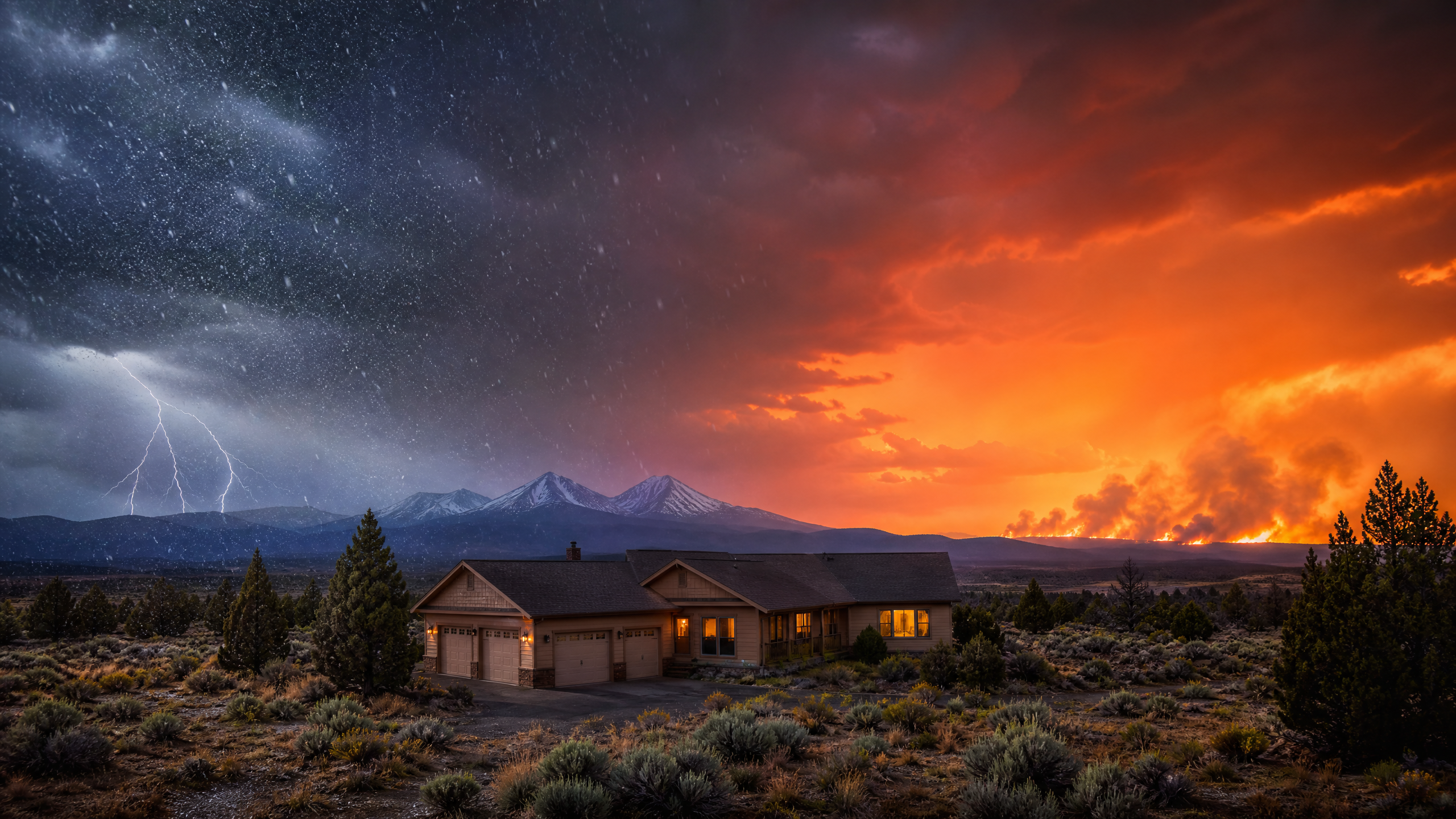
The Three Weather Threats Driving Up Premiums in Crook County
Central Oregon sits at the intersection of three distinct weather patterns that are each becoming more severe. The high desert east of the Cascades has always had dramatic weather, but the frequency and intensity of damaging events has accelerated in ways that insurance actuaries — the people who price risk — are now treating as a structural shift rather than a temporary anomaly.
Hail is the most underestimated threat. Prineville, Redmond, and the Crooked River corridor regularly see convective storms that produce hail large enough to dent metal roofing, crack asphalt shingles, and damage HVAC equipment. Unlike wildfire, hail damage is often invisible from the street — it shows up months later as leaks, premature shingle failure, and voided manufacturer warranties. Many homeowners don't realize their roof was damaged until a contractor points it out during a sale inspection.
Wind events in the high desert can exceed 60 mph without warning. Fences, outbuildings, detached garages, and older roof systems are particularly vulnerable. The challenge with wind claims is that standard policies often have separate wind deductibles — sometimes expressed as a percentage of your dwelling coverage rather than a flat dollar amount — that can leave you responsible for thousands of dollars even on a covered loss.
Wildfire is the risk that has most dramatically changed the insurance landscape in Oregon. Oregon's wildfire insurance crisis has caused multiple carriers to non-renew policies, tighten underwriting standards, and raise rates across the state — including in areas that have never experienced a fire. Insurers are pricing the probability of future losses, not just past ones.
Hail Damage
Roof, siding, gutters, HVAC units, and skylights. Often requires a separate inspection — damage isn't always visible from the ground.
Wind Damage
Roof systems, fences, outbuildings, and detached structures. Check your policy for percentage-based wind deductibles.
Wildfire
Dwelling, personal property, and additional living expenses if you're displaced. Defensible space and ember-resistant vents affect your insurability.
Why Carriers Are Tightening Underwriting — Even for Clean-Record Homeowners
Insurance companies don't just look at your personal claims history when setting your rate. They look at the claims history of every home in your ZIP code, your county, and your state. When a hailstorm causes $40 million in roofing claims across Deschutes and Crook counties, every homeowner in the region pays a little more — regardless of whether their own roof was touched.
This is called "geographic risk loading," and it's one of the primary reasons home insurance rates are rising in Oregon even for homeowners who have never filed a claim. Carriers are also factoring in reinsurance costs — the insurance that insurance companies buy to protect themselves — which have risen sharply as global catastrophe losses mount.
For wildfire specifically, carriers are using satellite imagery, vegetation maps, and fire behavior modeling to assign a "wildfire score" to every property in Oregon. Homes in Crook County with scores above a certain threshold may face surcharges, coverage restrictions, or non-renewal notices — even if the property has never been threatened by fire. If you've received a non-renewal notice related to wildfire, you have options — but you need to act quickly.
⚠ Important: Actual Cash Value vs. Replacement Cost
Many homeowners don't realize their policy pays "actual cash value" (depreciated value) rather than "replacement cost" for the roof. After a hailstorm, a 15-year-old roof with an ACV policy might pay out only $4,000 on a $22,000 replacement — leaving you responsible for the rest. Always verify your roof coverage type before a storm season, not after.
The Coverage Gaps Central Oregon Homeowners Most Often Discover Too Late
After working with Central Oregon homeowners through multiple storm seasons and wildfire events, the same coverage gaps appear again and again. Here are the most common — and most costly — ones to check before the next weather event.
Underinsurance on Dwelling Coverage
Construction costs in Central Oregon have risen 35–45% since 2020. If your dwelling coverage hasn't kept pace, you may be significantly underinsured for a total loss. Ask your agent about guaranteed replacement cost or extended replacement cost endorsements.
Detached Structures Sublimit
Standard policies typically cover detached garages, barns, and outbuildings at 10% of your dwelling coverage. For rural properties with significant outbuildings, this sublimit is often far too low.
Roof Age Exclusions
Many carriers now exclude or severely limit coverage for roofs over 15–20 years old. If your roof is aging, you may need to replace it to maintain full coverage — or accept an ACV payout on a future claim.
Smoke and Ash Damage
Wildfire smoke can penetrate a home and cause extensive HVAC, textile, and surface damage even when the fire never comes close. Some policies have sub-limits or exclusions for smoke damage — verify yours.
Additional Living Expenses (ALE)
If a wildfire evacuation or major storm forces you out of your home, ALE coverage pays for temporary housing, meals, and related costs. The limit and duration vary widely by policy — know yours before you need it.
Landscaping and Trees
Most policies have strict sublimits for trees, shrubs, and landscaping — often $500 per item and $1,500–$2,000 total. After a wind event that takes out mature trees, this gap becomes very real.
What You Can Do Right Now to Stay Insurable and Reduce Your Premium
The good news is that homeowners who take proactive steps are in a much stronger position — both for insurability and for premium pricing. Carriers reward homes that present lower risk, and many of the most effective mitigation steps are also the ones that protect your family and your investment.
For wildfire, home hardening and defensible space are the two most impactful actions. Clearing vegetation within 30 feet of your home, installing ember-resistant vents, and replacing wood shake roofing with Class A fire-rated materials can meaningfully lower your wildfire score — and in some cases, make the difference between being offered coverage and being declined. Oregon's wildfire mitigation discount programs can also reduce your premium when you document completed mitigation work.
For hail and wind, the most effective step is a professional roof inspection — ideally before storm season. Knowing the condition and age of your roof lets you make informed decisions about coverage, and a documented inspection can support a claim if damage occurs. Impact-resistant roofing (Class 4 shingles) qualifies for discounts with many carriers and significantly reduces the likelihood of a total roof replacement after a hailstorm.
Finally, consider whether your current policy structure still makes sense. If you haven't reviewed your homeowners coverage in the past two years, there's a real chance your dwelling limit is out of date, your deductibles have changed, or endorsements that used to be standard have been quietly removed. An annual review with a local independent agent costs nothing and can save you tens of thousands of dollars when you actually need to file a claim.
What to Do If You've Received a Non-Renewal or Rate Increase Notice
Receiving a non-renewal notice is alarming, but it's not the end of the road. Oregon law requires carriers to give you advance notice — typically 30 to 45 days — and you have options. An independent insurance agent who works with multiple carriers can shop your policy across the market and often find coverage that a single-carrier agent cannot. At Prineville Insurance, we work with over 50 carriers specifically to handle situations like this.
If you've received a significant rate increase rather than a non-renewal, the calculus is similar: the market has changed, and your current carrier may no longer be the best option. Comparing your current policy against alternatives — not just on price, but on coverage terms, deductibles, and endorsements — is the most important financial review a Central Oregon homeowner can do in 2026.
For rural properties and homes on larger parcels, a rural Oregon insurance review is especially important, as standard homeowner policies are often not the right product for properties with significant acreage, outbuildings, livestock, or agricultural equipment.
The Bottom Line for Central Oregon Homeowners in 2026
The weather in Central Oregon is not going back to what it was. Hail events are more frequent, wind events are more intense, and wildfire season now effectively runs from May through October. The insurance market has responded to this reality — and homeowners who understand what's happening and take proactive steps will be in a far better position than those who don't.
The most important thing you can do right now is know what you have. Pull out your declarations page, check your dwelling coverage limit against current construction costs, verify your roof coverage type, and confirm your wildfire-related endorsements. If anything looks unfamiliar or out of date, that's the conversation to have with your agent — before the next storm season, not during it.
At Prineville Insurance, we've been helping Central Oregon families navigate exactly these questions since 1935. We know the terrain, we know the carriers, and we know what coverage actually holds up when it matters. Get a no-obligation policy review and find out where you stand before the next weather event makes it urgent.
Talk to a Local Agent Who Knows Central Oregon
We work with 50+ carriers to find the right coverage for your home, your land, and your budget — even in today's challenging market.