



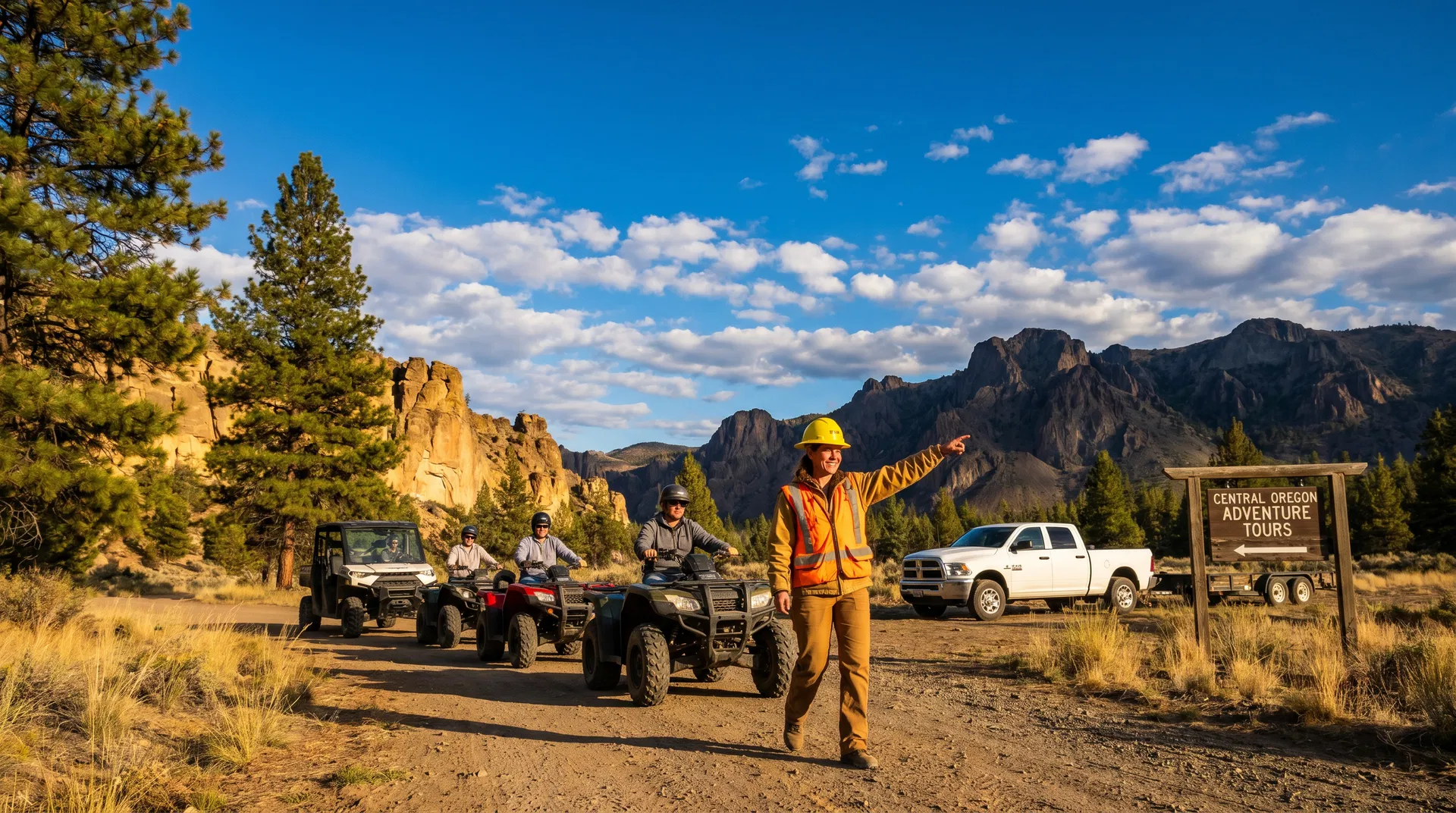

Oregon's outdoor recreation economy is one of the most powerful economic engines in the Pacific Northwest. In 2022 alone, outdoor recreation supported $16 billion in spending at Oregon businesses and sustained more than 224,000 jobs statewide — with Central Oregon at the epicenter. From the Deschutes River to the Ochoco Mountains, from Smith Rock to the Cascade Lakes, businesses built around guiding, outfitting, ATV rentals, RV services, and hunting operations are growing faster than at any point in the region's history. But that growth comes with a liability exposure that most standard commercial insurance policies are not designed to handle.
This guide covers the specific insurance requirements, common coverage gaps, and emerging legal risks facing Oregon's outdoor recreation businesses — with a particular focus on Central Oregon operators in Crook, Deschutes, and Jefferson counties.
Oregon's $16 Billion Outdoor Recreation Economy — and Its Insurance Problem
The numbers are striking. Oregon residents record approximately 1.27 billion outdoor recreation activity days annually, generating an estimated $57.1 billion in net economic value. Fishing, hunting, and wildlife watching alone produce more than $1.2 billion in participant spending each year. In Central Oregon, the Ochoco and Deschutes National Forests receive over 2 million recreational trips per year — a number projected to exceed 3 million by 2040.
Yet the insurance market serving these businesses is under severe stress. In 2026, Oregon's outdoor recreation industry is navigating a liability insurance crisis driven by a fundamental legal problem: Oregon courts have historically been inconsistent in upholding pre-activity liability waivers. Unlike California, Idaho, Washington, and most other Western states, Oregon does not have a clear statutory framework that makes recreational liability waivers reliably enforceable. The result is that insurers either refuse to write coverage for recreation businesses operating in Oregon, or they charge premiums that small operators cannot sustain.
Senate Bill 1593 (2026), sponsored by Senator Mark Meek, proposes to fix this by aligning Oregon's waiver law with other Western states. The bill has broad support from ski areas, outfitters, climbing gyms, and recreation businesses statewide. Until it passes — and even after — outdoor recreation businesses need insurance programs built for their actual risk profile, not off-the-shelf commercial policies that leave critical gaps.
Guides and Outfitters: ORS 704 Requirements and Federal Permit Minimums
Oregon's outfitter and guide licensing law (ORS Chapter 704) is one of the most specific insurance mandates in the state's commercial code. Under ORS 704.025, every licensed outfitter and guide must carry general liability insurance with a minimum combined single limit of $500,000 per occurrence, covering the outfitter, the guide, and all employees. The Oregon State Marine Board administers the licensing program and requires a current certificate of insurance as a condition of license issuance and renewal.
Federal land management agencies impose additional requirements. The U.S. Forest Service and Bureau of Land Management require proof of liability insurance as a condition of special use permits for commercial operations on federal land. Minimum limits vary by activity and agency district — some USFS districts require $1 million per occurrence for river guides, $2 million for motorized tours, and higher limits for operations involving horses or pack animals. An outfitter whose policy meets Oregon's $500,000 state minimum but falls short of their federal permit requirement can have their permit revoked mid-season.
Beyond the liability minimum, guides and outfitters need a comprehensive insurance program that includes workers' compensation for all employees, commercial auto coverage for guide vehicles and trailers, an equipment floater for boats, horses, and specialized gear, and a commercial umbrella to extend limits above the primary policy. Watercraft liability is essential for fishing and rafting guides — standard GL policies exclude watercraft above a certain length and horsepower.
Get a Free Outdoor Recreation Insurance Review
We specialize in placing coverage for Oregon guides, outfitters, ATV rental operators, RV services, and hunting lodges — including hard-to-place risks. Let us review your current policy for gaps before your next season.
Eight Coverage Lines Every Outdoor Recreation Business Should Review
The following coverage types address the most common gaps we see in outdoor recreation business insurance programs across Central Oregon. Not every business needs all eight — but every business should understand which apply to their operation.
Guide & Outfitter General Liability
Covers bodily injury and property damage claims from guided activities — river trips, horseback rides, hunting expeditions, climbing tours. Required by ORS 704 and federal land permits. Minimum $500K; most carriers recommend $1M/$2M.
ATV / UTV Rental Liability
Specialized off-road vehicle rental coverage for premises liability, off-road operations, and renters liability. Standard CGL policies exclude off-road operations — you need a purpose-built recreational vehicle rental policy.
Commercial Auto & RV Fleet
Covers your fleet of RVs, guide vehicles, trailers, and transport vehicles. RVs are motor vehicles, not equipment — they require commercial auto coverage, not an inland marine floater. Physical damage, liability, and uninsured motorist coverage.
Workers' Compensation
Required for all Oregon employees including seasonal guides, outfitter staff, and RV delivery drivers. Covers medical expenses and lost wages for work-related injuries. Misclassifying guides as contractors is a costly and common mistake.
Firearms & Archery Liability
Essential for hunting guides and outfitters. Covers incidents involving firearms, archery equipment, and hunting dogs during guided hunts. Often excluded from standard GL policies — requires a specific endorsement or standalone policy.
Equipment & Inland Marine
Covers boats, ATVs, UTVs, horses, fly fishing gear, camping equipment, and other specialized equipment used in guided operations. Standard property policies often exclude mobile equipment — an inland marine floater fills the gap.
Professional Liability / E&O
Covers claims that your professional advice or services caused a client's financial loss or injury — a guide who recommended a route that led to an accident, or an outfitter whose trip planning contributed to a client's injury.
Commercial Umbrella
Extends liability limits above your primary GL, commercial auto, and employers liability policies. Essential for outdoor recreation businesses where a single serious injury claim can easily exceed $1 million in damages.
Speak with a Central Oregon Outdoor Recreation Insurance Specialist
We place coverage for guides, outfitters, ATV rentals, RV services, and hunting operations across Crook, Deschutes, and Jefferson counties. Call us or request a quote online.
ATV and OHV Rental Operations: The Off-Road Coverage Gap
ATV and UTV rental businesses are among the fastest-growing segments of Central Oregon's outdoor recreation economy — and among the most frequently underinsured. The core problem is a policy exclusion that most operators don't discover until they file a claim: standard commercial general liability policies exclude off-road vehicle operations. If a customer rents one of your ATVs, rides it off your property onto a trail, and injures a third party, your standard CGL policy will likely deny the claim.
ATV rental operators need a purpose-built recreational vehicle rental policy that covers three distinct exposures. First, premises liability covers incidents that occur on your property — a customer who trips in your parking lot, or a vehicle that rolls back and damages another customer's truck. Second, off-road operations liability covers incidents that occur while your equipment is in use off-premises. Third, renters liability covers damage or injury caused by your customers to third parties while operating your equipment.
Physical damage coverage for your fleet is equally important. A fleet of six UTVs represents $60,000 to $120,000 in equipment value. A single rollover that totals a machine — or a theft from an unattended trailhead — can be a business-ending event without proper coverage. An inland marine floater for ATV and OHV equipment covers your fleet for physical damage regardless of where the loss occurs.
Oregon's waiver enforcement problem is particularly acute for ATV rental operators. Even with a signed liability waiver, Oregon courts have allowed injured customers to pursue claims against rental operators. Until SB 1593 resolves this, ATV rental businesses should carry minimum limits of $1 million per occurrence and consider a commercial umbrella for additional protection.
RV Rental and Service Businesses: Commercial Auto Is Not Optional
RV rental businesses occupy a unique insurance category that trips up many new operators: recreational vehicles are classified as motor vehicles under Oregon law, not equipment. This means your RV fleet requires commercial auto insurance — not an inland marine floater, not a general liability policy, and not a personal auto policy. A personal auto policy will not cover a vehicle used for commercial rental purposes, and an inland marine policy will not cover the liability arising from a vehicle accident on a public road.
Commercial auto coverage for an RV rental fleet should include liability coverage meeting Oregon's minimum requirements (though most lenders and campground operators require higher limits), physical damage coverage for each unit in your fleet, and uninsured/underinsured motorist coverage. If you deliver RVs to customers or move them between storage locations, you need hired and non-owned auto coverage for drivers who are not listed on your commercial auto policy.
RV service businesses — repair shops, mobile service technicians, and storage facilities — face a different set of exposures. Garage liability covers bodily injury and property damage that occurs in connection with your service operations. Garage keepers legal liability covers damage to customers' vehicles while they are in your care, custody, or control. These are distinct from general liability and are not automatically included in a standard commercial policy.
Hunting Operations and Lodges: Specialized Risks Require Specialized Coverage
Central Oregon's hunting economy is substantial. Crook, Grant, and Harney counties are among Oregon's premier destinations for deer, elk, pronghorn, and upland bird hunting. Guided hunting operations and hunting lodges face a risk profile unlike any other outdoor recreation business — one that combines the liability exposures of a guide service, a hospitality business, and a firearms range.
Firearms and archery liability is the most critical specialized coverage for hunting guides. Standard general liability policies typically exclude or severely limit coverage for incidents involving firearms. A hunting guide whose client accidentally discharges a firearm and injures a third party needs a policy that specifically covers firearms-related incidents. This is typically added as an endorsement to a guide and outfitter policy or purchased as a standalone firearms liability policy.
Hunting dog liability is a frequently overlooked exposure. Working dogs — retrievers, pointers, hounds — are valuable assets and potential liability sources. A hunting dog that bites a client, injures another dog, or causes a vehicle accident while being transported needs coverage that a standard homeowners or farm policy may not provide. Hunting lodge operators who serve alcohol need liquor liability coverage — a claim arising from an intoxicated guest who causes an accident after leaving your lodge can exceed your general liability limits quickly.
Remote lodge property coverage addresses the unique challenges of backcountry structures. Standard commercial property policies are priced for structures with fire department response times measured in minutes. A remote hunting lodge in the Ochocos or the Blue Mountains may have response times measured in hours — or no response at all. Replacement cost coverage for remote structures needs to account for the additional cost of transporting materials and labor to remote locations, which can be two to three times the cost of comparable urban construction.
Workers' Compensation: The Seasonal Employee Trap
Oregon requires workers' compensation coverage for all employees — and the outdoor recreation industry's reliance on seasonal, part-time, and contract workers creates significant compliance risk. The most common and costly mistake in the industry is misclassifying guides, outfitters, and seasonal staff as independent contractors to avoid workers' comp obligations.
Oregon's workers' comp division uses a multi-factor test to determine worker classification, and the bar for independent contractor status is high. A guide who works exclusively for one outfitter, uses the outfitter's equipment, follows the outfitter's schedule, and serves the outfitter's clients is almost certainly an employee under Oregon law — regardless of what the contract says. Oregon's workers' comp division actively audits seasonal employers in the outdoor recreation industry, and penalties for misclassification include back premiums for the entire period of misclassification, fines, and personal liability for the business owner.
For businesses that do use legitimate independent contractors — a fly fishing guide who operates their own licensed guide service and carries their own insurance — the key is documentation. Require proof of the contractor's workers' comp coverage and general liability insurance, and obtain a certificate of insurance naming your business as an additional insured. This protects you from being held responsible for an injury to a contractor who lacks their own coverage.
The farm and ranch insurance considerations that apply to agricultural employers with seasonal workers have direct parallels in the outdoor recreation industry — particularly for hunting operations and outfitters who employ seasonal staff during specific seasons.
Federal Land Permits: The Insurance Condition You Cannot Afford to Miss
A significant portion of Central Oregon's outdoor recreation economy operates on federal land — the Deschutes National Forest, Ochoco National Forest, Crooked River National Grassland, and BLM lands covering millions of acres in Crook, Deschutes, and Jefferson counties. Operating commercially on federal land requires a special use permit, and virtually every permit includes an insurance condition specifying minimum liability limits and requiring the federal agency to be named as an additional insured.
The consequences of failing to maintain the required insurance are severe. A permit holder whose insurance lapses, whose limits fall below the required minimum, or who fails to add the required additional insured endorsement can have their permit suspended or revoked — mid-season, with no refund of permit fees and no compensation for lost bookings. For a guide or outfitter whose entire business model depends on federal land access, permit revocation is a business-ending event.
Federal permit insurance requirements are not uniform. Different USFS districts and BLM field offices have different requirements, and requirements can change when permits are renewed. An outfitter who has operated under the same permit for ten years may find that their renewal includes new insurance conditions that their current policy does not satisfy. Annual review of your permit conditions against your current insurance program is essential — and your insurance agent should be familiar with the specific requirements of the federal agencies that manage the land you operate on.
This is closely related to the agritourism insurance considerations that apply to farm and ranch operations that host recreational activities — the federal land permit issue is the public lands equivalent of the private land liability exposure that agritourism operators face.
Oregon Liability Waiver Warning
Oregon courts have not consistently upheld pre-activity liability waivers, unlike most other Western states. Even if your customers sign a waiver before participating in your guided activity, you may still face a successful liability claim. Until SB 1593 (2026) resolves this, do not rely on waivers as a substitute for adequate liability insurance. Carry minimum limits of $1 million per occurrence and consider a commercial umbrella.
Frequently Asked Questions
Outdoor Recreation Business Insurance Checklist
Use this checklist to identify gaps in your current coverage program. If you cannot check all boxes that apply to your business, contact us for a review.
Central Oregon's Outdoor Recreation Economy Deserves Purpose-Built Insurance
The outdoor recreation businesses that define Central Oregon's economy — the fly fishing guides on the Deschutes, the ATV outfitters in the Ochocos, the hunting lodges in Crook County, the RV rental operators serving the Cascade Lakes corridor — are not well served by off-the-shelf commercial insurance policies. Their risk profiles are specific, their regulatory requirements are layered, and the consequences of a coverage gap can be immediate and severe.
At Prineville Insurance, we have been placing specialty commercial coverage for Central Oregon businesses for over 90 years. We understand the federal land permit requirements of the Ochoco and Deschutes National Forests, the workers' comp classification rules that apply to seasonal guides, and the specialized endorsements that hunting and ATV operations need. Whether you are a solo fly fishing guide or a multi-operation outfitting company, we can build a coverage program that matches your actual risk — not a generic commercial policy with exclusions you won't discover until you file a claim.
For more on related coverage areas, see our guides on commercial general liability insurance, Oregon workers' compensation, agritourism insurance, and farm and ranch insurance programs for Central Oregon operations.
Ready to Build the Right Coverage Program?
Our Central Oregon specialists can review your current policies, identify gaps, and build a coverage program that meets ORS 704 requirements, federal permit conditions, and your business's specific risk profile.


