



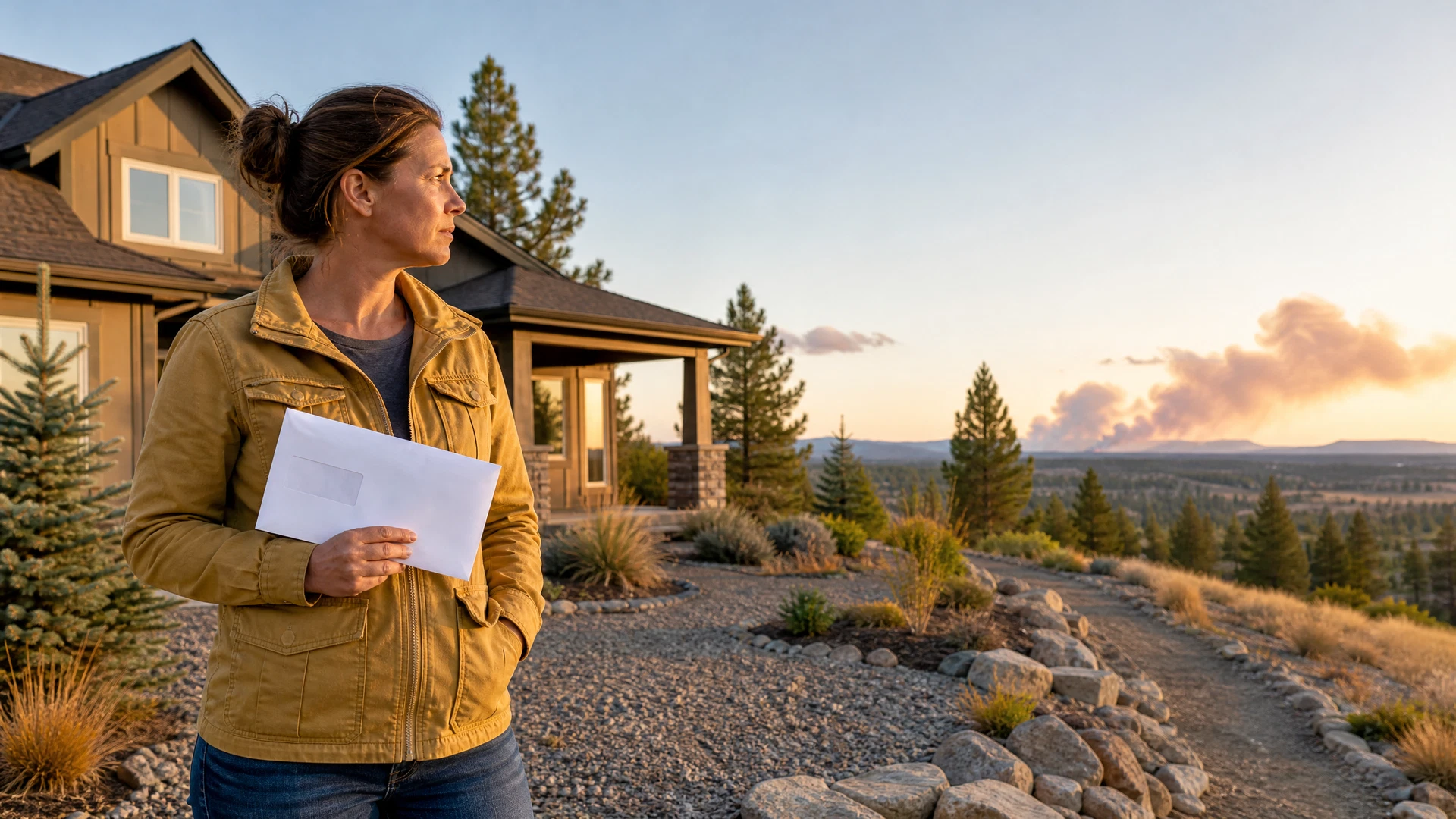

A wildfire-related homeowners insurance non-renewal notice can feel like an emergency, especially when your home is in Prineville, Bend, Redmond, Sisters, La Pine, Madras, or another Oregon community where wildfire is part of the insurance conversation. The notice is important, but it is not the same thing as an immediate loss of coverage. Your job is to understand exactly what it says, protect the remaining time on the current policy, and begin a careful replacement-coverage process before the policy term ends.
Oregon's Division of Financial Regulation (DFR) advises homeowners not to wait until the last minute, not to cancel their existing policy until new coverage is in place, and to ask for detailed property-specific reasons when a policy is nonrenewed or a premium increases.[1] This guide gives you a practical roadmap. It is not a promise of eligibility, price, or coverage; each insurer, property, policy form, deductible, and underwriting file is different. But a complete file and an early start can create better options than a rushed search at the end of the term.
First, Confirm Whether the Notice Is a Non-Renewal or a Cancellation
The words matter. A non-renewal means the insurer does not intend to offer a new policy when your existing policy expires. A cancellation generally ends coverage before the policy's stated expiration date and is subject to separate reasons and notice rules. DFR explains that insurers may cancel homeowners coverage for specific reasons such as nonpayment, material misrepresentation, certain policy-term violations, or a substantial increase in risk; for a non-renewal, DFR says a company must give at least 30 days' notice for a reason other than nonpayment.[1]
Read every page of the notice and save a PDF or printed copy. Confirm the named insured, policy number, property address, effective end date, stated reason, and any referenced inspection, aerial image, photo, repair request, or underwriting condition. If the language is unclear, ask the company or your agent to clarify it in writing. Our existing wildfire insurance after non-renewal resource can also help you organize the immediate conversation.
Ask for the Property-Specific Reason — Then Turn It into a Work Plan
A vague explanation is not very useful when you are trying to decide whether to repair a roof, clear vegetation, update a property description, or seek a different market. Oregon Senate Bill 82 requires insurers to disclose property-specific information explaining why a consumer is being nonrenewed or receiving a premium increase. DFR specifically encourages homeowners to ask what mitigation, maintenance, repair, or property changes could make a home more insurable or less expensive to insure.[1] [2]
Make the response actionable. If the concern is combustible material near the home, record the exact area and date it was corrected. If it is an aging roof, obtain a roofer's report, invoice, permit information if applicable, and close-up photographs. If it is access, address visibility, outbuilding condition, or occupancy information, assemble the current record. The goal is not to argue with a carrier's guidelines; it is to give the next underwriter accurate, complete property information.
| What to preserve | Why it helps the review | Useful examples |
|---|---|---|
| The full notice | It establishes the remaining timeline and documents the stated reason. | All notice pages, envelope date, email follow-up, insurer communications. |
| Current declarations | It lets you compare replacement terms item by item instead of comparing premium alone. | Dwelling, other structures, personal property, liability, loss of use, endorsements, deductible. |
| Property updates | Underwriters may need evidence of completed repairs or risk-reduction work. | Roof invoice, repair receipts, inspection reports, exterior photographs, permits where applicable. |
| Wildfire preparation record | It provides a current view of the home ignition zone and mitigation work. | Roof/gutter photos, vents, hardscape near the home, trimmed vegetation, access clearance. |
| Claims and occupancy details | It helps a new carrier understand the home's current use and history accurately. | Prior-loss summaries, primary/seasonal/rental use, renovation status, outbuildings, animals. |
Protect Continuous Coverage While You Shop
The practical objective is to have a replacement policy effective before the current policy ends. That does not mean every homeowner will find the same coverage, limit, deductible, or premium they previously had. It does mean you should compare proposals carefully and avoid assuming that a quote, application, or conversation equals active insurance. DFR advises consumers to begin shopping early and not cancel existing coverage until a new policy is in place.[1]
Start with an organized intake file: the notice, declarations pages, loss history, roof age and condition, exterior photos, mitigation documents, property access details, occupancy, outbuildings, and any recent improvements. An independent agency can use that information to seek appropriate standard-market and specialty options while helping you compare exclusions, valuation method, deductible structure, wildfire terms, and required risk controls. If you are also reviewing your broader home policy, visit our Oregon home insurance guide and high-value home insurance resource for questions to bring to the comparison.
Use Mitigation as Documentation, Not as a Coverage Promise
Wildfire mitigation has an obvious safety value and can be useful in an underwriting conversation, but it is not a universal guarantee of a quote or a discount. Oregon DFR explains that insurers have their own underwriting rules and may look at location, fire protection, construction, claim history, property maintenance, and surrounding vegetation. It also says the state's former wildfire hazard map cannot be used to cancel, nonrenew, or increase premiums, while insurers can still use their own proprietary models and property information.[1] [2]
Start close to the structure. The Oregon State Fire Marshal describes the first five feet as a critical area and recommends practical measures such as clearing roofs and gutters, using noncombustible materials near the house, screening vents with 1/8-inch metal mesh, removing debris under decks, maintaining vegetation, and keeping emergency access clear.[4] Oregon State University Extension similarly describes home hardening as a primary defense against wildfire home loss and defines defensible space as managing combustible materials around the house.[5] Use our Central Oregon fire mitigation guide to organize a property-specific checklist and take dated photos before, during, and after work is completed.
Have a Notice? Get a Local Second Set of Eyes Before the Deadline
Prineville Insurance can help you organize the notice and declarations pages, identify the questions a replacement-coverage review may need to answer, and compare available options. Coverage, eligibility, limits, deductibles, pricing, and mitigation requirements remain subject to each insurer's underwriting and policy terms.
When the Standard Market Is Limited: FAIR Plan and Specialty-Market Conversations
If standard-market options are limited, do not assume the search is over. DFR identifies the Oregon FAIR Plan as a policy of last resort for Oregon property owners unable to find standard-market coverage. DFR says an applicant must have been declined by two standard-market insurers before qualifying, and it also notes that surplus-lines insurers may offer coverage for risks that are not typically accepted in the standard market.[1] The Oregon FAIR Plan overview explains why this path should be evaluated as part of a full insurance plan, rather than treated as automatically equivalent to a traditional homeowners policy.
The Oregon FAIR Plan says its coverage is basic and may not provide the full extent of protection a homeowner needs.[3] That makes the comparison especially important: examine property limits, deductible, personal-property protection, liability, additional living expense, exclusions, endorsements, and whether a separate difference-in-conditions or companion policy may be relevant. A surplus-lines option can also have different terms, pricing, and consumer protections. Ask the agent to explain the policy documents and effective dates before you decide.
Review the Full Policy, Not Just the Wildfire Question
Wildfire risk can bring the notice to your attention, but a replacement policy needs to fit the whole household. Compare dwelling replacement cost with current rebuilding realities; other-structures and personal-property limits; personal liability; loss-of-use or additional-living-expense provisions; water, sewer, earthquake, flood, home-business, rental, and high-value-item questions; deductibles; and endorsements. A lower premium can reflect a different coverage form or more restrictive deductible, so a side-by-side comparison matters more than a headline price.
It is also a good time to refresh your home inventory. DFR recommends taking photos of every room, including closets, walls, storage spaces, garage, shed, and attic, then recording useful details such as make, model, and purchase price.[2] Keep a copy away from the home or in secure cloud storage along with policy documents and important financial records. For a focused companion checklist, see our Oregon home insurance non-renewal resource; an individual property's eligibility still depends on the carrier's current guidelines.
Build a Practical 30-Day Survival Plan
Use the days before expiration to move from uncertainty to documented decisions. On day one, preserve the notice and current declarations pages. During the first week, request the property-specific explanation and assemble your home, claims, occupancy, and mitigation file. Next, correct clear maintenance or documentation issues you can reasonably address, take dated photographs, and begin a like-for-like coverage comparison. As proposals arrive, confirm the exact effective date, deductible, exclusions, requirements, and any cancellation conditions before you allow current coverage to end.
For homes in the wildland-urban interface, the plan may also include a conversation about resilience. Passive home hardening and defensible space are foundational. For some properties, homeowners may want to explore active exterior wildfire-defense systems as an additional preparedness option. Our wildfire defense technology resource explains the questions to consider without suggesting that any product replaces evacuation planning, fire-department guidance, policy requirements, or a full insurance review. For broader location-specific planning, use the Oregon wildfire insurance and Central Oregon wildfire insurance resources.
Frequently Asked Questions
Is a homeowners insurance non-renewal the same as a cancellation?
No. A non-renewal means the insurer does not plan to offer a new policy when the current term ends. A cancellation generally ends coverage before the stated expiration date and is subject to different reasons and notice rules. Read the notice, confirm the policy end date, and ask the insurer or agent if the notice is unclear.
How much notice should an Oregon insurer give for a homeowners non-renewal?
Oregon DFR states that when homeowners coverage is nonrenewed for a reason other than nonpayment, the company must give at least 30 days' notice. Your actual notice should identify the effective end date. Because market shopping and property documentation can take time, it is wise to start as soon as the notice arrives rather than rely only on the minimum notice period.
Can I ask why my Oregon homeowners policy is not being renewed?
Yes. Oregon DFR says Senate Bill 82 requires insurers to disclose property-specific information explaining a non-renewal or premium increase. Ask for the information in writing, save the response, and ask what property, maintenance, mitigation, or underwriting information would be useful for a replacement-coverage review.
What is the Oregon FAIR Plan?
The Oregon FAIR Plan is a market of last resort for responsible Oregon property owners unable to secure coverage through normal insurance markets. DFR says applicants must have been declined by two standard-market insurers. The FAIR Plan itself cautions that its coverage is basic and may not provide the full protection a homeowner needs, so limits, deductibles, exclusions, and any companion coverage should be reviewed carefully.
Will defensible space guarantee a new homeowners policy?
No. Mitigation can improve the property information available to an underwriter, but eligibility, pricing, terms, and carrier requirements are policy- and company-specific. Oregon DFR encourages homeowners to ask which risk-mitigation and maintenance actions may help; no single improvement guarantees a quote, renewal, or particular premium.
The Bottom Line
A wildfire non-renewal notice deserves prompt attention, but it does not require panic. Separate non-renewal from cancellation, preserve the deadline, request the property-specific explanation, document the home and mitigation work, shop early, and compare complete policy terms rather than a single price. If you have questions about the notice or need help preparing for a replacement-coverage review, contact Prineville Insurance or use our secure quote-request page. We will help you work through the options that are available for your property and situation.
References
- Oregon Division of Financial Regulation — Help with home insurance
- Oregon Division of Financial Regulation — Wildfires
- Oregon FAIR Plan Association — Coverage and mission
- Oregon State Fire Marshal — Defensible Space
- Oregon State University Extension Fire Program — Preparing your home
- Insurance Institute for Business & Home Safety — Wildfire research


