



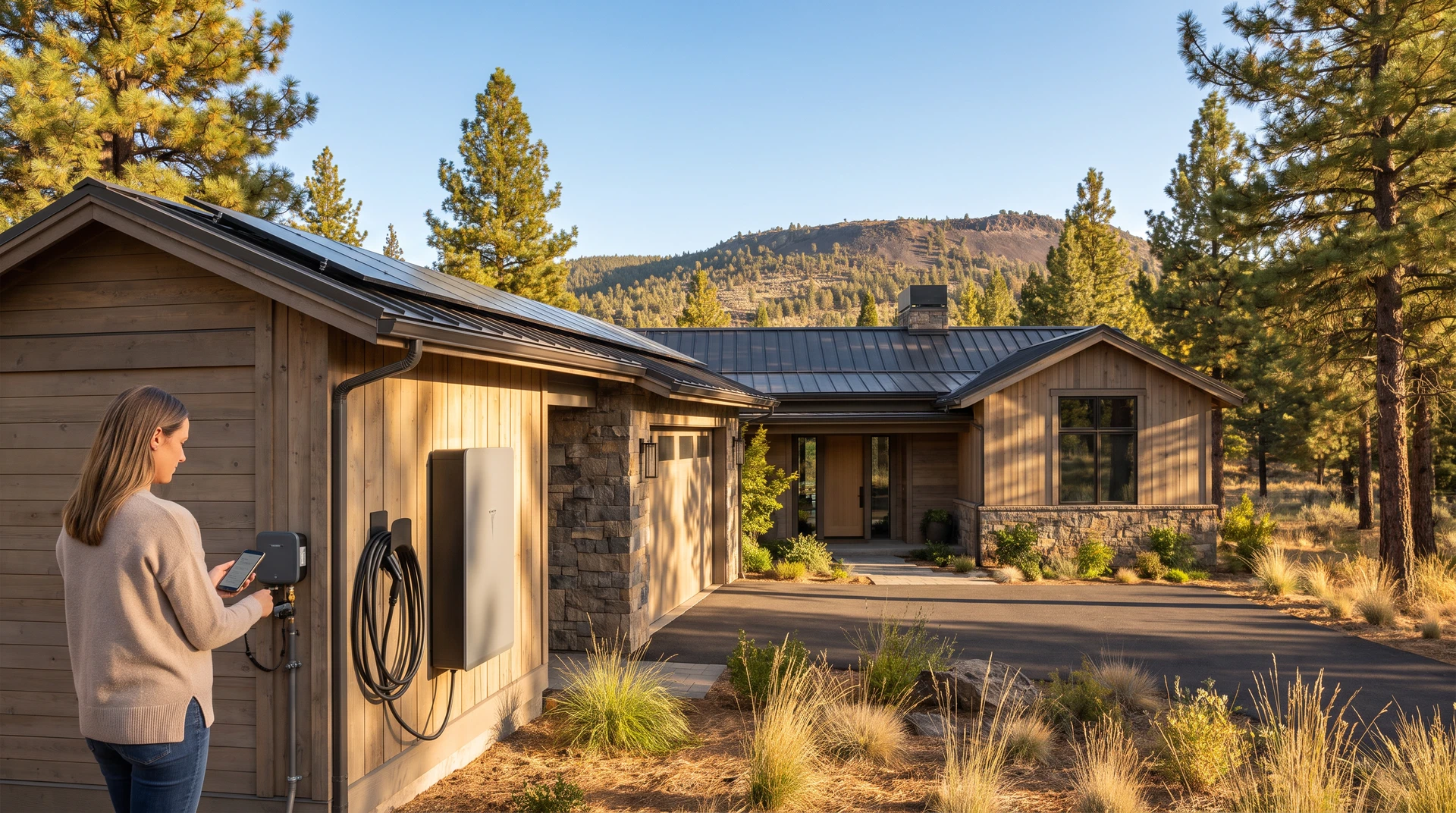

A connected home can help you spot a leak, monitor an entryway, keep critical systems powered, or manage energy during an outage. It can also change what you own, how your house operates, and the questions worth asking at renewal. For Oregon households, the useful question is not “Does smart-home technology help?” It is whether your current policy, property record, installation details, deductibles, and endorsements still match the home you actually have.
Cameras, monitored water devices, EV chargers, solar arrays, battery storage, backup generators, and app-controlled equipment do not all create the same insurance issue. Oregon's Division of Financial Regulation explains that insurance underwriting can consider a property's construction, condition, maintenance, location, fire protection, accessibility, and changes in risk.[1] That does not mean a device automatically helps or hurts coverage. It means a clear, accurate property conversation matters. This guide is educational; coverage, availability, valuation, underwriting, discounts, deductibles, and claim outcomes are always determined by the actual policy, insurer, installation, and cause of loss.
Think Beyond the Gadget: Six Questions That Protect the Property Record
Before adding equipment—or after a remodel that added several systems—make one simple inventory. Save receipts, installer records, permits when applicable, warranty information, serial numbers, photographs, and the location of the device. Note whether the equipment is attached to the structure, detached, leased, financed, portable, shared with a tenant, or used for a home-based business. Then compare that record with your current Oregon home insurance coverage and declarations page.
| Connected-home equipment | Questions to bring to an insurance review | Keep in your property file |
|---|---|---|
| Cameras, smart locks, alarm hubs | Are privacy, identity-theft, electronic-data, theft, liability, or system-failure questions addressed in the policy? | Purchase date, device list, account recovery plan, network and update records. |
| Water sensors and automatic shutoff valves | How does the policy distinguish sudden water damage from seepage, wear, backup, freezing, or maintenance issues? | Plumber/installer invoice, valve location, test schedule, photos, and alert contacts. |
| EV charger and electrical upgrades | Does the property record reflect the charger, wiring, panel upgrade, garage use, and equipment ownership? | Licensed installer documentation, permits if applicable, model and warranty records. |
| Solar panels and battery storage | Who owns the equipment? Is the value and installation type reflected accurately? What happens during a power outage? | Contract, financing or lease documents, battery capacity, outage plan, and installation records. |
| Standby or portable generator | How is the equipment installed, stored, fueled, and maintained? Which equipment is connected during outages? | Installation/maintenance records, manufacturer instructions, CO-detector test log, and photos. |
| Smart thermostats and connected appliances | Could an outage, freeze, electrical problem, or malfunction create a property-loss question the policy treats differently? | Model list, updates, repair records, and documentation of critical alerts. |
Water Alerts Are Helpful—But They Do Not Replace Maintenance or Policy Review
A sensor can alert you when a leak begins, and an automatic shutoff may limit the amount of water released in some situations. Both can be valuable parts of a prevention plan, especially for second homes, rural properties, or homes left empty while the family travels. They are not a blanket answer to every water-loss question. DFR notes that homeowners policies generally exclude damage caused by seepage, dry rot, or pests because those losses are often associated with maintenance rather than a sudden and accidental event.[1]
Test the alerts, keep a written response plan, and know who can access the property when you are away. For a home outside town or with its own well, septic system, solar equipment, or backup power, our off-grid and rural-home insurance guide can help organize the equipment questions. If your property is also exposed to ember risk, the practical prevention work in our Central Oregon fire mitigation guide is worth keeping in the same home-maintenance file.
EV Chargers, Solar, Batteries, and Generators Are Major Property Changes
Electrical and energy improvements should be discussed before a claim, not reconstructed afterward. An EV charger may involve new wiring or an electrical-panel upgrade. Solar may be owned, leased, or financed. A battery may be wall mounted, integrated with a solar system, or intended only to run selected circuits. A generator can be permanently installed or portable. Those facts affect the questions—not a one-size-fits-all coverage answer.
Oregon Department of Energy describes battery storage paired with onsite renewable energy as an emerging residential backup-power technology, while noting that systems must be sized appropriately and have limits.[2] Its solar-storage homeowner information says that a system needs islanding capability to stand apart from the grid during an outage.[3] An installer can explain the equipment's electrical function; an insurer or agent can help you verify how the installed property should be described and what your policy says about valuation, perils, deductibles, and optional protections. Owners of complex properties may also find the planning questions in our high-value home insurance guide helpful.
A 20-Minute Smart-Home Insurance Review Can Clarify Important Questions
Gather your declarations page, device inventory, installation records, updated-home photos, and questions about solar, batteries, water protection, EV charging, generator use, or security cameras. Prineville Insurance can help you organize a conversation about available options. Each carrier determines its own eligibility, coverage, valuation, deductibles, pricing, and policy terms.
Connected Devices Add a Privacy and Cybersecurity Layer
A camera, lock, thermostat, hub, router, or phone app can hold useful information about your home and household. CISA recommends strong passwords, a password manager, multifactor authentication, phishing awareness, and software updates as straightforward steps to reduce online risk.[5] NIST's consumer IoT work underscores that cybersecurity features are an important consideration for connected products.[6] The issue is broader than a camera feed: an unsecured device can become a pathway into a network that holds personal records.
Start with the home network. Change default router settings, enable available encryption, remove unused devices, install updates, and consider a separate guest network for household IoT devices. These are security practices, not insurance promises. The New York State Office of Information Technology Services specifically recommends separating household IoT from devices that hold personal information and limiting unnecessary permissions or remote access.[7] For a home office, rental operation, or other business activity, compare that exposure with our cyber liability insurance resource; business coverage is a separate conversation from a personal homeowners policy.
Backup Power Is a Safety Plan Before It Is an Insurance Question
In Central Oregon, a backup plan can matter during winter weather, wildfire-related outages, or utility disruptions. That plan should include what needs power, how long it needs power, who depends on medical devices or refrigerated medicine, and how the equipment will be used safely. Ready.gov says portable generators and fuel should be used outdoors, at least 20 feet away from windows, doors, and attached garages; it also recommends working carbon-monoxide detectors on every level of the home.[4] Follow manufacturer instructions and use qualified professionals for electrical work.
For wildfire-exposed property, connect energy planning with the larger property-preparedness plan. Our wildfire defense technology page and Oregon wildfire insurance resource explain related questions to organize before the next season. Neither a battery nor a generator replaces a defensible-space plan, home hardening, evacuation planning, or a careful review of the insurance policy that is actually in force.
Do Not Forget Liability, Personal Property, and Household Changes
Smart-home additions are often made alongside larger changes: a garage conversion, pool equipment, a second vehicle, a home business, a guest suite, solar financing, or a rental arrangement. That is why a review should include more than the device itself. Ask about dwelling and other-structure limits, personal property limits, special limits, liability, medical payments, loss of use, deductibles, and any endorsements that may apply. If your household has significant assets or multiple properties, our Oregon umbrella insurance guide can help frame the underlying-liability questions.
The best time to update an insurance file is when the change happens. Send the agent or carrier accurate photos and installation details, retain the declaration page that confirms any change, and ask whether the policy has a relevant endorsement or exclusion. When in doubt, use the policy documents as the source of truth—not a device advertisement, a retailer summary, or a general internet discussion.
Frequently Asked Questions
Will my homeowners insurance automatically cover a new smart-home device?
Do not assume so. The answer can depend on the device, whether it is permanently installed or portable, who owns it, how it was installed, the policy form, the cause of loss, applicable deductibles, and the carrier's terms. Review the declarations page and endorsements with the insurer or agent before relying on any specific protection.
Can a water sensor or shutoff device prevent a denied water-damage claim?
A device can provide an alert or shut off water when it works as designed, but it cannot guarantee that a loss will be prevented or covered. Homeowners policies commonly distinguish sudden and accidental water damage from seepage, wear, maintenance problems, or other excluded causes. Read the actual policy and report a new loss promptly.
Do solar panels and home batteries provide full backup power during an outage?
Not necessarily. Oregon Department of Energy explains that solar-plus-storage systems must be sized appropriately and have limits. Its homeowner guidance says a system needs islanding capability to operate apart from the grid during an outage. Ask the installer what the system is designed to power, then separately ask your insurer how the installed equipment should be described and valued.
Does a home EV charger create an insurance problem?
A professionally installed charger is an important property change to discuss with an insurer or agent. Coverage and underwriting treatment depend on the equipment, installation, wiring, location, ownership, policy, and loss facts. Do not rely on a general online answer in place of the carrier's guidance for your address and policy.
Are hacked cameras, smart locks, or leaked data covered by home insurance?
Cyber, privacy, identity-theft, electronic-data, and service-interruption provisions vary widely. A standard homeowners policy may not respond the same way as a dedicated personal-cyber endorsement or commercial cyber policy. Protect the devices with strong passwords, multifactor authentication, and updates, then ask about the policy's specific cyber and identity-theft provisions.
The Bottom Line
Smart-home technology can support a more informed, resilient household when the equipment is installed, maintained, and secured correctly. It can also reveal a mismatch between a fast-changing property and an old insurance file. Before your next renewal, renovation, EV purchase, solar installation, or long trip, make the device inventory, review your declarations page, and bring the facts to a coverage conversation. Contact Prineville Insurance or request a review through our quote page to discuss the available options for your Oregon home.
References
- Oregon Division of Financial Regulation — Help with home insurance
- Oregon Department of Energy — Backup Power
- Oregon Department of Energy — Oregon Solar + Storage Rebate Program: Homeowners
- Ready.gov — Power Outages
- Cybersecurity and Infrastructure Security Agency — Secure Our World
- National Institute of Standards and Technology — Consumer IoT Cybersecurity
- New York State Office of Information Technology Services — Securing Your Smart Home
- Federal Trade Commission — Internet-connected home security camera privacy enforcement


