



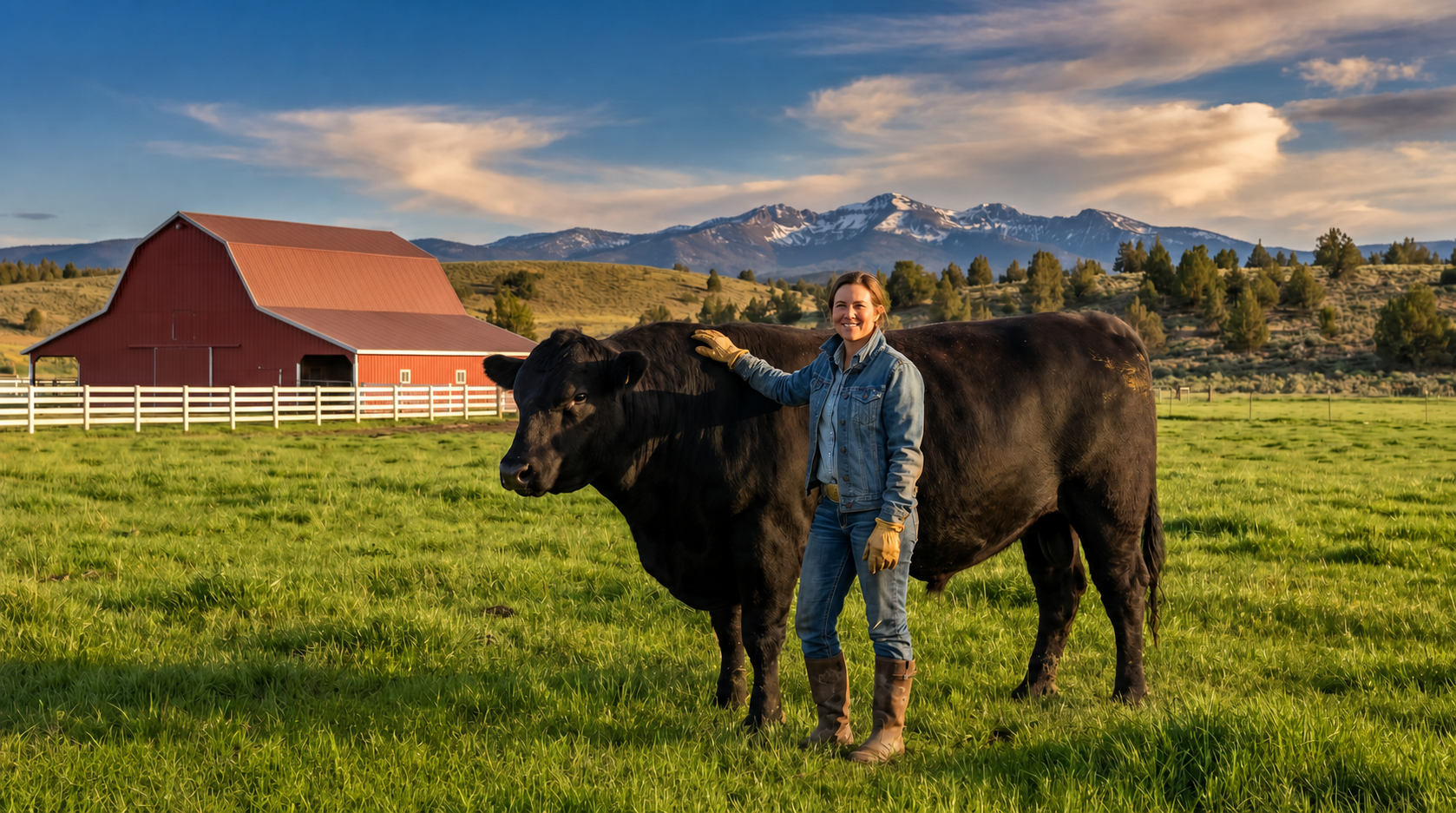

A registered Angus bull is the most valuable single animal on most Central Oregon ranches. A good one costs $8,000 to $25,000. An exceptional one can sell for $50,000 or more. He is the genetic engine of your entire cow-calf operation — his traits determine the quality and value of every calf you sell for the next decade. When he dies unexpectedly from hardware disease, a respiratory infection, a breeding injury, or a trailer accident on the way to a summer BLM allotment, the financial loss is immediate and severe.
Most Central Oregon ranchers believe their farm policy covers that bull. Most of them are wrong — or at least, not covered in the way they think. The gap between what a standard farm policy actually covers and what a rancher assumes it covers is one of the most expensive misunderstandings in agricultural insurance. This guide explains exactly how cattle mortality insurance works, what your farm policy likely does and does not cover, and what steps you need to take to properly protect your most valuable breeding stock.
Is Your Breeding Stock Properly Insured?
Most Central Oregon ranchers discover their livestock coverage gap only after losing a high-value animal. A free farm and ranch insurance review takes 20 minutes and can prevent a five-figure loss.
Get a Free Farm & Ranch Insurance ReviewThe Standard Farm Policy Gap: What Blanket Livestock Coverage Actually Means
Most farm and ranch insurance policies include livestock coverage — but the details of how that coverage works are almost never explained clearly at the time of sale. Standard farm policies typically cover livestock under a "blanket livestock" provision that works like this: the policy schedules a per-head value for each category of livestock (beef cattle, dairy cattle, horses, sheep, etc.) and covers death from a list of named perils — fire, lightning, windstorm, flood, and a few others.
The problem is that the per-head value is almost always set at commodity cattle prices — the going rate for a generic market steer or cow, not the value of a registered breeding animal. A policy written in 2020 might schedule beef cattle at $800 per head. Your registered Angus bull, purchased at a production sale for $18,000, is covered at $800. The remaining $17,200 is your loss.
The second problem is the named perils limitation. Blanket livestock coverage under a standard farm policy typically does not cover death from illness, disease, or unexplained causes. If your bull dies from hardware disease, BVD, a reproductive injury, or any cause other than the listed perils, the claim is denied. This is not a technicality — it is the standard policy language, and it catches ranchers off guard every year.
Individual Animal Mortality Insurance: How It Actually Works
Individual animal mortality insurance — sometimes called livestock mortality insurance — works like a term life insurance policy for a specific animal. You insure the animal at its actual market value, pay an annual premium based on that value, and receive a payout equal to the insured value if the animal dies from a covered cause during the policy period.
There are two main coverage types. Limited mortality (named perils) covers death from the causes specifically listed in the policy — typically fire, lightning, windstorm, flood, transport accidents, and a few others. It is less expensive but leaves significant gaps. Full mortality (all-risk) covers death from any cause not specifically excluded — including illness, disease, accident, and injury. For high-value breeding stock, full mortality coverage is almost always the right choice.
To qualify for full mortality coverage, the animal must be in good health at the time the policy is written. A veterinary health certificate — issued by a licensed veterinarian who has examined the animal — is required. This certificate establishes the animal's baseline health and becomes the reference point for any future claim. Pre-existing conditions that are not disclosed on the health certificate are excluded from coverage, and undisclosed conditions are the most common reason livestock mortality claims are denied.
Registered Bulls: The Most Underinsured Asset on Most Central Oregon Ranches
Crook, Jefferson, Wheeler, and Lake counties are home to some of the most productive cow-calf operations in the Pacific Northwest. Registered Angus, Hereford, Simmental, and Charolais bulls are common on Central Oregon ranches, and their values reflect the genetics, EPDs (Expected Progeny Differences), and production records that make them worth far more than a commercial steer.
The farm and ranch insurance programs that properly cover registered bulls require individual scheduling — each animal listed by name, registration number, and insured value. The insured value should reflect the animal's current market value, which may be established by the purchase price (if recent), a breed association appraisal, or a veterinarian's valuation. For bulls purchased at production sales, the sale receipt is the best documentation of value.
Premium rates for full mortality coverage on registered bulls typically run 2 to 5 percent of the insured value annually. A $15,000 bull costs $300 to $750 per year to insure for full mortality — a small fraction of his value and a fraction of what you would spend replacing him if he died uninsured. Age limits apply: most carriers will not write full mortality on bulls over 10 to 12 years old, and premiums increase as animals age.
Bred Heifers: The Double-Loss Problem
A bred heifer represents two investments: the value of the heifer herself and the value of the calf she is carrying. If she dies while pregnant — from dystocia, hardware disease, a transport accident, or any other cause — you lose both. This double-loss risk is one of the most significant financial exposures in a cow-calf operation, and it is one that standard farm policies handle poorly.
When scheduling bred heifers on a livestock mortality policy, the insured value should reflect her status as a bred animal — typically higher than an open heifer of the same age and genetics. Some policies will include the value of the unborn calf; others will not. This is a specific question to ask your agent when reviewing your livestock coverage. Veterinary pregnancy documentation at the time of policy inception — a preg-check record from your veterinarian — strengthens any future claim and establishes the pregnancy as a known, disclosed condition rather than a surprise discovery.
1. The Blanket Livestock Valuation Gap
The most common and costly gap on Central Oregon ranches: a standard farm policy schedules livestock at a blanket per-head value — often $500 to $1,500 per head — that reflects commodity cattle prices, not breeding stock values. A registered Angus bull worth $15,000 insured at $1,500 is 90 percent underinsured. Review how your livestock is scheduled and at what per-head value. High-value breeding animals must be individually scheduled at their actual market value.
2. Named Perils vs. All-Risk Coverage
Limited mortality (named perils) covers only the causes listed: fire, lightning, windstorm, flood, transport accidents. It does not cover death from illness, disease, or unexplained causes. Full mortality (all-risk) covers death from any cause not specifically excluded — including BVD, respiratory complex, hardware disease, and other common cattle ailments. For high-value breeding stock, full mortality coverage is almost always the right choice. The premium difference is real, but so is the risk.
3. Transit Coverage Gap
Standard farm policies cover livestock at the insured location — your ranch. When cattle are in a trailer headed to the sale barn, a summer BLM allotment, or a feedlot, they may not be covered. Transit losses are among the most common livestock insurance claims: trailer accidents, overturned trucks, bridge collapses, and loading/unloading injuries. If you regularly haul cattle, confirm your policy includes a transit endorsement or obtain a separate livestock transit policy.
4. Bred Heifer Double-Loss Risk
A bred heifer represents two investments: the cow and the calf she is carrying. If she dies while pregnant, you lose both. Standard livestock policies insure the animal at her scheduled value — which should reflect her bred status. Some policies include the unborn calf's value; others do not. When scheduling bred heifers, confirm the insured value reflects her pregnancy and ask specifically whether the calf is included. Veterinary pregnancy records at policy inception strengthen any future claim.
5. Pre-Existing Condition Exclusions
All livestock mortality policies exclude death from pre-existing conditions that were not disclosed at the time the policy was written. If a bull has a known health issue — a previous injury, a reproductive problem, a documented disease exposure — and you do not disclose it, the carrier can deny the claim. A veterinary health certificate is required for full mortality coverage and serves as the baseline health record. Be thorough and honest in the health certificate process. Undisclosed conditions are the most common reason livestock mortality claims are denied.
6. Herd Disease and Epidemic Loss
BVD (Bovine Viral Diarrhea), Johne's disease, respiratory complex, and other herd diseases can kill multiple animals in a short period. Standard farm policies often exclude epidemic disease losses or limit coverage to individual animals rather than herd-wide events. Some specialty livestock policies cover disease; others do not. If you run a cow-calf operation in Crook, Jefferson, or Wheeler County, ask your agent specifically how your policy handles a disease event that kills multiple animals.
7. Oregon Brand Law Documentation
Oregon's brand law (ORS 596 and OAR Division 14) requires brand registration for cattle, and your insurance carrier will require brand documentation to process a mortality claim. The Oregon Department of Agriculture charges $1.75 per head for brand inspections. Keep your brand registration current and maintain records of brand inspections, purchase documents, and breed association registration papers for all high-value animals. Without proper documentation, a claim for a $20,000 registered bull can become a protracted dispute.
8. Leased and Off-Premises Livestock
If your cattle are on a leased grazing allotment, a neighbor's pasture, or a BLM permit area, they may not be covered under your farm policy's insured location provision. The policy covers livestock at the scheduled location — if that location is your home ranch, cattle on a summer BLM allotment may be uninsured. Review your policy's insured locations and add endorsements for all locations where your cattle graze. This is especially important for Central Oregon ranchers who run cattle on BLM or Forest Service allotments from May through October.
Schedule a Livestock Coverage Review
Prineville Insurance specializes in farm and ranch insurance throughout Crook, Jefferson, Wheeler, and Lake counties. We can review how your livestock is scheduled, identify valuation gaps, and find the right mortality coverage for your breeding stock.
Call (541) 447-6372Text Us!Transit Coverage: Are Your Cattle Covered on the Road?
Central Oregon ranchers regularly haul cattle to sale barns in Madras, Redmond, and Prineville; to summer BLM grazing allotments in the Ochoco and Malheur National Forests; and to feedlots in Eastern Oregon and Idaho. During those trips, the cattle are in a trailer on a public road — and they may not be covered by your farm policy.
Standard farm policies cover livestock at the scheduled insured location — typically your home ranch. When cattle leave that location in a trailer, the coverage may end at the ranch gate. Transit losses — animals killed in a trailer accident, injured during loading or unloading, or lost when a truck overturns — are among the most common livestock insurance claims, and they are among the most frequently denied under standard farm policies that lack a transit endorsement.
If you regularly haul cattle, confirm that your policy includes a livestock transit endorsement. If it does not, ask your agent to add one. Short-term transit policies are also available for individual trips — useful if you are hauling a high-value bull to a production sale or a breeding lease. The cost is modest; the protection is significant.
Herd Disease: When One Animal's Death Becomes Many
BVD (Bovine Viral Diarrhea) is endemic in Oregon cattle herds. A BVD-PI (persistently infected) animal can silently infect an entire herd, causing reproductive failure, respiratory disease, and death across multiple animals before the source is identified. Johne's disease (paratuberculosis) is a chronic wasting disease that can persist in a herd for years, causing progressive weight loss and death in affected cattle. Respiratory complex — the combination of viral and bacterial pathogens that causes pneumonia in stressed cattle — kills calves and yearlings every year on Central Oregon ranches.
Standard farm policies often exclude epidemic disease losses or limit coverage to individual animals rather than herd-wide events. Some specialty livestock policies cover disease; others exclude it entirely or require a waiting period after policy inception before disease coverage applies. If you run a cow-calf operation in Central Oregon, ask your agent specifically how your policy handles a disease event that kills multiple animals. The answer may surprise you.
Oregon Brand Law and Insurance Documentation
Oregon's brand law — governed by ORS 596 and OAR Division 14 (Livestock Identification and Theft Prevention) — requires brand registration for cattle in Oregon. The Oregon Department of Agriculture charges $1.75 per head for brand inspections, which are required for the sale, transfer, or movement of cattle. Brand registration is the foundation of livestock ownership documentation in Oregon, and it is the first thing an insurance carrier will ask for when you file a mortality claim.
For registered breeding stock, breed association registration papers (from the American Angus Association, American Hereford Association, or other registry) are equally important. These papers establish the animal's identity, pedigree, and registered value — all of which are relevant to a mortality claim for a high-value bull or heifer. Keep these documents in a secure location outside your ranch — a fireproof safe, a bank safe deposit box, or cloud storage — so they are accessible even if your ranch office is destroyed in a fire.
When you file a mortality claim, your carrier will also require a veterinary necropsy report identifying the cause of death. For a full mortality (all-risk) policy, the necropsy is essential — it establishes that the cause of death was a covered peril and not a pre-existing condition or excluded cause. Do not dispose of a high-value animal's remains before contacting your insurance carrier and arranging a necropsy.
What a Complete Cattle Insurance Program Looks Like
A properly structured cattle insurance program for a Central Oregon cow-calf operation typically includes several components working together. The farm policy provides the foundation: property coverage for structures and equipment, general liability for ranch operations, and blanket livestock coverage for commodity-value animals. Individual animal mortality policies layer on top for high-value breeding stock — registered bulls, bred heifers, and show cattle. A livestock transit endorsement or separate transit policy covers animals in movement. And a commercial umbrella policy extends liability limits above the farm policy's base coverage.
For ranchers who also employ workers — whether full-time ranch hands, seasonal hay crews, or part-time help — workers' compensation insurance is required under Oregon law for most employers and is a critical component of the overall risk management program. Agricultural workers face some of the highest injury rates of any occupation, and a workers' comp claim without adequate coverage can be financially devastating.
Standard Farm Policy vs. Individual Mortality: What Each Covers
| Coverage Scenario | Standard Farm Policy | Individual Mortality Policy |
|---|---|---|
| Death from fire or lightning | ✓ Covered (named peril) | ✓ Covered |
| Death from illness or disease | ✗ Usually excluded | ✓ Covered (full mortality) |
| Death from accident or injury | ✗ Usually excluded | ✓ Covered (full mortality) |
| Registered bull at market value | ✗ Blanket commodity value only | ✓ Insured at actual value |
| Bred heifer with calf value | ✗ Not typically included | ✓ Can be scheduled with calf |
| Death in transit | ✗ Requires endorsement | ✓ With transit endorsement |
| Death on leased grazing allotment | ✗ Requires location endorsement | ✓ With location endorsement |
| Herd disease event | ✗ Often excluded | Varies by policy |
When to Review Your Livestock Coverage
Livestock coverage should be reviewed any time the composition or value of your herd changes significantly. If you purchase a new registered bull at a production sale, add him to your policy immediately — do not wait for the annual renewal. If you sell a bull or a group of bred heifers, remove them from the policy to avoid paying premiums on animals you no longer own. If you add a new grazing location — a leased pasture, a BLM allotment, or a neighbor's ground — confirm that your policy covers that location.
Annual reviews are also important because livestock values change. A bull you purchased for $10,000 in 2022 may be worth $14,000 today based on his production record and the current market for his genetics. If he is still insured at his 2022 purchase price, you are underinsured. Work with your agent to update insured values annually, and keep purchase records, appraisals, and breed association documentation current.
For a complete review of your farm and ranch insurance program — including how your livestock is scheduled, what your transit coverage looks like, and whether your breeding stock values are current — contact Prineville Insurance. We have served Crook County and Central Oregon ranchers for decades and understand the specific risks and coverage needs of the region's cattle operations.
Frequently Asked Questions
Don't Let Your Most Valuable Animal Be Your Biggest Coverage Gap
Prineville Insurance has served Crook County and Central Oregon ranchers for decades. We know the difference between a blanket livestock provision and a proper individual mortality policy — and we know what it costs a rancher when that difference goes unaddressed. A free livestock coverage review takes 20 minutes.
Get a Free Livestock Coverage Review

