



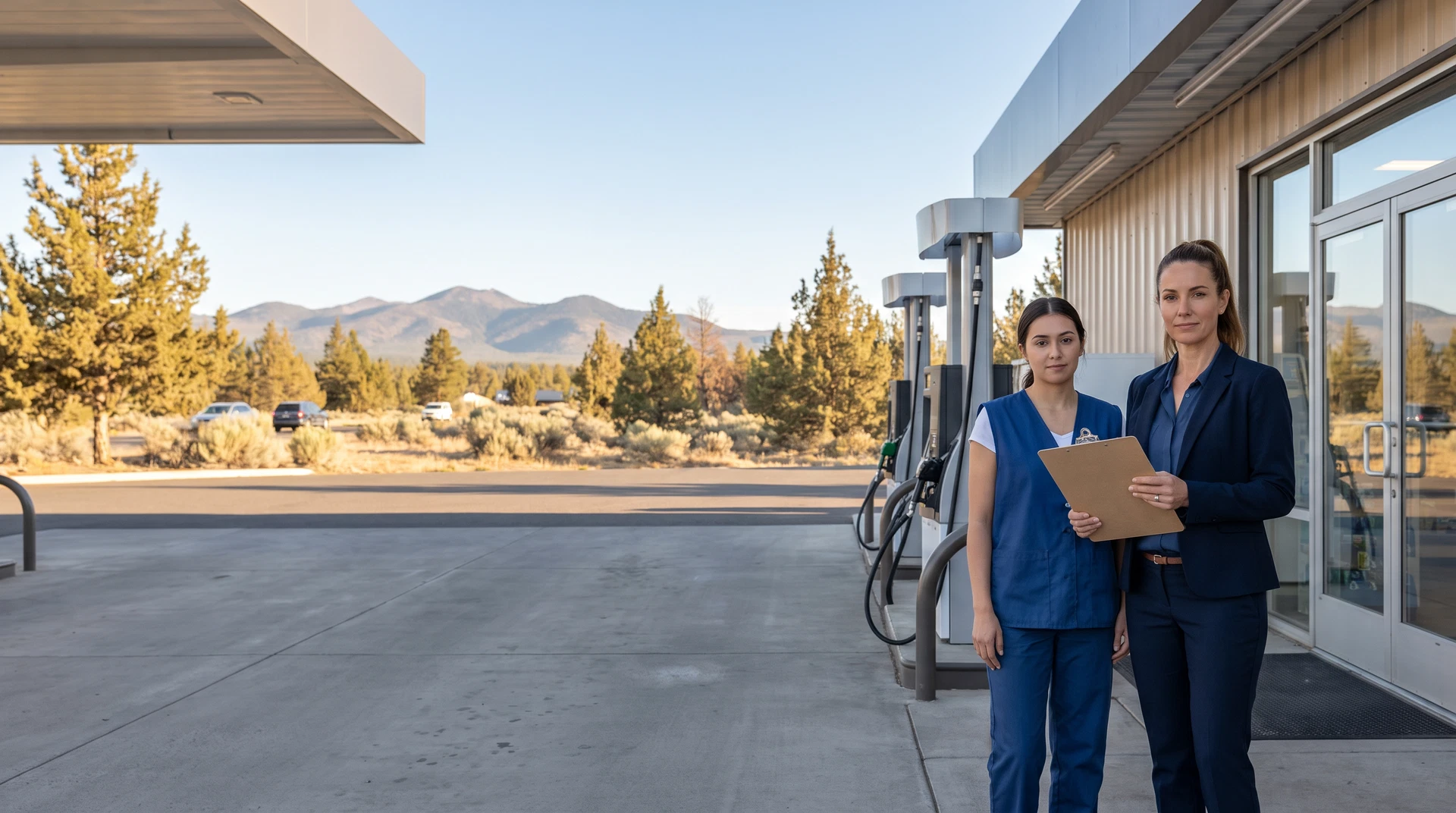

A Central Oregon quick-stop can look simple from the road: fuel pumps, cold drinks, a grab-and-go counter, and a steady flow of customers. Behind the counter, however, the operation may combine fuel storage, food, alcohol, cash, payment systems, employees, delivery activity, leased equipment, and a building that needs to stay open. That is why a convenience-store review should begin with the operation itself—not a one-size-fits-all package.
This guide is educational, not a promise of coverage or regulatory advice. It outlines questions a gas station, convenience store, or rural quick-stop owner can bring to an insurance conversation. A strong starting point is the existing convenience-store insurance page, followed by a comparison of each actual policy, endorsement, limit, deductible, and exclusion.
Why Quick-Stop Businesses Need a More Detailed Review
A store may be a neighborhood market in Prineville, a highway stop serving travelers through Madras, a Bend corner store with prepared food, or a rural location selling fuel and seasonal supplies. Those differences change the questions carriers may ask about the premises, product mix, equipment, foot traffic, crime controls, employees, contracts, and loss history. A broader small-business insurance review can organize the basics, but it should not replace a business-specific inventory of the quick-stop’s operations.
Start by mapping what happens at the location in an ordinary week: dispensing fuel, stocking coolers, handling cash, accepting cards, preparing food, selling alcohol, receiving deliveries, using a company vehicle, maintaining a parking lot, managing contractors, or operating a car wash. Each activity can change the insurance questions worth asking.
A useful exercise is to trace the customer journey from the driveway to checkout, then trace the employee journey from opening to closing. Where can a customer slip, a freezer fail, a pump service contractor work, a product spoil, a payment terminal go offline, or a delivery arrive? That exercise does not determine coverage, but it turns a broad request for “store insurance” into a practical list of operations, property, records, and contractual obligations to review.
Liability for customers and operations
General liability may respond to certain third-party injury or property-damage claims connected to store operations, subject to the policy’s terms, limits, and exclusions. It should be reviewed alongside the actual services offered: fuel sales, a deli counter, seating, car-wash operations, propane exchange, package handling, or vendor activity.
Property, refrigeration, and income interruption
A commercial property policy may address covered damage to the building, fixtures, coolers, inventory, or equipment. Business-income and extra-expense provisions may matter if a covered loss interrupts operations, but the cause of loss, waiting period, valuation, limits, and endorsements all matter.
Fuel, tanks, and environmental exposures
Environmental and pollution-related coverage is often highly specialized. A general liability or property policy may contain pollution exclusions, so owners should ask how the proposed policy treats fuel releases, remediation costs, transport, contractor work, and claims tied to underground or aboveground storage systems.
Crime, cash, and payment information
Employee dishonesty, robbery, counterfeit currency, payment-card theft, social engineering, and cyber events can involve different coverage forms. A policy review should distinguish physical cash losses, employee theft, computer fraud, privacy obligations, and business interruption after a cyber event.
Prepared food, alcohol, and product operations
A packaged-snack counter, coffee station, made-to-order deli, beer cooler, propane exchange, and lottery terminal do not create identical insurance questions. Owners should identify each revenue stream, its location, its suppliers, and the operational controls used for food safety, age verification, inventory, and equipment maintenance.
Vehicles, deliveries, and mobile work
A company pickup, store delivery, bank run, fuel-service contractor, or employee using a personal vehicle for a store errand can require a different review. Commercial auto, hired and non-owned auto, contracts, driver screening, and vehicle-use rules should be discussed before an incident rather than after one.
Contracts, lenders, and recovery planning
Leases, franchise documents, fuel-supply agreements, lender covenants, and vendor contracts can request particular limits, endorsements, or certificates. Those requests should be compared with the actual policy—not merely placed on a certificate—while the business also plans for an orderly property, fuel, refrigeration, and customer-service recovery after a loss.
Fuel, Tanks, and Environmental Questions Belong at the Start
Oregon DEQ’s Underground Storage Tank Program addresses registration and operating certificates, installation, operation and removal, system-operator training, contractor licensing, enforcement, and financial liability protection for future releases.[1] Those are compliance obligations, not substitutes for a policy review. Owners should identify the tanks and related equipment on site, who owns them, the operating-certificate status, contractor responsibilities, the response plan, and which party carries what contractual responsibility.
Aboveground equipment can introduce a different question. EPA explains that a gas station may be subject to the federal SPCC rule when it has more than 1,320 gallons of aggregate aboveground oil-storage capacity, and that UST-associated transfer areas at an otherwise regulated facility are subject to secondary-containment requirements.[2] Applicability is site-specific. Environmental counsel, compliance specialists, and qualified contractors should address the rule; an insurance professional can help translate the resulting risk information into questions for carriers.
The insurance conversation becomes much more useful when the owner can explain who owns the tanks and dispensers, whether equipment is leased, the last testing or maintenance activity, the fuel supplier’s role, the emergency contacts, and which entity has responsibility under the operating agreement. Do not assume that a fuel-supplier contract, landlord policy, or basic property form responds the way the store expects. Pollution, cleanup, groundwater, transportation, and contractor-caused-loss issues can be treated differently by different policies and endorsements.
Keep the compliance and insurance files separate but coordinated. A current equipment list, service invoices, certificates, site plan, release-response contacts, and carrier contact information can reduce confusion during a loss. The right question for an agent is not “Does this cover a spill?” but “Which policy or endorsement is intended to address this specific scenario, what limits and exclusions apply, and what must we do if an event occurs?”
Match Core Policies to the Actual Store Operation
General liability may be part of the foundation, but the right review is wider. Ask whether the proposed general liability policy reflects the store’s customer areas, parking lot, fuel operations, prepared food, vendor work, and any side businesses. Pair it with a commercial property review for the building, tenant improvements, coolers, point-of-sale equipment, shelving, signage, inventory, and equipment breakdown options. A business owners policy may combine some property and liability features for eligible businesses, but eligibility and the policy’s actual scope should be confirmed rather than assumed.
If the store runs deliveries, sends employees for supplies, or owns a service vehicle, discuss commercial auto insurance and hired/non-owned auto exposure. If it prepares meals, runs a coffee bar, receives packaged food, or sells products under its own label, bring those details into the conversation about food-industry insurance considerations. The purpose is to identify where one line of insurance may stop and another may need to begin.
Property, Coolers, Kitchen Equipment, and Store Income
A convenience store’s physical property can be more complicated than its square footage suggests. Refrigerated cases, walk-in coolers, point-of-sale terminals, fuel-canopy equipment, shelving, security cameras, signage, backup power, a deli counter, lottery equipment, and tenant improvements can each have a different owner, value, maintenance record, or contractual responsibility. A retail insurance review can help frame the inventory, while a restaurant insurance review may be relevant if the business has meaningful food preparation rather than only packaged goods.
When reviewing property and business-income coverage, compare the declared values and waiting periods with the store’s actual recovery plan. How quickly can a replacement cooler be sourced? Can the store operate around a closed fuel island? What does a week without card processing, ice, refrigeration, or a deli counter mean for sales? A policy may respond only to covered causes of loss and subject to the selected limits, deductibles, valuation provisions, and business-income terms. The calculation should be supported by current sales, payroll, expense, and inventory records—not a guess made at renewal.
Equipment-breakdown, spoilage, utility-service, ordinance-or-law, and extra-expense options may be worth discussing, but their availability and scope are policy-specific. An agent can help compare proposals; the owner should still ask which equipment is scheduled, which event triggers apply, whether a utility interruption is addressed, and how the policy handles stock, debris, temporary equipment, or code-required rebuilding.
Turn Your Operation Into a Clear Insurance Conversation
Bring your current declarations, property schedule, fuel and tank details, sales mix, food or alcohol operations, employee count, payroll, vehicle details, lease requirements, and loss history. Prineville Insurance can help organize a carrier comparison around the business you actually run.
Food, Alcohol, Workers, and Everyday Store Controls
Selling beer, wine, or other alcohol does not automatically mean every store has the same insurance obligation. Oregon’s liquor-liability rule applies to specified license categories and requires at least $300,000 of liquor-liability insurance or a bond for those categories; it also has proof and renewal requirements.[3] Confirm the current license type, how alcohol is sold or consumed, and whether the proposed policy addresses the relevant exposure. Do not rely on a generic online checklist.
Employees create their own set of questions: slips, lifting, late shifts, food handling, cash procedures, training, and employer responsibilities. Review workers’ compensation insurance with payroll and role information that matches the real operation. For payments and customer data, a cyber-liability review can clarify whether the business has coverage options for a data event, computer fraud, privacy response, or cyber-related interruption. Terms and triggers differ materially by carrier and endorsement.
A store that sells alcohol should also make the underlying operation clear. Is alcohol sold only for off-premises consumption? Is there seating, a tasting event, food service, a special event, or a separate bar operation? For relevant businesses, our liquor-store insurance resource can help organize the questions. The appropriate requirement and insurance arrangement depend on license type, operation, policy wording, and applicable rules—not a label on the storefront.
Cash, Crime, Cyber, and Payment-Terminal Readiness
Quick-stops often handle more cash and more small transactions than many businesses of similar size. That makes physical security, cash-counting procedures, bank-run practices, safe access, employee permissions, cameras, alarm protocols, counterfeit screening, and incident reporting practical risk-management topics. These controls do not promise a claim outcome, but they can make a loss easier to document and can help the owner explain the operation accurately to a carrier.
Do not combine every type of loss under the word “theft.” A robbery, a safe shortage, a fraudulent vendor-payment request, employee dishonesty, card-data incident, ransomware event, and a false transfer instruction may implicate different policy forms, endorsements, deductibles, reporting deadlines, and exclusions. Keep current written procedures for who can change payment instructions, access the POS platform, issue refunds, approve vendor banking changes, and speak to a bank or payment processor after suspicious activity.
Cyber preparation should also account for the business interruption that follows a system issue. Capture processor contacts, POS support contacts, backup access procedures, customer-notice obligations, and manual sales procedures before an outage occurs. Ask whether the proposed cyber policy addresses the specific systems, vendors, data, fraud scenarios, and interruption costs that the business actually has. “Cyber coverage” alone is not a meaningful answer without the policy details.
Leases, Fuel-Supply Agreements, Vendors, and Contract Requirements
A landlord, lender, fuel supplier, franchise, delivery platform, food vendor, car-wash vendor, or equipment lessor may require certificates, additional insured status, waiver language, particular limits, or other risk-transfer terms. Those requirements should be read early—before signing, renewing, or sending a certificate. A certificate may show that a policy exists, but it generally does not change the policy or settle a contract-interpretation issue.
Keep a contract register with the agreement name, effective date, expiration date, insurance requirement, responsible contact, and renewal deadline. Then compare the register with the declarations and endorsements. If the operation carries substantial third-party liability exposure, a commercial umbrella insurance discussion can help evaluate excess-liability options; it should not be treated as an automatic replacement for proper underlying policies or separate environmental, cyber, or contract-specific requirements.
Employees, Contractors, and Shift-by-Shift Documentation
An accurate payroll and role breakdown matters because a manager who opens a store, a deli employee, a fuel-service technician, a bookkeeper, a delivery driver, and a contracted cleaner may present different duties and contractual relationships. Track which roles are employees, which are independent businesses, and who is authorized to drive, handle food, close the store, access cash, or call emergency vendors. Coverage and legal classification should be reviewed with the appropriate qualified professionals.
A short incident record can be valuable even where no claim is expected. Record the date, time, weather or site conditions, people involved, photos, video-preservation steps, immediate safety actions, witnesses, vendor contacts, and any items moved or repaired. Prompt notice may be required under a policy, so the record should support—not delay—the owner’s contact with the carrier or agent when a potentially covered event occurs.
What to Do After a Loss or Extended Interruption
Safety and regulatory response come first. Then follow emergency plans, preserve receipts and records, protect property from additional damage when it is safe to do so, and notify the relevant carrier, broker, lender, fuel supplier, landlord, or vendor as required. Do not discard damaged stock, equipment, video, or documentation before receiving appropriate instructions unless safety or law requires it. The policy’s duties after loss, preservation, inspection, proof-of-loss, and mitigation provisions govern.
A practical recovery file may include daily sales reports, payroll, inventory counts, temperature records, invoices, repair estimates, temporary-equipment costs, alternative-location costs, communications, photographs, video, and a clear timeline. The goal is to create a factual record of what happened and what the business did next. It is not a substitute for adjusting, legal, environmental, or food-safety advice.
A Practical Renewal Checklist
Before renewal, update the property values, inventory peaks, cooler and kitchen equipment, sales mix, fuel operations, alcohol license details, hired contractors, leased space, security procedures, employee counts, payroll, vehicles, loss history, and business-continuity plan. If a major change is planned—new pumps, a deli expansion, a car wash, propane, a new location, a franchise agreement, or extended hours—raise it before the change, not only at renewal.
Go one step further by gathering the documents behind those answers: tank and equipment schedules; supplier and lease agreements; current certificates; property values and replacement estimates; refrigeration, kitchen, and POS records; monthly sales and payroll; incident logs; employee roles; driver lists; food and alcohol licenses; vendor contacts; and the current declarations and endorsements. The clearer the file, the easier it is to compare changes in limits, deductibles, exclusions, and insurer appetite year over year.
The goal is not to predict every loss. It is to give the insurer and your agent an accurate picture of a fast-moving business. For a broader comparison of coverage options, visit our commercial insurance resource center or contact Prineville Insurance for a policy-specific discussion.
Frequently Asked Questions
Do every gas station and convenience store need the same insurance package?
No. A card-only fuel kiosk, a full quick-stop with a deli and lottery sales, a rural market with propane exchange, and a store with an alcohol license can have very different exposures. The appropriate policies, limits, and endorsements depend on the location, services, sales mix, property values, equipment, employees, contracts, and carrier underwriting.
Does a standard business policy automatically cover a fuel release?
Not necessarily. Pollution, fuel-release, remediation, and environmental liability provisions can be restricted or excluded in a standard policy. Ask for the actual policy language and discuss the site’s tanks, product, contractors, and environmental obligations with qualified insurance and compliance professionals.
When might liquor liability matter for a quick-stop business?
The obligation is driven by the license type and the facts of the business, not simply by calling a store a convenience store. Oregon Administrative Rule 845-005-0400 applies its $300,000 liquor-liability insurance or bond requirement to specified license categories. Owners should confirm their current OLCC license requirements and any policy terms with the appropriate professionals.
What information helps an agent quote a quick-stop business?
Bring the store address, ownership details, sales mix, fuel and tank information, alcohol or food operations, equipment list, payroll, delivery or company-vehicle details, loss history, lease or lender requirements, current policies, and any vendor or franchise contracts. Good information helps carriers evaluate the real operation rather than an incomplete description.
Should a business owner rely on a certificate of insurance to understand a vendor’s coverage?
A certificate can be useful evidence of a policy at a point in time, but it generally does not amend the policy or replace a review of contractual requirements. Owners should compare their vendor, contractor, lease, and fuel-supply requirements with the relevant policy wording and obtain legal advice for contract interpretation when needed.
What is worth documenting after a power outage, cooler failure, or covered property loss?
Preserve safety first, then follow carrier and vendor instructions. Depending on the event, useful records can include photos, video, invoices, inventory records, temperature logs, repair estimates, temporary-expense records, payroll, sales reports, communications, and an incident timeline. The policy’s notice, proof-of-loss, mitigation, and documentation terms still control.
Can an umbrella policy solve every liability gap?
No. Commercial umbrella policies can differ in underlying-policy requirements, covered operations, exclusions, attachment points, aggregate treatment, and endorsements. It should be evaluated as one part of the overall program, not as an automatic substitute for proper primary limits, environmental coverage, cyber coverage, or required contract terms.
Ready to Review Your Quick-Stop’s Coverage?
Start with a clear description of your store, its fuel and product operations, property, employees, contracts, and goals. We can help you compare available options and the policy language that matters to your business.


