



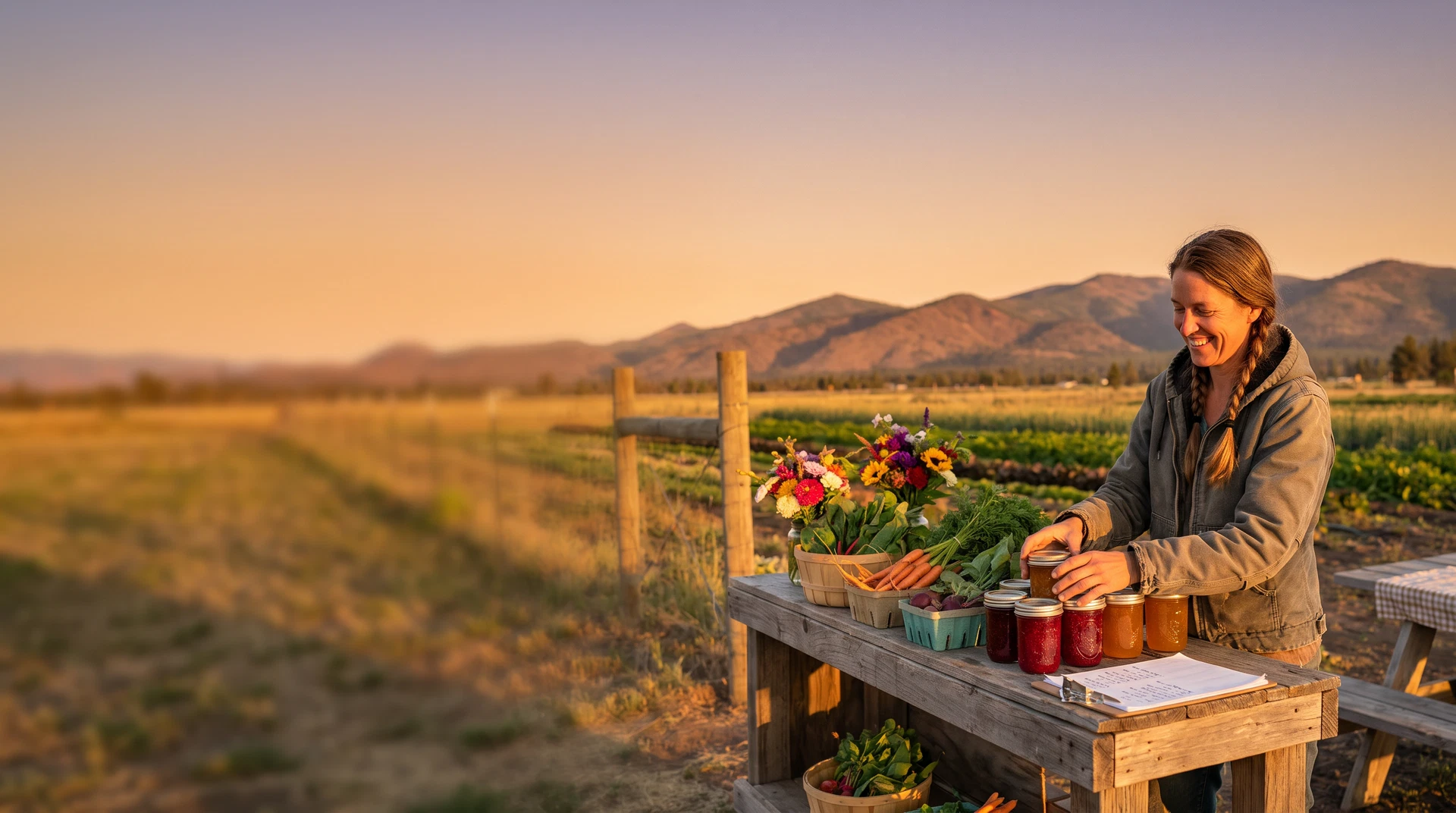

Central Oregon food businesses often begin with a practical idea: sell produce at the farm gate, turn a harvest into jam or salsa, bring baked goods to a market, cater a gathering, or operate a truck or pop-up. Once money changes hands, the operation may involve customers, products, ingredients, premises, equipment, contracts, vehicles, cash, and online orders.
This educational guide helps operators prepare for an insurance review; it does not promise coverage or provide legal or food-safety advice. Start with our food-industry insurance resource, then compare every proposed policy, endorsement, limit, deductible, and exclusion with the activities actually performed.
Start With the Sales Model, Not the Product Name
A Prineville farm stand, Bend market vendor, Sisters farmstay, Redmond caterer, and Madras mobile-food operator can all sell food while creating different insurance questions. Map where products are made and sold, whether they are eaten immediately, who transports them, where money is collected, who owns the equipment, and whether customers come onto the property.
That map can guide reviews of small-business insurance, general liability, commercial property, and commercial auto. Each may apply differently under selected policy terms.
Farm stands and U-pick operations
Customer traffic, parking, seasonal staff, displays, farm equipment, and visitor activities may create different property and liability questions than a production-only farm.
Cottage-food and value-added makers
Jam, salsa, pickles, dried herbs, baked goods, and packaged products can involve labels, ingredients, batch records, distribution, and business-property questions.
Pop-ups, markets, and events
A temporary booth can combine event requirements, rented equipment, cash handling, food preparation, certificates, transportation, and vendor agreements in a single weekend.
Mobile and prepared-food businesses
Food trucks, coffee carts, catering, delivery, and on-site service introduce questions about vehicles, mobile equipment, customer locations, employees, and contracts.
Oregon Farm Direct Rules Change the Planning Conversation
ODA guidance explains that qualifying farm-direct marketers may be exempt from ODA licensing for producer-processed products made from agricultural products they grow and sold directly to the end retail consumer.[1] The exemption is detailed and product-specific; it is not blanket approval for every homemade or farm-branded product.
For qualifying producer-processed acidic foods, ODA guidance identifies a $50,000 annual sales limitation and record requirements.[1] Keep product lists, labels, recipes, sales records, equipment values, invoices, photos, and agreements as organized as the insurance file.
Customers, Products, and Premises Create Different Questions
Customer walkways, market booths, food served at events, farm stands, and deliveries should all be described in the insurance application. General liability may respond to certain third-party injury or property-damage claims, but coverage remains subject to actual policy terms, limits, and exclusions. Markets and venues may also request certificates or additional-insured status.
Build a Review Around Your Actual Operation
Bring product lists, sales channels, locations, equipment values, employees, delivery activity, contracts, sales records, and current policies.
Five Central Oregon Scenarios That Change the Insurance Conversation
Scenario one: the seasonal farm stand. A grower begins with eggs, vegetables, flowers, and honey on a self-service stand outside Prineville, then adds a card reader, a cooler, roadside signs, a fall pumpkin event, and occasional school visits. The questions are no longer only about the product. They can include visitors, the driveway and parking area, cash controls, a cooler loss, farm equipment near customers, and whether an advertised activity is included in the current farm policy.
Scenario two: the cottage-food maker. A Bend home baker sells shelf-stable packaged goods at markets and online. The owner should identify the home area used for business, ingredients and inventory stored there, business equipment, delivery or pickup arrangements, product records, and whether customers ever visit. A homeowners policy and a business policy can treat these facts very differently.
Scenario three: the shared-kitchen or pop-up operator. A Redmond entrepreneur rents kitchen time and sells at rotating markets. The kitchen agreement may allocate responsibility for damage, require a certificate, or request additional-insured status. The market may have its own rules. Review the contract language before assuming a certificate alone creates the coverage a contract requires.
Scenario four: the mobile operator. A coffee trailer, food truck, or caterer moves between Sisters events, private ranches, and Bend offices. The vehicle, trailer, generator, propane, equipment, catering location, customer agreement, employees, and delivery activity should be described as one connected operation—not handled as unrelated pieces.
Scenario five: the growing farm brand. A Madras producer begins with direct sales and later adds wholesale, a subscription box, employees, a rented warehouse, and a harvest event. Each change can affect revenue, property values, locations, contracts, inventory, business income, employment, and product-distribution questions. Review the program before the next growth step, not after it.
Coverage Discussions: What to Ask About, and Why
Insurance should be discussed by exposure rather than by an assumption that a familiar label—such as “farm policy,” “business policy,” or “home policy”—automatically solves every issue. The right structure depends on the applicant, carrier, activity, location, policy form, endorsements, limits, deductibles, and exclusions.
| Business question | Coverage conversation to have | Documents to bring |
|---|---|---|
| Someone slips at a stand or market | Ask how premises, operations, event, and product-related liability are treated under the proposed policy. | Market agreement, site photos, activity list, expected attendance. |
| A cooler, freezer, oven, or POS system fails | Discuss business personal property, equipment breakdown, spoilage, valuation, waiting periods, and income interruption features. | Equipment list, purchase records, inventory values, revenue records. |
| Products travel to a customer or retailer | Review product, cargo, delivery, auto, hired/non-owned auto, and contract questions according to the distribution model. | Delivery methods, vehicle ownership, retailer contracts, product list. |
| A seasonal helper is added | Discuss employment status, payroll, workplace duties, volunteer use, and workers’ compensation obligations. | Payroll estimate, job descriptions, schedule, prior claims. |
| Orders and payments move online | Review card processing, customer data, funds-transfer controls, vendor-payment changes, and cyber coverage options. | Platform list, POS system, online-sales process, controls. |
Contracts, Certificates, and Market Rules Need a Second Read
Farmers markets, commercial kitchens, landlords, breweries, restaurants, wedding venues, event organizers, distributors, and retailers often use written agreements. A contract may request liability limits, additional-insured status, waiver language, a certificate, indemnity, limits for vehicles, or evidence of workers’ compensation. Those requests should be reviewed early, because an agent can explain whether the current or proposed policy may address the request, while an attorney can advise on the contract itself.
A certificate communicates limited information about a policy on its issue date; it does not rewrite the policy, add missing endorsements, or settle a claim. Keep a copy of the agreement, request wording, certificate, endorsements, and correspondence in the same file. That discipline is especially useful when a market opens, an event moves locations, or a customer asks the operator to take on more responsibility than the operation can reasonably insure.
Food Safety Records Also Help Tell the Business Story
This article does not replace ODA or local public-health guidance. Still, organized product and food-safety records can help an insurance conversation move faster after an incident. Keep labels, batch or production records, ingredient and supplier information, temperature logs when applicable, complaint records, recall procedures, photos of signage, and dates/locations of sales. If an issue occurs, those records can help the operator, regulator, insurer, and counsel understand what was made, where it traveled, and what happened next.
Cash, Cyber, and Online Sales: Small Systems Can Carry Big Consequences
Many small food businesses use a phone, tablet, card reader, email inbox, social-media direct messages, online marketplace, and local pickup coordination. A bad actor does not need a large corporation to attempt an invoice-change scam, a false delivery request, a password reset, or an unauthorized card transaction. Use unique passwords, multi-factor authentication, limited access to payment accounts, written refund procedures, and a verify-by-phone process for any change to bank or vendor payment instructions.
Cyber coverage and crime coverage can be evaluated when an operation handles customer information, payment data, vendor payments, employee access, or online orders. Whether a particular policy responds depends on its terms, triggers, exclusions, sublimits, and the facts of the event. The key is to discuss the process—not merely check a box labeled “cyber.”
When a Loss Happens: Protect People, Preserve Records, Report Promptly
After an injury, suspected product issue, theft, equipment loss, fire, wind event, or cyber incident, first protect people and follow emergency or regulatory requirements. Then preserve photos, video, receipts, communications, product/batch records, contracts, and damaged-property information. Do not make assumptions about fault or promise payment. Contact the insurer or agent promptly and follow policy reporting requirements. Our Oregon insurance claims guide outlines general documentation and communication steps.
A Practical Renewal Checklist for Food Entrepreneurs
At least 45–60 days before renewal—or before a major season, market, event, or product launch—set aside time to update the business story. This conversation can identify questions earlier, when options may be easier to evaluate.
Property, Equipment, Inventory, and Interrupted Sales
Coolers, freezers, ovens, mixers, canning tools, POS equipment, tents, generators, seasonal inventory, and leased kitchen improvements can be important property. A property policy may address certain covered damage and business-income features may matter after a covered interruption, but valuation, cause of loss, limits, waiting periods, and endorsements matter.
Our catering insurance discussion can help organize off-site service questions, while the food-truck insurance page is relevant when a vehicle, trailer, generator, or mobile setup is central to the business.
Employees, Online Orders, and Delivery
Seasonal help, family members, event workers, delivery drivers, and contractors can affect a workers' compensation discussion. Online orders, card readers, vendor-payment changes, customer information, and point-of-sale systems can also create questions for a cyber-liability review.
Renew Before the Season Changes
Update product labels, revenue, online sales, market locations, kitchen arrangements, vehicles, equipment, payroll, controls, and contracts. The commercial insurance overview can organize a broader conversation when the business has several operations or locations.
Frequently Asked Questions
Does Oregon's Farm Direct Marketing Law mean a farm stand needs no insurance?
No. Licensing and insurance are different questions. A qualifying activity may have an ODA licensing exemption, while property, customer-injury, product, vehicle, contract, employment, or cyber exposures may still need to be reviewed under the actual policy terms.
Can a homeowners policy cover a cottage-food business?
Do not assume it will. Business property, products, deliveries, customer injury, employees, and off-premises activity may be limited or excluded. Review the actual operation and policy language before relying on a personal policy.
What should I bring to a food-business insurance review?
Bring product and sales-channel details, locations, revenue, equipment and inventory values, employees, vehicle use, market contracts, requested certificates, food-safety records, prior losses, and current policies.
Do market vendors and food trucks need the same insurance?
Not necessarily. Packaged-goods vendors, food-for-immediate-consumption vendors, caterers, and mobile units can have different equipment, vehicle, location, licensing, and contract exposures.
Why do contracts and certificates matter?
Markets, landlords, venues, distributors, and event organizers may request certificates, additional-insured status, or stated limits. Compare each request with the actual policy and endorsements before signing or issuing a certificate.
Next Step: Bring the Full Business Story
Whether you are adding a market date, canned product, delivery vehicle, farm-stand event, shared kitchen, or catering service, review the insurance questions before the change becomes a claim or contract problem. Request a food-business insurance review, or call or text the commercial team.
References
Planning a New Food Business Season?
A quick review can organize questions around products, locations, vehicles, staff, contracts, and existing coverage before the season gets busy.


