



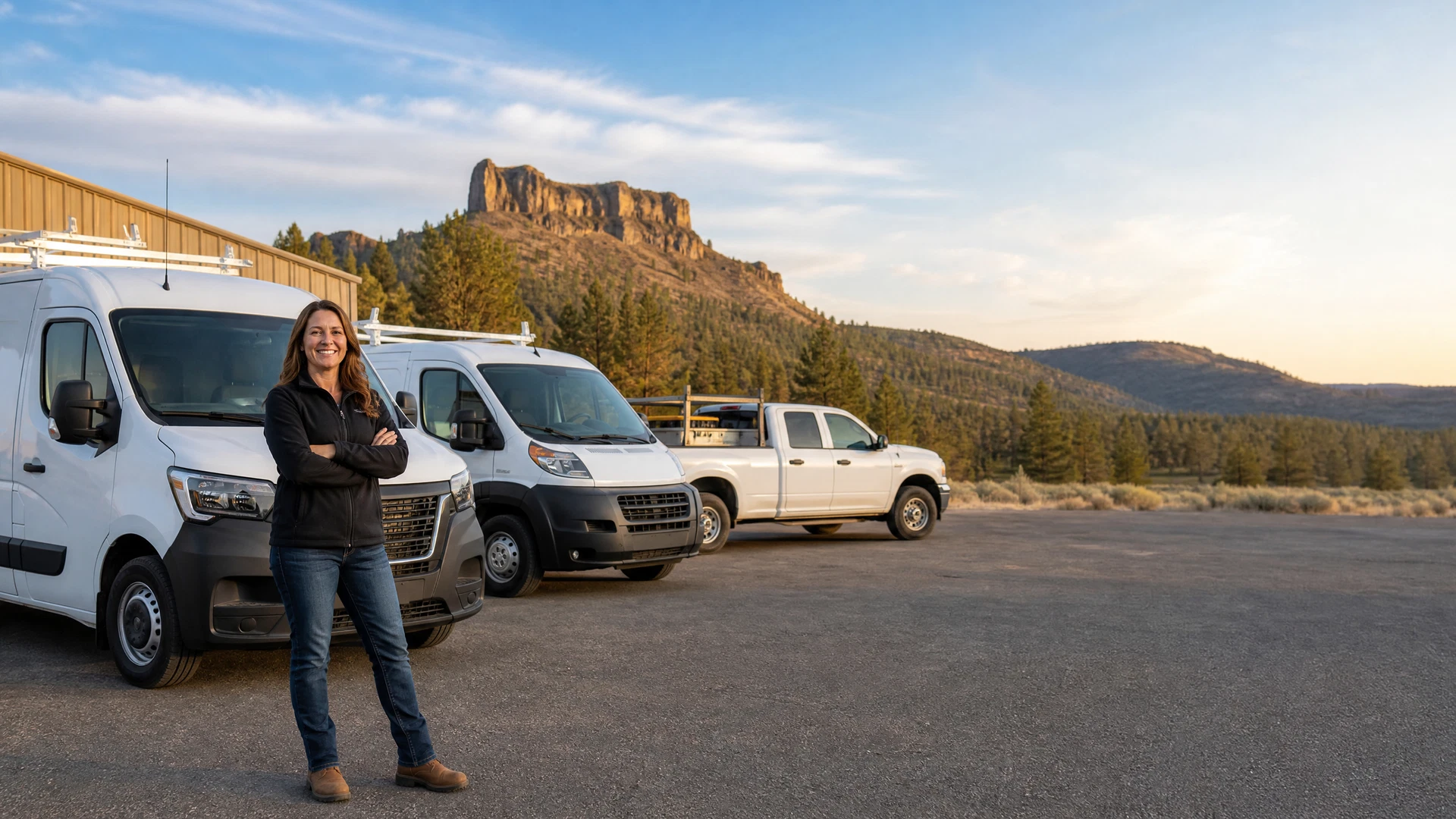

Commercial auto insurance is not just for trucking companies or businesses with large fleets. In Central Oregon, the exposure can start with one contractor pickup, one employee running parts across town, one restaurant delivery vehicle, one farm truck driving on public roads, or one rented van used for a weekend event. If the vehicle is being used for business, the insurance conversation changes.
The Oregon Division of Financial Regulation explains that commercial auto policies typically have higher liability limits than personal auto policies and may address rented, non-owned, or employee-owned vehicles used for company business. The right policy depends on who owns or leases the vehicle, who drives it, and how the vehicle is used.[1] For business owners in Prineville, Bend, Redmond, Madras, Sisters, La Pine, and the surrounding rural communities, that makes commercial auto a practical risk-management issue, not just a paperwork requirement.
Why Personal Auto Insurance Can Fall Short for Business Driving
A personal auto policy is built around personal driving. It may not be designed for a work truck loaded with tools, a van used for deliveries, a pickup pulling a trailer to a job site, or an employee using a personal car for company errands. Oregon regulators specifically tell business owners to review who owns or leases the vehicle, who drives it, and whether the vehicle is used for business activities such as delivery, transporting people, or carrying materials.[1]
This matters because a vehicle accident can name the business, not just the driver. A claim involving an employee, customer, delivery stop, trailer, tools, job-site materials, or rented vehicle can quickly become a business liability issue. That is why a commercial auto review should be part of the broader commercial insurance conversation alongside general liability, business owners policy, and workers' compensation coverage.
Do You Know Which Vehicles Are Actually Covered?
Prineville Insurance can review owned vehicles, employee drivers, trailers, rented vehicles, and occasional business-use situations before a claim reveals a coverage gap.
Who Needs Commercial Auto Insurance in Central Oregon?
Many business owners wait too long to ask this question because they assume the answer depends on the number of vehicles they own. The better question is whether a vehicle is used to generate revenue, serve customers, haul tools or inventory, transport employees, make deliveries, visit job sites, or complete business errands.
Contractors and trades
A contractor pickup, van, trailer, or service truck may carry tools, materials, ladders, compressors, generators, or job-site equipment. The policy should be structured around how the vehicle is used, who drives it, and what is attached or transported.
Restaurants and delivery operations
A restaurant that uses owned vehicles, employee vehicles, or delivery drivers can create a commercial auto or hired and non-owned auto exposure even if the vehicle is not titled to the business.
Farms, ranches, and agribusinesses
A ranch pickup, hay truck, livestock hauling vehicle, or farm service vehicle may need more than a farm property discussion when it operates on public roads or supports business operations.
Professional and sales teams
Real estate professionals, consultants, sales representatives, medical offices, and service teams may need hired and non-owned auto coverage when employees use personal vehicles for business.
Nonprofits, churches, and events
Volunteer drivers, rented vans, donated-use vehicles, and event errands can create liability questions that should be reviewed before the organization assumes a personal policy will respond.
Small fleets and growing companies
Two or more vehicles can create scheduling, driver, renewal, and limit decisions. A fleet review can help simplify the program and identify risk controls before renewal.
The Core Coverages Inside a Commercial Auto Policy
Commercial auto coverage is not one single promise. It is a collection of liability, vehicle damage, driver, rented-vehicle, and sometimes cargo-related protections that must be selected and scheduled correctly. Oregon's state insurance guidance also notes that business owners should consider collision and comprehensive coverage and review permanently attached items such as generators or tool boxes.[1]
| Coverage discussion | Why it matters | Common Central Oregon example |
|---|---|---|
| Commercial auto liability | Responds to covered third-party bodily injury or property damage claims arising from covered business vehicle use. | A service van rear-ends another vehicle while traveling between Bend and Redmond job sites. |
| Physical damage | Collision and comprehensive coverage can address damage to the business vehicle itself, subject to policy terms and deductibles. | A contractor pickup is damaged by hail, theft, vandalism, collision, or a deer strike on a rural road. |
| Hired auto | Addresses liability exposures when the business rents, leases, hires, or borrows a vehicle for work purposes.[3] [4] | A company rents a box truck for a seasonal delivery push or a nonprofit rents a van for an event. |
| Non-owned auto | Addresses liability exposure when employees use personal vehicles for business errands or work travel.[3] [4] | An employee drives a personal car to pick up parts, office supplies, catering, or documents. |
| Cargo or transported property | Some hauling and for-hire operations need a separate cargo discussion; Oregon motor-carrier filings may require cargo proof in certain cases.[2] | A business hauls customer goods, livestock, materials, equipment, or inventory for hire. |
| Attached equipment | Permanent attachments may need to be scheduled or valued properly so the policy matches the vehicle's real business use.[1] | A generator, ladder rack, compressor, toolbox, liftgate, refrigeration unit, or custom service body is attached to the vehicle. |
Hired and Non-Owned Auto: The Gap Many Businesses Miss
The most overlooked commercial auto exposure is not always the company truck. It is the vehicle the business does not own. Travelers explains that hired and non-owned auto coverage helps protect a business when rented, hired, leased, or personal non-owned vehicles are used for work purposes, because a business can be held liable after an employee accident during work-related driving.[3]
The Hartford describes hired coverage as applying to vehicles rented, leased, or borrowed for business, while non-owned auto applies when employees use their own cars for business. The coverage is generally liability-focused and does not automatically repair the employee's vehicle, cover employee injuries, replace stolen property from the vehicle, or address personal-use driving.[4]
That distinction matters for restaurants, construction businesses, nonprofits, small businesses, sales teams, event organizers, and office-based companies that occasionally ask employees to drive for work. The exposure may be occasional, but a serious accident can still name the business.
Oregon Motor Carrier and Cargo Considerations
Some businesses need more than a basic business auto policy review. The Oregon Department of Transportation states that certain motor carriers applying for Intrastate 1A Permit Authority must file proof of public liability and property damage insurance, and Oregon's minimum acceptable amount for certain motor-carrier auto liability filings is $750,000 per accident combined single limit.[2] ODOT also notes that cargo insurance may be required for certain for-hire hauling operations and that Oregon's minimum acceptable cargo limit is $10,000 for those filings.[2]
If your business hauls loads for hire, operates heavier commercial vehicles, crosses state lines, carries hazardous materials, or uses vehicles subject to motor-carrier filings, the conversation should include commercial auto, trucking insurance, cargo, filings, driver qualification, and federal or state requirements. Prineville Insurance can help identify when a standard commercial auto conversation needs to expand into a motor-carrier review.
Commercial auto mistakes that can become expensive quickly
• Assuming a personal auto policy covers routine business errands.
• Forgetting to list the business as the principal insured when the business owns or leases the vehicle.
• Letting employees drive for work without reviewing their motor vehicle records and driver expectations.
• Failing to schedule permanently attached equipment, toolboxes, liftgates, refrigeration units, or service bodies.
• Renting or borrowing vehicles without hired auto coverage.
• Letting employees use personal vehicles without non-owned auto coverage.
• Using low liability limits on a vehicle that creates a significant business lawsuit exposure.
• Treating cargo, tools, inventory, or customer property as automatically covered without checking the policy language.
How to Prepare for a Commercial Auto Quote
A stronger commercial auto quote starts with accurate information. Before requesting quotes, gather the vehicles' year, make, model, VIN, current garaging address, ownership or lease status, driver list, employee driver records, vehicle use, annual mileage, radius of operation, transported property, trailer use, and any permanently attached equipment. Oregon regulators note that premiums can be affected by vehicle type, safety devices, anti-theft devices, parking location, operating geography, prior claims, coverage limits, and deductibles.[1]
Prineville Insurance is independent, which means the agency can compare multiple carriers instead of trying to force every business into one company. That is especially helpful for Central Oregon businesses because a contractor in Prineville, a restaurant in Bend, a ranch outside Madras, a winery near Terrebonne, and a nonprofit using volunteer drivers may all need different underwriting conversations.
Prineville Insurance can help compare the whole account, not just the vehicle.
Many commercial auto decisions connect to other policies. A vehicle accident may also involve workers' compensation, general liability, inland marine, cargo, a commercial umbrella, or a business owners policy. A local review helps make sure the pieces are coordinated.
Central Oregon Business Examples
A Prineville contractor may need commercial auto for pickups and vans, inland marine for tools and equipment, and a commercial umbrella for added liability limits. A Bend restaurant may need owned auto or hired and non-owned auto depending on who drives and how delivery is structured. A ranch near Madras may need a review of farm trucks, livestock hauling, trailers, and public-road use alongside farm and ranch insurance. A nonprofit event organizer may need to address volunteer drivers, rented vans, and special event logistics through nonprofit event insurance and hired/non-owned auto.
None of those businesses should rely on a one-size-fits-all answer. The key is to describe real vehicle use honestly before a claim. Who drives? Where do they drive? What do they carry? Are customers, employees, tools, food, livestock, equipment, or inventory involved? Are vehicles owned, leased, rented, borrowed, or employee-owned? Those answers shape the coverage.
FAQs About Commercial Auto Insurance
Do I need commercial auto insurance if I only have one work truck?
Possibly, yes. The number of vehicles is not the only factor. If the truck is owned by the business, used for job sites, carries tools or materials, transports employees, supports deliveries, or is regularly used for revenue-producing work, it should be reviewed for commercial auto coverage.
Does hired and non-owned auto cover an employee's car?
Hired and non-owned auto is generally liability coverage for the business when an employee-owned, rented, leased, borrowed, or hired vehicle is used for business purposes. It usually does not repair the employee's vehicle or cover every loss involving that vehicle, so policy terms should be reviewed carefully.
Can commercial auto cover tools or cargo in the vehicle?
Not automatically in every situation. Permanently attached equipment, transported cargo, tools, inventory, customer property, and contractor equipment may require separate scheduling, inland marine, cargo, or endorsement discussions.
Do Oregon motor carriers need special filings?
Some Oregon motor carriers and for-hire hauling operations may need insurance filings with ODOT Commerce and Compliance Division, including liability and sometimes cargo filings. The exact requirement depends on the operation, vehicle use, authority, and cargo.
The Bottom Line
Commercial auto insurance is about matching the policy to the way the business actually uses vehicles. For some companies, that means a scheduled commercial auto policy for owned vehicles. For others, the biggest gap may be hired and non-owned auto. For motor carriers, it may involve filings, cargo, and higher liability requirements. For growing businesses, it may mean fleet controls, driver standards, and umbrella limits.
If your business uses vehicles anywhere in Central Oregon, the safest next step is a local review. Prineville Insurance can help compare coverage options, discuss multiple carriers, identify gaps, and connect your commercial auto coverage to the rest of your business insurance program. Start a quote request, call (541) 447-6372, or text us when you are ready to review your vehicles.


